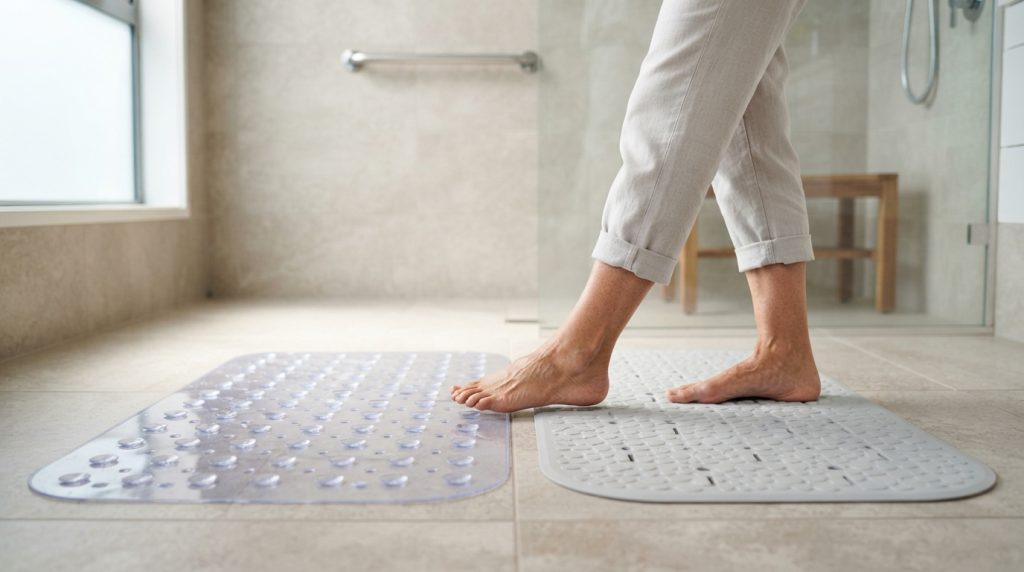
PVC vs TPE shower mats can look almost identical when you see them online.
Both may have suction cups, drainage holes, textured surfaces and similar rectangular designs. Prices can also overlap, making it difficult to understand whether the material actually makes a meaningful difference.
For seniors, however, the most important question is not simply whether a mat is made from PVC or TPE.
A shower mat needs to stay stable on the actual bathroom surface, drain water properly, lie flat, remain easy to clean and provide enough usable coverage where the person stands and turns.
Material still matters, but it is only one part of the decision.
ACC reports that around 30% of people aged 65 and over who live in the community will fall at least once a year, which is one reason bathroom traction and support deserve careful attention.
For a broader comparison of finished products, see our guide to non-slip shower mats for seniors in New Zealand, including suction, drainage, size and floor compatibility.
This guide compares PVC and TPE shower mats from a practical senior-safety perspective and explains which features matter more than the material name printed on the packaging.
Safety Note
A non-slip shower mat can improve traction, but it should not be treated as a complete fall-prevention solution.
If an older adult has frequent falls, significant balance problems, difficulty stepping into the shower, weakness while standing or needs to hold onto taps or towel rails for support, additional safety measures may be needed.
Depending on the situation, these may include securely installed grab bars, a shower chair, improved bathroom flooring or professional assessment.
ACC’s Home Safety Checklist recommends using a non-slip mat in the shower or bath when needed, installing sturdy handrails when additional support is required, and considering a bath seat when standing to shower feels unsteady.
Always test a shower mat on the actual bathroom surface before relying on it.
Disclosure
This article may contain affiliate links in the future. If you buy through these links, Golden Vibe may earn a small commission at no additional cost to you.
Golden Vibe does not assume that one material is automatically safer than another. The performance of a shower mat depends on the complete product design, including its suction system, texture, drainage, dimensions, thickness and compatibility with the floor surface.
Quick Answer: PVC or TPE?
For most seniors, there is no automatic winner between PVC and TPE shower mats.
TPE is often softer and more elastic, while flexible PVC can be durable, practical and relatively affordable.
However, a well-designed PVC mat can be a better choice than a poorly designed TPE mat, and the reverse is also true.
For shower safety, these factors normally matter more than the material alone:
- How firmly the mat grips the floor
- Whether the suction cups work on the actual surface
- How quickly water drains
- Whether the mat lies completely flat
- How much standing area it covers
- Whether the edges curl or lift
- How easy it is to keep clean
- Whether the surface remains comfortable under bare feet
If two mats have similar designs and both fit the shower correctly, TPE may appeal to people who prefer a softer and more elastic material.
But do not choose a mat simply because the product listing says “TPE”.
PVC vs TPE Shower Mats: Quick Comparison
| Feature | PVC Shower Mat | TPE Shower Mat |
|---|---|---|
| Feel | Can range from firm to flexible | Usually softer and more elastic |
| Price | Often budget-friendly | Often slightly more expensive |
| Water resistance | Very good | Very good |
| Suction cups | Common | Common |
| Drainage holes | Common | Common |
| Flexibility | Depends heavily on formulation and thickness | Usually good |
| Surface texture | Depends on product design | Depends on product design |
| Cleaning | Usually straightforward | Usually straightforward |
| Senior suitability | Depends on the complete mat design | Depends on the complete mat design |
The important point is that neither material automatically guarantees better slip resistance.
What Is a PVC Shower Mat?
PVC stands for polyvinyl chloride.
PVC can be manufactured in rigid forms or formulated into flexible products such as flooring, coverings and bathroom mats.
Flexible PVC shower mats are popular because the material can be made water-resistant, relatively durable and affordable. It can also be manufactured in many shapes, colours and textures.
Advantages of PVC Shower Mats
Affordable
PVC products are often competitively priced. For households wanting a simple shower or bath mat without spending too much, this can make PVC attractive.
Water resistant
PVC handles regular exposure to water well, which makes it suitable for bathroom applications.
Available in many designs
PVC mats can be produced with:
- Suction cups
- Drainage holes
- Raised textures
- Transparent finishes
- Different colours
- Different thicknesses
- Different sizes and shapes
This makes it possible to find designs for baths, showers and larger wet areas.
Can provide a firmer feel
Some seniors prefer a mat that feels relatively firm rather than extremely soft underfoot. A firmer mat may also feel more predictable when standing and turning.
However, firmness alone does not mean the mat will stay in place.
Possible Drawbacks of PVC Shower Mats
PVC quality varies considerably. Two mats described as PVC can feel completely different.
Flexibility can vary
Flexible PVC depends heavily on its formulation. One product may be soft and flexible while another feels considerably harder.
A very stiff mat may be uncomfortable or difficult to position properly, while an overly thin mat may not remain as flat as expected.
Odour can vary
Some new PVC products can have a noticeable smell when first removed from the packaging. The intensity can depend on formulation, manufacturing, packaging and storage.
If odour is important to you, check manufacturer information and customer feedback before buying.
Material does not guarantee grip
A PVC mat can still slide. If the suction cups are too small, poorly positioned or incompatible with the shower floor, the material itself will not solve the problem.
What Is a TPE Shower Mat?
TPE stands for thermoplastic elastomer.
Rather than referring to one single formulation, TPE describes a family of materials that can provide rubber-like flexibility while still being processed as thermoplastics.
This is one reason TPE is often used for soft-touch household products, grips and modern shower mats.
Advantages of TPE Shower Mats
Softer and more elastic feel
TPE is often chosen because it can provide a softer, more rubber-like feel. For bare feet, this may feel more comfortable than a relatively rigid mat.
Good flexibility
A TPE mat can usually flex without feeling excessively stiff. This can make it easier to lift the mat for cleaning and reposition it when necessary.
Suitable for suction-cup designs
TPE can be moulded into flexible suction cups underneath a shower mat.
A well-designed suction system can help the mat attach securely to a compatible smooth surface. However, the number of suction cups alone is not enough to judge performance.
Cup size, shape, flexibility and placement also matter.
Wide range of surface textures
TPE can be moulded into raised patterns, small bumps and other textured surfaces. These may help provide more secure footing under bare feet.
Possible Drawbacks of TPE Shower Mats
TPE is not automatically a premium product. The material name alone tells you relatively little about the quality of the finished shower mat.
Quality still varies
Different TPE products may vary in:
- Hardness
- Elasticity
- Surface feel
- Thickness
- Durability
- Odour
- Grip
This makes the actual product design more important than simply seeing “TPE” in the product title.
Very soft mats can move or fold
Softness can feel comfortable, but excessive flexibility is not always desirable.
A thin and very soft mat may fold during handling, develop raised areas or fail to sit completely flat.
For an older adult, a flat and predictable surface is more important than simply choosing the softest mat.
Often costs more
TPE shower mats may cost more than basic PVC alternatives. That extra cost may be worthwhile if the product has better construction, but paying more for TPE does not guarantee better safety.
Which Material Has Better Grip?
When comparing PVC vs TPE shower mats, grip should be judged by the complete mat design rather than the material name alone.
This is where many product descriptions can become misleading.
It is tempting to assume that because TPE often feels more rubber-like, it must automatically provide better grip. Shower-mat stability is more complicated than that.
A shower mat needs grip in two different places:
- Between the mat and the shower floor
- Between the user’s feet and the top of the mat
These are separate problems.
Grip Underneath the Mat
For a suction-cup shower mat, underneath grip depends heavily on the suction system.
Check:
- Number of suction cups
- Diameter of the cups
- How flexible they are
- How evenly they are distributed
- Whether the edges are properly supported
- Whether they attach to the actual shower surface
A mat with a large number of suction cups may still perform poorly if the cups cannot form a proper seal.
Grip Under the Feet
The top surface also matters.
Look for:
- Raised texture
- Ridges
- Small bumps
- Open drainage areas
- A surface that does not feel excessively smooth when wet
PVC and TPE can both be manufactured with effective textured surfaces.
Floor Compatibility Matters More Than PVC vs TPE
This is one of the most important points when comparing PVC vs TPE shower mats for an older adult.
Before buying any suction shower mat, look closely at the shower floor.
Suction cups generally work best when they can seal against a relatively smooth and flat surface.
Problems may occur on:
- Textured tiles
- Uneven tiles
- Heavily patterned shower bases
- Grout lines
- Pebble-style flooring
- Rough non-slip tiles
A person may buy a very good shower mat and still find that it moves because the bathroom surface is incompatible with suction cups.
Changing from PVC to TPE will not necessarily fix that problem.
If suction mats cannot attach reliably, a different type of anti-slip solution may be more appropriate. Our guide to non-slip bathroom flooring for seniors in New Zealand compares mats, grip products, floor treatments and more permanent options.
Drainage Is Critical
A mat that grips strongly but traps large amounts of water underneath is not ideal.
Look for enough drainage openings to allow water to move away from the main standing area.
Good drainage can help reduce:
- Water pooling
- Soap residue
- Persistent dampness
- Cleaning difficulty
- Unpleasant smells
Large drainage holes are not automatically better. The drainage pattern should still leave enough comfortable standing surface.
For a senior, the goal is a balance between drainage and secure footing.
Size and Coverage Matter
A common mistake is buying a mat that is too small.
Imagine a senior standing safely on the mat but stepping onto an exposed slippery section when turning around or leaving the shower.
The mat has not solved the complete problem.
Before buying, measure:
- Shower width
- Shower depth
- Main standing position
- Entry and exit position
- Drain location
The mat should provide useful coverage without interfering with the drain, shower door or other equipment.
Do not simply choose the largest mat available. An oversized mat that bunches against the walls or cannot lie flat is also unsuitable.
Check the Edges Carefully
For seniors, the edges deserve special attention.
Some older adults lift their feet less when walking. Others may shuffle slightly when entering or leaving the shower.
A thick, curled or raised edge can therefore become a trip point.
Check whether the mat:
- Lies flat
- Returns to shape after storage
- Has corners that stay down
- Moves when stepped on near the edge
- Develops waves or folds
This matters whether the mat is PVC or TPE.
Cleaning Can Change Grip
A shower mat is not a fit-and-forget safety product.
Soap, shampoo, body oils and other residue can gradually build up on the surface and underneath the mat. This can affect both hygiene and traction.
Lift the mat regularly and inspect:
- The top texture
- Drainage holes
- Suction cups
- The underside
- The shower floor underneath
Follow the manufacturer’s cleaning instructions.
If suction cups are covered in residue, they may no longer grip as effectively. A mat that was stable when new should therefore still be checked over time.
What About Mould and Mildew?
Any product that remains wet for long periods can become harder to keep clean.
The material matters less than the complete bathroom environment.
Important factors include:
- Drainage
- Ventilation
- How often the mat is lifted
- Drying time
- Cleaning frequency
- Soap build-up
A mat advertised as “mould resistant” should not be treated as maintenance-free. It still needs regular cleaning and drying.
PVC vs TPE for Odour
Material discussions often become overly simplistic here.
You may see claims that one material always smells while the other does not. Real products are not that predictable.
Odour can depend on:
- Material formulation
- Additives
- Manufacturing process
- Packaging
- Storage
- Product age
If a strong chemical smell is a concern, do not rely only on words such as “PVC-free”, “TPE” or “eco-friendly”. Check the manufacturer’s product information and customer feedback.
Be Careful With “Non-Toxic” and “Eco-Friendly” Claims
Bathroom-product listings frequently use terms such as:
- Non-toxic
- Eco-friendly
- Safe material
- Premium TPE
- Medical grade
- Food grade
These descriptions can sound reassuring, but they do not always tell you enough about the finished product.
A seller should be able to explain what the claim actually refers to.
Useful questions include:
- What exact material is used?
- Has the finished product been tested?
- Which substances were tested?
- Is supporting documentation available?
- Does the claim apply to the complete mat or only the raw material?
For senior safety, marketing language should never replace practical assessment of grip, drainage and stability.
When I Would Choose a TPE Shower Mat
A TPE mat may make sense when:
- A softer underfoot feel is preferred
- The user dislikes a stiff shower mat
- The product has a strong suction system
- The mat lies completely flat
- Drainage is good
- The shower surface is compatible with suction cups
- The additional cost is reasonable
TPE can be a good material for a shower mat, but only when the complete design is good.
When I Would Choose a PVC Shower Mat
A PVC mat may make sense when:
- Budget is important
- The mat feels sufficiently flexible
- It has effective suction cups
- Drainage is well designed
- The product lies flat
- The user prefers a slightly firmer surface
- The mat fits the exact shower or bath area
There is no reason to reject a properly designed PVC mat simply because a TPE alternative is available.
When I Would Choose Neither
Sometimes the real answer is neither PVC nor TPE.
A suction shower mat may not be the right solution if:
- The shower floor is strongly textured
- Suction cups will not attach
- The mat repeatedly moves
- Edges become a trip hazard
- Mobility equipment interferes with the mat
- The entire bathroom floor is slippery rather than just the shower
- The person has significant balance or transfer difficulties
In those situations, consider whether the problem would be better addressed with different bathroom flooring, an appropriate anti-slip floor treatment, grab bars, shower seating or a more accessible shower layout.
For a wider review of the whole room, use our bathroom safety checklist for seniors in New Zealand.
PVC vs TPE Shower Mats for Seniors: Buying Checklist
1. Measure the Shower
Do not estimate. Measure the usable floor area and check where the drain, door and walls are located.
2. Check the Floor Surface
Determine whether suction cups can actually seal against it.
3. Test the Suction System
Once installed, press the mat down firmly and check several areas. Apply pressure from different directions. The mat should not slide unexpectedly.
4. Look at Drainage
Water should not remain trapped across the main standing area.
5. Check the Edges
Make sure corners and edges sit flat.
6. Consider the User’s Feet
The surface should feel secure without being unnecessarily hard or uncomfortable.
7. Check Cleaning Instructions
A mat that is difficult to clean is less practical for everyday use.
8. Review the Material Information
If material composition is important to you, look for more than a vague “premium material” description.
9. Check the Complete Bathroom
A mat will not solve poor grab support, unsafe transfers or water collecting outside the shower.
10. Recheck the Mat Over Time
Suction cups, edges and material condition can change with regular use. Replace the mat if it becomes damaged, permanently curled or unreliable.
Common Mistakes When Choosing a Shower Mat
Choosing TPE Simply Because It Sounds More Premium
TPE can be an excellent material, but product design matters more than the label.
Choosing the Cheapest PVC Mat Without Checking Construction
A very low price is not useful if the mat does not stay in place.
Counting Suction Cups Instead of Testing Them
More suction cups do not automatically mean better grip.
Ignoring the Shower Surface
Even excellent suction cups may fail on incompatible textured flooring.
Buying a Mat That Is Too Small
The standing and turning area needs enough coverage.
Buying a Mat That Is Too Large
The mat still needs to lie flat without blocking drainage or bunching against walls.
Leaving the Mat Down Permanently
Regular lifting makes it easier to clean the shower floor and inspect the underside.
Assuming “Non-Slip” Means It Cannot Move
Non-slip is a product description, not a guarantee for every bathroom surface.
Think Beyond the Shower Mat
For seniors, bathroom safety should be considered as a complete system.
A good shower mat may improve footing, but also check:
- Is there a secure grab bar at the right location?
- Can the senior enter and leave the shower comfortably?
- Is standing for the whole shower tiring?
- Is water collecting outside the shower?
- Is lighting adequate?
- Are toiletries within easy reach?
- Does the user need to twist or bend excessively?
- Is the bathroom floor slippery after showering?
If additional hand support is needed, our guide to grab bars for seniors in New Zealand explains the main rail types, installation considerations and situations where fixed support may be useful.
If standing throughout a shower is tiring or unsteady, see our guide to shower chairs for seniors in New Zealand.
The best way to compare PVC vs TPE shower mats is to look at real-world stability, drainage, fit and cleaning rather than material marketing.
Final Recommendation
When comparing PVC vs TPE shower mats, do not make the decision based on material alone.
TPE often provides a softer, more elastic feel. PVC is often affordable, durable and available in a wide range of designs.
But neither one is automatically safer for an older adult.
For seniors, prioritise the following:
- Compatibility with the actual shower floor
- Reliable grip underneath the mat
- Secure footing on the top surface
- Effective drainage
- Correct size and coverage
- Flat, stable edges
- Easy cleaning
- Material quality
- Comfort
- Price
If a well-designed PVC mat passes those checks and a TPE mat does not, choose the PVC mat.
If the TPE mat provides better stability, drainage, fit and comfort, choose the TPE mat.
The better choice is the product that works properly in the real bathroom rather than the material that sounds better in a product description.
Frequently Asked Questions
Is TPE better than PVC for shower mats?
Not automatically. TPE is often softer and more elastic, while PVC can be durable and affordable. For shower safety, suction performance, drainage, fit and surface compatibility matter more than material alone.
Is TPE safer for seniors?
TPE can work well for seniors when the mat is stable and correctly fitted. However, being made from TPE does not guarantee that a mat will stay in place. Always test the complete product.
Are PVC shower mats suitable for older adults?
A properly designed PVC mat can provide useful additional traction when it grips the floor securely, drains properly and lies flat. The individual product should be assessed rather than judging all PVC mats as one group.
Which material has better suction?
Both PVC and TPE mats can use suction cups. Suction performance depends on the design of the cups and the shower surface, not simply whether the mat is PVC or TPE.
Can suction cups work on textured shower floors?
They may not work reliably on heavily textured or uneven surfaces because the cups need an appropriate surface to form a seal. Test the mat carefully before relying on it.
Is a softer shower mat safer?
Not necessarily. A soft mat may feel more comfortable, but it must still stay flat and stable. An excessively flexible mat that folds or moves can create another problem.
Which material is easier to clean?
Both PVC and TPE shower mats can be relatively easy to clean. The design of the drainage holes, texture and suction cups may have a greater effect on cleaning difficulty than the material itself.
Why does my shower mat still move even though it has suction cups?
Possible reasons include an incompatible textured floor, residue underneath the mat, worn suction cups or poor suction-cup design. Clean both surfaces and check whether the product is intended for your type of shower floor.
How often should I check a shower mat used by a senior?
Inspect it regularly. Check that the mat still lies flat, the suction system works, drainage holes are clear and there are no cracks, permanent curls or damaged sections.
Should I choose a shower mat or non-slip bathroom flooring?
A shower mat is a simpler option when the problem is mainly inside a bath or shower. If a larger area of the bathroom becomes slippery, improving the underlying flooring or using another appropriate anti-slip solution may make more sense.