Introduction
Grab bars for seniors in NZ can provide steady hand support in bathrooms, showers, toilets, hallways and other areas where older adults may need extra confidence. In the bathroom, grab bars are especially useful because wet floors, small spaces and repeated sitting or standing movements can increase the risk of slips or loss of balance.
The best grab bar is not simply the cheapest rail or the one that looks strongest. Seniors usually need the right rail type, correct placement, secure installation, comfortable grip, suitable wall fixing and a design that matches the movement they are trying to support.
This guide compares practical bathroom grab bars, shower rails, toilet rails, folding support rails and suction grab rails available through New Zealand retailers. It also explains where grab bars may be useful, what to check before buying and when professional installation is important.
Safety Note
Grab bars should be properly selected and installed. A poorly fitted rail can create a false sense of security and may become dangerous if it moves, loosens or pulls away from the wall.
Suction grab rails may be useful for temporary balance support on suitable smooth surfaces, but they should not be treated as permanent rails or relied on to support full body weight. For transfers, shower entry, toilet use or high-risk situations, professionally installed fixed rails are usually safer.
Disclosure
This article may contain affiliate links in the future. If you buy through these links, Golden Vibe may earn a small commission at no extra cost to you. We only recommend products that are relevant to senior safety, comfort, mobility and everyday living.
How We Selected These Grab Bars
Golden Vibe has not physically tested every grab bar listed below.
We compared publicly available product information from New Zealand mobility and bathroom safety retailers, including:
- Rail type
- Length and shape
- Material
- Grip surface
- Installation method
- Bathroom and toilet suitability
- Fold-up or fixed design
- Temporary or permanent use
- Availability through New Zealand shopping channels
- Suitability for older adults with different bathroom needs
Prices, stock levels and specifications may change. Always confirm current details with the retailer before buying.
Quick Recommendations
| Product | Best For | Price Guide | Why It May Suit Seniors | Where to Check |
|---|---|---|---|---|
| Roma Stainless Steel Grab Rail | Best simple wall-mounted grab bar | From around $99 | Multiple lengths, stainless steel, non-slip surface | Mobility Centre |
| Roma 750×750 90-Degree Stainless Steel Rail | Best corner or toilet support rail | Around $120–$270 | 90-degree shape, useful where horizontal and vertical support are needed | Mobility Centre |
| Roma Bath Grab Bar | Best clamp-on bath support rail | Around $139 | Clamp-on bath rail, no drilling, rubber pads, 275 kg downward rating | Mobility Plus NZ |
| Roma T-Bar Support Rail | Best shower rail and slide holder combination | Around $185 | Grab rail plus adjustable shower-head holder, stainless steel, anti-slip horizontal bar | Mobility Plus NZ |
| Roma Looped Support Rail | Best fold-up toilet or bathroom rail | Around $273 | Fold-up looped support rail, useful beside toilet or bathroom area | Mobility Plus NZ |
| Suction Grab Rail | Best temporary or travel option | Around $90–$170 | No drilling, fast temporary placement on smooth non-porous surfaces | Independent Living / Mobility retailers |
Best Simple Wall-Mounted Grab Bar: Roma Stainless Steel Grab Rail
The Roma Stainless Steel Grab Rail is a practical fixed grab bar for seniors who need reliable hand support in a bathroom, toilet or other home area. It is available in multiple lengths, which makes it easier to choose a rail that suits the exact location.
A straight wall-mounted grab bar may be useful near a shower entrance, beside a toilet, next to a bath or along a wall where the senior needs steadying support.
For many homes, a properly installed fixed grab bar is the safest starting point because it is designed to stay secure when used correctly.
Good For
- Seniors who need reliable wall support
- Shower entry support
- Toilet-area support
- Bathrooms where professional installation is possible
- Users needing a simple fixed rail
Be Careful If
- The wall structure is not suitable
- The rail is installed without proper fixings
- Placement is guessed rather than matched to the user
- The senior needs a folding rail instead
- The rail is used to pull heavily from an awkward angle
Best 90-Degree Support Rail: Roma 750×750 90-Degree Stainless Steel Rail
A 90-degree grab rail can provide both horizontal and vertical support in one product. This may be useful near a toilet, shower or corner area where the senior needs different hand positions during movement.
The Roma 750×750 90-degree Stainless Steel Rail is an example of this style. Its angled shape may help when the user needs to hold one part while standing and another part while repositioning.
This type of rail should be placed carefully. The height, distance from the toilet or shower seat and user’s arm reach all matter.
Good For
- Toilet-area support
- Shower-area support
- Users needing more than one grip direction
- Bathrooms where a straight rail is not enough
- Professionally planned bathroom setups
Be Careful If
- The angle does not match the user’s movement
- The rail is installed too high or too low
- The wall cannot support the fixing
- A fold-up toilet rail would be more suitable
- The user needs support on both sides
Best Clamp-On Bath Support Rail: Roma Bath Grab Bar
The Roma Bath Grab Bar is a clamp-on bath rail designed to provide a handhold when getting in and out of a bath. It does not require drilling and uses rubber pads to help protect the bath surface.
This may suit seniors who still use a bath and need a more secure handhold at the bath edge. It can also be useful where permanent drilling is not practical.
However, a clamp-on rail is not the same as a professionally fixed wall grab bar. It must be compatible with the bath shape and tightened securely.
Good For
- Seniors entering or leaving a bath
- Bathrooms where wall drilling is difficult
- Users who need a handhold at the bath edge
- Some rental or temporary setups
- Households comparing non-wall-mounted options
Be Careful If
- The bath edge is not compatible
- The rail moves after installation
- The senior pulls sideways or heavily
- Full transfer support is needed
- The user has significant balance problems
Best Shower Rail and Slide Holder Combination: Roma T-Bar Support Rail
The Roma T-Bar Support Rail combines a grab rail with a sliding shower-head holder. This can be useful in showers where the senior needs both a hand support point and an adjustable shower-head position.
This type of product may suit bathrooms being upgraded for safer showering. The horizontal rail can provide a steadying handhold, while the vertical component helps position the shower head. If shower-head reach is the main concern, our handheld shower heads for seniors in NZ guide compares standard rail showers with assisted-living combinations.
It is not just a normal shower slide rail. It should be installed as a support product and fitted correctly.
Good For
- Shower safety upgrades
- Seniors using a handheld shower head
- Bathrooms where shower controls need better access
- Users who need a handhold while showering
- Families planning a more complete bathroom setup
Be Careful If
- It is installed like a decorative shower rail
- The wall structure is not suitable
- The senior needs support beside the toilet instead
- The user needs a shower chair as well
- Placement does not match the user’s reach
Best Fold-Up Toilet or Bathroom Rail: Roma Looped Support Rail
The Roma Looped Support Rail is a fold-up grab rail that can be used near a toilet or bathroom area. Because it folds up when not needed, it may suit smaller bathrooms or shared spaces.
A fold-up rail can be useful when a senior needs strong side support while sitting or standing from the toilet, but the space also needs to remain accessible for other users.
This type of rail should be installed securely into suitable wall structure. It may also need careful positioning so the user can push down safely without twisting.
Good For
- Toilet transfers
- Shared bathrooms
- Seniors needing side support
- Bathrooms where space matters
- Users who need the rail folded away when not in use
Be Careful If
- The wall cannot support the rail
- The senior needs support on both sides
- A freestanding toilet frame is more practical
- The user pushes unevenly
- Professional installation is not available
Best Temporary or Travel Option: Suction Grab Rail
A suction grab rail can be useful for temporary balance support, travel or situations where drilling is not possible. It attaches to smooth, clean and non-porous surfaces such as some tiles, glass or acrylic shower linings.
This can be helpful for seniors who need a light steadying handhold when standing, but it should not be treated as a permanent safety rail.
Suction rails can lose grip if the surface is textured, wet, dirty, uneven or unsuitable. They should be checked before every use.
Good For
- Temporary use
- Travel
- Smooth non-porous surfaces
- Light steadying support
- Situations where drilling is not possible
Be Careful If
- Full body-weight support is needed
- The senior pulls hard on the rail
- The surface is textured or porous
- The rail will be used for transfers
- The rail is not checked before each use
Fixed Grab Bars vs Suction Grab Rails
Fixed grab bars are installed into a suitable wall structure. They are usually the better option when a senior needs reliable support for shower entry, toilet transfers, sitting, standing or regular daily use.
Suction grab rails attach without screws. They may be convenient for temporary use, travel or light balance support, but they are not the same as fixed rails.
For seniors with significant balance issues, frequent falls or transfer difficulty, fixed rails installed by a suitable professional are usually the safer choice.
Straight, Angled or Fold-Up Grab Bars
A straight rail is simple and useful in many locations.
An angled or 90-degree rail can provide different grip directions, which may help with sitting, standing or shower transfers.
A fold-up rail is useful near toilets or in shared bathrooms where space is limited.
The best shape depends on the movement being supported. A rail should be placed where the senior naturally reaches, not simply where it looks neat.
Where Grab Bars May Be Useful
Grab bars may be useful in several bathroom and home locations, including:
- Shower entrance
- Inside the shower
- Beside the bath
- Beside the toilet
- Near a raised toilet seat
- Near a shower chair
- Along a hallway
- Near steps
- At home entrances
- Near a bed or bedroom doorway if appropriate
The exact location should match the senior’s movement pattern. For a step-by-step approach to shower, toilet and entrance positioning, read our grab bar placement for seniors guide.
Grab Bars for Shower Safety
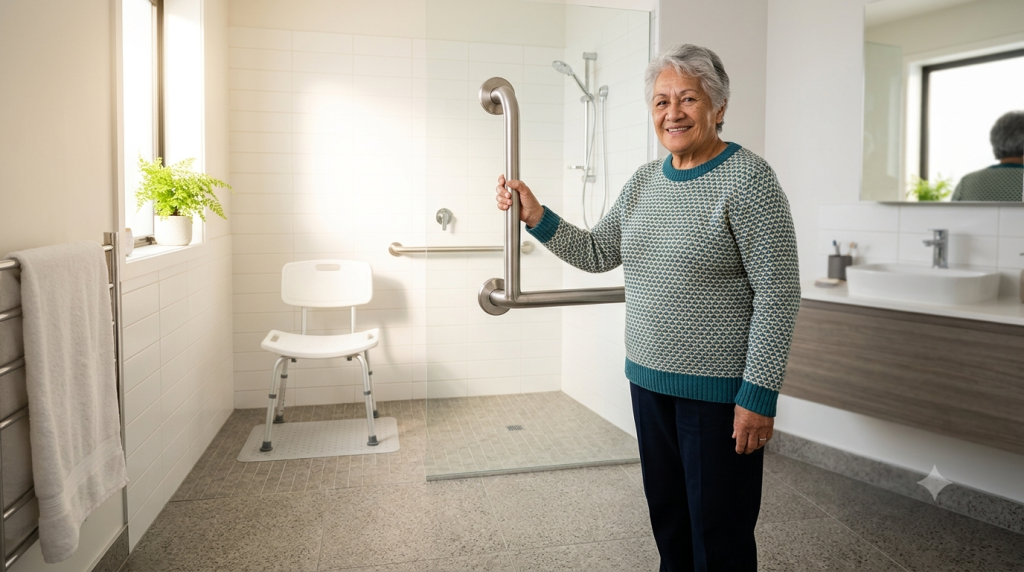
A shower grab bar can help when entering, exiting, standing or repositioning in the shower.
It may be especially useful when paired with a shower chair, handheld shower head and anti-slip mat.
A grab bar should not be positioned so far away that the senior needs to lean or twist to reach it.
Common shower-related rail options include:
- A vertical rail near the shower entrance
- A horizontal rail inside the shower
- A T-bar support rail
- A rail near a shower chair
- A combination of rails for entry and seated showering
Grab Bars for Toilet Support
Toilet transfers often involve sitting, standing, turning and clothing adjustment. A grab bar can help support these movements.
Options may include:
- A wall-mounted horizontal rail
- A 90-degree rail
- A fold-up toilet support rail
- A toilet frame
- A raised toilet seat with arms
If the toilet is very low, a raised toilet seat may also be useful. If the senior needs support on both sides, a toilet frame or two appropriately placed rails may be better.
Grab Bars vs Raised Toilet Seats
A grab bar provides hand support.
A raised toilet seat increases seat height.
They solve different problems. A raised seat may reduce how far the senior needs to bend, while a grab bar can help control the movement when sitting or standing.
Many seniors may need both, especially if they find the toilet low and also need a secure handhold.
Grab Bars vs Shower Chairs
A shower chair helps reduce standing time.
A grab bar helps with movement and hand support.
A senior who becomes tired while showering may need a shower chair. A senior who feels unsafe entering, exiting or standing in the shower may also need grab bars.
For higher-risk bathrooms, both products may be useful.
Who Should Consider Grab Bars for Seniors?
Grab bars for seniors may be useful for older adults who:
- Feel unsteady in the bathroom
- Need support entering or leaving the shower
- Need help sitting or standing from the toilet
- Hold towel rails or walls for support
- Use a shower chair
- Use a raised toilet seat
- Have reduced leg strength
- Feel nervous on wet bathroom floors
- Are recovering from injury or surgery
- Want more confidence during daily routines
They can also help caregivers by giving the senior a safer place to hold during movement.
Who May Need More Than Grab Bars?
Grab bars may not be enough if the senior:
- Has frequent falls
- Cannot stand safely
- Needs physical assistance with transfers
- Cannot use their hands effectively
- Has severe balance problems
- Uses a wheelchair and needs transfer support
- Has confusion or poor judgement
- Needs a shower commode or transfer bench
- Has a bathroom layout that cannot support safe movement
In these cases, professional advice may be needed.
What to Look For When Buying Grab Bars for Seniors
1. Fixed or Temporary Design
Decide whether the senior needs a permanent fixed rail or temporary light support.
For daily bathroom safety, fixed rails are usually more reliable.
2. Correct Location
The rail must be placed where the senior actually needs support.
Placement should match sitting, standing, stepping, turning or showering movements.
3. Wall Structure
A grab bar is only as secure as the wall and fixing.
Professional installation may be needed, especially in tiled bathrooms.
4. Length
Common straight rails may be available in different lengths.
Longer rails provide more hand positions, but they still need to fit the space.
5. Shape
Straight, angled, T-bar and fold-up designs suit different needs.
Choose the shape based on the movement being supported.
6. Grip Surface
A non-slip or textured grip can be useful, especially in wet areas.
The rail should feel comfortable and secure in the hand.
7. Diameter
The rail should be easy to grip.
A rail that is too thick or too thin may be uncomfortable for seniors with hand weakness or arthritis.
8. Material
Stainless steel is common for bathrooms because it is durable and easier to clean.
Powder-coated rails may suit some home designs but should still be suitable for wet areas.
9. Weight and Force
Some rails are designed for steadying support, while others are designed for stronger transfer support.
Do not assume every rail has the same strength.
10. Cleaning and Maintenance
Bathroom rails should be easy to clean and inspect.
Check regularly for looseness, corrosion, cracking or movement.
Measuring and Planning Before Installation
Before buying or installing grab bars, check:
- Where the senior naturally reaches
- Whether the rail is for shower, toilet, bath or hallway use
- Wall material and fixing options
- Height from the floor
- Distance from the toilet, shower seat or bath edge
- Door swing and shower door movement
- Space for caregivers
- Space for walking frames or wheelchairs
- Whether the rail will block other bathroom products
- Whether a professional installer is needed
Do not install a grab bar only based on appearance. It should support a real movement.
Buying Checklist
Before choosing a grab bar, ask:
- Is this for shower, toilet, bath or general support?
- Does the senior need fixed support or temporary support?
- Can the wall support the rail?
- Is the rail long enough?
- Is a straight, angled, T-bar or fold-up rail better?
- Is the grip comfortable?
- Is the surface suitable for wet hands?
- Is professional installation needed?
- Will the rail be used with a shower chair or raised toilet seat?
- Could a toilet frame or transfer aid be safer?
- Is the senior likely to pull heavily on the rail?
- Does the product suit the bathroom layout?
Common Mistakes When Buying Grab Bars
Using Towel Rails as Grab Bars
Towel rails are not designed to support body weight.
A senior should not rely on towel rails, shelves, shower screens or vanity units for support.
Relying on Suction Rails for Transfers
Suction rails may be useful for temporary steadying support, but they should not be treated as permanent transfer rails.
Installing Rails in the Wrong Position
A rail that is too far away or at the wrong height may not help.
The rail should match the senior’s real movement.
Ignoring Wall Strength
A strong rail on a weak wall is unsafe.
Wall structure and fixing method matter.
Choosing Based Only on Price
The cheapest rail may not be the safest choice.
Placement, installation and suitability are more important.
Waiting Until After a Fall
If a senior is already grabbing walls or towel rails, the bathroom should be reviewed before a fall happens.
Bathroom Safety Tips With Grab Bars
Grab bars work best as part of a complete bathroom safety setup.
Helpful steps include:
- Keep bathroom floors dry
- Use anti-slip mats where appropriate
- Consider a shower chair if standing is tiring
- Use a raised toilet seat if the toilet is too low
- Improve night lighting
- Keep soap and shampoo within reach
- Remove loose mats and clutter
- Use handheld shower heads where helpful
- Check rails regularly for movement
- Seek help if transfers still feel unsafe
A grab bar is important, but it is not the whole safety plan.
When to Seek Professional Advice
Professional advice may be useful if the senior:
- Has frequent falls
- Needs help transferring
- Uses a wheelchair or walking frame
- Has serious balance problems
- Cannot stand safely
- Is recovering from surgery or injury
- Has a very small or unusual bathroom layout
- Needs rails installed in tiled walls
- Is unsure where rails should be placed
- May qualify for equipment or housing modification support
An occupational therapist, physiotherapist, doctor, nurse, mobility equipment specialist or qualified installer may help identify the safest setup.
For New Zealand grab rail installation context, see the ACC and Enable New Zealand grab rail service toolkit.
ACC New Zealand also lists grab bars and hand rails among helpful equipment for bathing, showering and toileting.
FAQ
What are the best grab bars for seniors in NZ?
The best grab bars for seniors depend on the bathroom layout, wall structure, movement being supported and whether the senior needs shower, toilet or bath support. Fixed wall-mounted rails are usually better for regular daily support, while suction rails are more suitable for temporary light support.
Are suction grab bars safe for elderly people?
Suction grab bars can be useful on suitable smooth non-porous surfaces for temporary balance support. They should be checked before every use and should not be relied on for full body-weight transfers.
Where should grab bars be placed in a bathroom?
Common positions include near the shower entrance, inside the shower, beside the toilet and beside the bath. The best position depends on how the senior moves and where support is needed.
Are grab bars better than shower chairs?
They solve different problems. Grab bars provide hand support, while shower chairs reduce standing time. Many seniors benefit from both.
Do grab bars need professional installation?
Fixed grab bars often need professional installation, especially in tiled bathrooms or where wall structure is uncertain. A properly installed rail is much safer than a rail fixed into an unsuitable wall.
Can grab bars help with toilet transfers?
Yes. Grab bars or fold-up toilet rails can help some seniors sit down and stand from the toilet. If more support is needed, a raised toilet seat or toilet frame may also be useful.
Final Recommendation
For most seniors in New Zealand, the best grab bar is a properly installed fixed rail placed exactly where support is needed. Straight stainless steel grab rails are a practical starting point for many showers and toilets. A 90-degree rail may suit some toilet or corner layouts. A T-bar rail may be useful in showers, while a fold-up support rail can help in tighter toilet areas.
Suction grab rails can be useful for temporary or travel situations, but they should not be relied on like fixed rails for body-weight transfers.
The best choice is not simply the strongest-looking rail. It is the rail that fits the wall, supports the senior’s real movement, is positioned correctly and can be used safely every day.
For a broader review of shower, toilet, floor and lighting risks, read our bathroom safety checklist for seniors in NZ.