Introduction
Grab bar placement for seniors matters just as much as the type of grab bar being installed.
A strong rail can still be difficult to use when it is too far away, too high, too low or positioned at an awkward angle.
The best location depends on the movement being supported.
A senior entering a shower may naturally reach in a different direction from someone standing from a toilet. A person using a shower chair may also need a different handhold from someone who showers while standing.
For that reason, grab bars should be positioned around the senior’s real movement pattern rather than installed according to appearance alone.
This guide explains how New Zealand seniors and families can think about grab bar placement around showers, toilets, baths and other common home locations.
Safety Note
Grab bars are safety equipment.
They should be installed into suitable structural support using fixings appropriate for the wall and rail.
Tiles, wall linings and decorative surfaces alone do not necessarily provide enough structural support.
Professional assessment or installation is especially important when the senior:
- Has frequent falls
- Needs significant body-weight support
- Requires physical assistance
- Transfers from a wheelchair
- Has weakness on one side
- Uses a shower chair or commode
- Has recently had surgery
- Has major balance difficulties
- Needs several rails
- Has an unusual bathroom layout
- Is unsure where the rail should be positioned
Do not use towel rails, shower screens, shelves or vanity units as body-support rails unless they were specifically designed and installed for that purpose.
Disclosure
This article may contain affiliate links in the future. If you buy through these links, Golden Vibe may earn a commission at no additional cost to you.
Golden Vibe has not assessed the individual user, wall structure or bathroom.
Grab-bar installation should always be matched to the senior, the wall and the movement being supported.
Quick Answer
The best grab bar placement for seniors is usually the position where the person naturally reaches during the exact movement that feels difficult.
Before installing a rail, identify whether the senior needs support for:
- Entering the shower
- Leaving the shower
- Standing while washing
- Sitting onto a shower chair
- Standing from a shower chair
- Sitting onto the toilet
- Standing from the toilet
- Stepping into or out of a bath
- Moving across a small threshold
- Reaching support immediately after standing
Then check:
- Which hand the senior naturally uses
- Whether one or both sides need support
- The direction of force
- Wall structure
- The senior’s height
- The toilet or shower-seat height
- Door and shower-screen movement
There is no single universal rail height or position that is correct for every older adult.
The 7 Main Grab Bar Placement Checks
| Check | What to Review | Why It Matters |
|---|---|---|
| 1. Movement | What is the senior actually trying to do? | Placement should support a real movement |
| 2. Reach | Where does the senior naturally reach? | Prevents leaning and twisting |
| 3. Direction | Vertical, horizontal, angled or fold-up | Different movements need different grip directions |
| 4. Wall structure | Can the wall support the rail? | A rail is only as secure as its fixing |
| 5. Other equipment | Shower chair, toilet seat, frame or handheld shower | Equipment changes the required position |
| 6. Clear space | Doors, controls and walking routes | A rail should not create another obstacle |
| 7. Real-world test | Can the user reach it comfortably? | Confirms the planned position before installation |
1. Start With the Movement, Not the Wall
A common mistake is looking at an empty wall and asking:
“Where would a grab bar look good?”
The better question is:
“What movement does the senior need help with?”
Ask the senior to demonstrate the movement without rushing.
For example:
Shower Entry
Observe:
- Where the senior pauses
- Which hand reaches first
- Whether they step over a lip or threshold
- Whether they turn while entering
- Where the shower door moves
- Whether they use a walking frame before entering
Toilet Transfer
Observe:
- How the senior approaches
- Which direction they turn
- Where the hands naturally go
- Whether they push down or pull
- Whether they use one or both arms
- Whether the toilet is too low
Shower Chair Transfer
Observe:
- Where the chair sits
- How the senior turns
- Which hand is free
- Where they need support while lowering
- Where they need support while standing
The rail should support the difficult part of the movement rather than simply occupy available wall space.
2. Check the Senior’s Natural Reach
A grab bar should normally be reachable without excessive:
- Leaning
- Twisting
- Shoulder elevation
- Stretching
- Turning away from the intended movement
Before drilling, ask the senior to stand or sit in the real position where the rail will be used.
Ask them to reach naturally.
The hand position gives a useful starting point for planning.
Pain, stiffness, previous injury or one-sided weakness can substantially change comfortable reach.
A rail that works for one household member may be poorly positioned for another.
Why Universal Heights Can Be Misleading
Online diagrams often show fixed grab-bar heights.
These can be useful as general design references, but they do not automatically suit every senior.
Actual positioning can be affected by:
- User height
- Arm length
- Shoulder range
- Toilet height
- Raised toilet seats
- Shower-seat height
- Bath depth
- Walking aid use
- Wheelchair transfers
- Wall structure
For home safety, actual reach and movement should remain the priority.
3. Vertical, Horizontal or Angled Grab Bar?
Different rail directions support different movements.
Vertical Grab Bars
A vertical rail gives several grip heights on the same rail.
It can be useful where the senior:
- Steps into or out of a shower
- Changes body height during movement
- Wants to slide the hand up or down
- Needs a handhold near an entrance
Vertical rails are commonly considered near shower entrances because the senior can choose a comfortable grip height while stepping.
Be Careful If
- The rail is too far inside the shower
- The senior must lean to reach it
- The shower door blocks access
- The wall fixing is unsuitable
Horizontal Grab Bars
A horizontal rail provides a longer sideways gripping surface.
It may be useful:
- Inside the shower
- Alongside a shower chair
- Beside a toilet
- Where the senior needs several hand positions
- During controlled side-to-side movement
A horizontal rail can also provide support while the user repositions.
Be Careful If
- The rail is installed too high or too low
- The senior needs a vertical grip instead
- The wall is too short for useful positioning
- Soap or toiletries obstruct the rail
Angled or 90-Degree Rails
An angled or L-shaped rail can provide more than one direction of support.
This may help when a movement involves:
- Sitting
- Standing
- Turning
- Changing hand position during a transfer
These rails can be particularly useful around toilets and shower areas when one straight rail does not match the whole movement.
The exact angle should match how the senior actually uses their arms.
Fold-Up Rails
Fold-up rails are often used beside toilets.
They may suit:
- Bathrooms with limited space
- Shared bathrooms
- Users who need strong side support
- Situations where access is needed from the side
The rail can be lowered during use and folded away afterwards.
A fold-up rail still needs secure structural fixing.
Grab Bar Placement at a Shower Entrance
The shower entrance is one of the most common locations for a grab bar.
This is because the senior may need to:
- Step over a shower lip
- Move from dry to wet flooring
- Release a walking aid
- Turn
- Change surface level
- Manage a shower door
A vertical rail near the entrance can provide a handhold over several different grip heights.
Before installation, test whether the senior can reach the proposed position:
- Before stepping into the shower
- During the step
- After entering
The rail should not require the user to lean inside the shower before they have secure footing.
Check the Shower Door
Door movement can change rail placement.
Check whether the shower door:
- Opens inward
- Opens outward
- Slides
- Folds
- Has a fixed glass panel
A rail installed behind an open door may be almost useless during entry.
A rail should also not prevent the door from operating correctly.
Grab Bar Placement Inside the Shower
Inside the shower, the correct location depends on whether the senior stands or sits.
For Standing Showering
A horizontal or angled rail may help with:
- Repositioning
- Turning
- Reaching the shower controls
- Maintaining a steady handhold
The rail should be close enough that the senior can reach it without leaning.
For Seated Showering
When a shower chair is used, test the rail from the seated position.
The senior may need support:
- While lowering onto the chair
- While standing again
- While repositioning
- During washing
The rail should not be installed so far behind the chair that the user must twist.
It should also not interfere with the handheld shower head or controls.
For shower-chair sizing and space, use our shower chair size and fit guide for seniors in NZ.
Grab Bar and Handheld Shower Placement
A handheld shower system and grab bar should be planned together.
The best location for the shower handset is not automatically the best location for body support.
Check whether the senior can:
- Reach the shower head
- Reach the grab bar
- Reach the mixer
- Remain seated when appropriate
Some assisted-living systems combine a shower rail and structural support rail.
Ordinary decorative shower rails should not automatically be treated as grab bars.
For rail-shower and long-hose options, read our handheld shower heads for seniors in NZ guide.
Grab Bar Placement Beside the Toilet
Toilet transfers usually involve:
- Approaching the toilet.
- Turning.
- Positioning the feet.
- Reaching for support.
- Lowering.
- Sitting.
- Standing again.
- Regaining balance.
The grab bar should support the parts of this sequence that are difficult.
Common options may include:
- A horizontal wall rail
- An angled rail
- A 90-degree rail
- A fold-up rail
- Two rails when appropriate
- A toilet frame instead of fixed rails
The senior should not need to reach backwards blindly or twist excessively.
One Side or Both Sides of the Toilet?
One rail may be enough for some independent seniors.
Support on both sides may be useful when:
- Leg strength is reduced
- Balance is poor
- The senior naturally pushes through both arms
- One wall is too far away
- More controlled lowering is needed
A freestanding toilet frame may sometimes be more practical than installing two wall rails.
For freestanding surrounds and raised over-toilet options, compare our toilet frames for seniors in NZ guide.
Raised Toilet Seats Change Grab Bar Position
A raised toilet seat changes the final sitting height.
This can change:
- Arm height
- Shoulder position
- Standing mechanics
- The most useful rail height
Do not install toilet rails based only on the original toilet height if a raised seat will also be added.
Set up the final toilet equipment first where practical, then review hand position. Before finalising the rail position, use our raised toilet seat height guide to check whether the final seat height keeps the senior’s feet securely supported.
For product types and height options, read our raised toilet seats for seniors in NZ guide.
Grab Bars Near a Bath
Bath transfers can be more complex because the user may need to step over a high side.
A rail may be used to support:
- Standing beside the bath
- Stepping over the edge
- Lowering toward a bath seat
- Standing again
However, a grab bar does not solve every difficult bath transfer.
If the senior cannot safely lift the leg over the bath edge, other solutions may be needed, including:
- Bath boards
- Bath seats
- Transfer equipment
- A level-access shower
- Professional bathroom modification
Do not assume that installing more rails automatically makes a difficult bath transfer safe. If the home has a shower over the bath, our bath board for seniors guide explains how to check bath width, rim support, board fit and transfer safety.
Grab Bars Near Steps and Entrances
Grab rails can also be useful outside the bathroom.
Possible locations include:
- Small entrance steps
- Door thresholds
- Garage entrances
- Back doors
- Front doors
- Changes in floor level
Observe:
- Which hand the senior uses
- Door movement
- Weather exposure
- Step height
- Surface condition
- Whether a longer handrail would be more appropriate
A short grab bar may be useful for one isolated movement.
A proper handrail may be better when support is needed for several consecutive steps.
Wall Structure Comes Before Final Position
The perfect hand position is not useful if the rail cannot be fixed securely.
Before installation, determine what is behind the wall.
Possible structures include:
- Timber framing
- Masonry
- Concrete
- Reinforced wall systems
- Wet-area wall linings
- Tiled framing walls
The installer needs to select fixings suitable for both:
- The wall structure
- The loads expected during use
Do not assume that a tile itself provides structural support.
What If the Stud Is in the Wrong Place?
Sometimes the most comfortable hand position does not line up with suitable structural support.
Possible solutions may include:
- A longer rail reaching suitable fixing points
- Additional wall reinforcement
- A different rail orientation
- A purpose-designed support system
- Professional modification
Moving the rail to a completely different location just because installation is easier can make the finished product less useful.
Fixed Grab Bars vs Suction Grab Rails
Fixed rails and suction rails should not be treated as equivalent products.
A fixed grab bar can be designed for regular body support when installed correctly.
A suction rail attaches to a suitable smooth surface without permanent fixings.
Suction models may be useful for:
- Travel
- Temporary positioning
- Light steadying support
They are generally not the best choice when the senior:
- Pulls strongly
- Needs support during transfers
- Has frequent falls
- Relies on the rail every day
- Needs reliable body-weight support
For current fixed, angled, fold-up and temporary products, compare our grab bars for seniors in NZ guide.
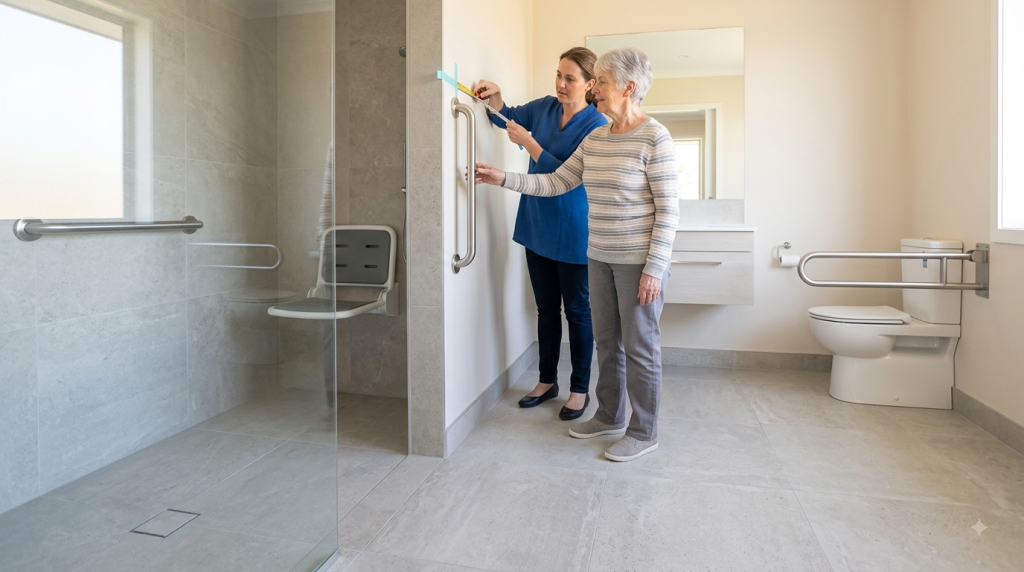
Test the Planned Position Before Drilling
One of the most useful steps is to simulate the rail position first.
Depending on the wall and environment, a family or professional may use:
- Painter’s tape
- Removable markers
- A temporary mock-up
- A measuring tape
Mark the proposed rail position.
Then ask the senior to repeat the real movement.
Check:
- Can they reach it?
- Does the shoulder feel comfortable?
- Do they need to lean?
- Do they use the rail naturally?
- Would another direction be better?
- Does the door still work?
- Does the shower chair still fit?
- Can a caregiver still assist?
Do not ask the senior to place body weight on a temporary mock-up.
The purpose is only to test reach and positioning.
Right-Handed and Left-Handed Use
Hand dominance can influence preferred rail position.
However, the stronger or safer side is not always the dominant hand.
A senior may prefer the opposite side because of:
- Previous stroke
- Shoulder pain
- Arthritis
- Injury
- Surgery
- Reduced grip
- Balance strategy
Ask which hand they naturally use during the transfer rather than assuming.
Placement for Seniors With One-Sided Weakness
One-sided weakness makes individual assessment more important.
The safest side for a rail may depend on:
- Stronger arm
- Stronger leg
- Transfer direction
- Bathroom layout
- Walking aid
- Professional rehabilitation strategy
Do not copy a generic diagram when neurological weakness or major asymmetry is present.
Small Bathrooms
Grab-bar placement becomes harder in compact bathrooms because rails may compete with:
- Vanity units
- Shower doors
- Toilet frames
- Raised toilet-seat arms
- Walking frames
- Storage
- Caregiver space
Wall-mounted or fold-up rails can preserve floor space.
However, a rail that fits physically must still be reachable.
Measure the room before installation.
Rental Homes
Permanent rails normally involve drilling and structural fixing.
In a rental home, discuss changes with the landlord or property manager before installation.
Do not automatically substitute a suction rail simply because permanent drilling is difficult.
If reliable transfer support is needed, professional advice may identify another suitable solution such as:
- Toilet frames
- Freestanding equipment
- Different shower seating
- Approved housing modifications
Grab Bars and Bathroom Renovations
If a bathroom is being renovated, grab-bar planning should happen early.
Consider the future location of:
- Shower chair
- Toilet
- Shower controls
- Handheld shower
- Wall reinforcement
- Doors
- Vanity
- Level-access shower
- Caregiver space
Installing suitable wall reinforcement during renovation can provide more flexibility for rail placement later.
A rail added as an afterthought may be limited by wall structure and finished surfaces.
Common Grab Bar Placement Mistakes
Installing Where It Looks Symmetrical
The rail should match the user’s movement, not the visual centre of the wall.
Installing Too Far Away
The senior should not need to lean or twist before reaching support.
Copying Another Person’s Bathroom
Different body size and transfer technique can require different placement.
Installing Before Choosing the Shower Chair
Seat height and position affect hand reach.
Ignoring a Raised Toilet Seat
Changing toilet height changes the transfer.
Blocking the Shower Door
Check the complete door swing before drilling.
Treating a Shower Rail as a Grab Bar
Only use it as structural support when it is specifically designed for that purpose.
Using Towel Rails
A towel rail may not be designed for body-weight support.
Choosing a Suction Rail for Heavy Transfer Support
Temporary suction products are not equivalent to correctly installed fixed rails.
Ignoring Wall Structure
A rail is only useful when the fixing is secure.
Installing Too Much Rail
More rail is not automatically safer.
The goal is effective support in useful locations.
When to Seek Professional Advice
Professional assessment is especially useful when the senior:
- Has fallen
- Has frequent near-falls
- Cannot transfer independently
- Uses a wheelchair
- Has weakness on one side
- Uses a shower commode
- Needs several rails
- Requires caregiver assistance
- Has cognitive changes
- Is recovering from major surgery
- Needs bathroom reconstruction
- Needs a level-access shower
- Has an unusual home layout
- Is unsure whether the wall is suitable
An occupational therapist or physiotherapist can observe the real movement and recommend equipment or modifications based on the person rather than a generic diagram.
A qualified installer can then determine the appropriate structural fixing.
New Zealand Grab-Rail Support and Housing Modifications
Enable New Zealand provides an ACC grab-rail service toolkit for ACC staff and housing assessors.
ACC housing modifications can include installation of grab rails in locations such as baths, showers, toilets and home entrances when the modification relates to an accepted injury and appropriate support pathway.
For disability-related home modifications not covered by ACC, Disability Support Services may also provide housing-assessment and modification pathways for eligible New Zealanders.
Always check eligibility and approval before organising work with the expectation that it will be funded.
Final Recommendation
Good grab bar placement starts with the senior’s movement.
Before installation:
- Identify the exact difficult movement
- Watch where the senior naturally reaches
- Decide what rail direction supports that movement
- Check other equipment
- Confirm the wall structure
- Test the proposed position
- Use appropriate professional assessment or installation when needed
Near a shower entrance, a vertical rail may provide useful grip at several heights.
Inside a shower, horizontal or angled rails may support standing, turning or shower-chair transfers.
Beside a toilet, horizontal, angled or fold-up rails may help control sitting and standing.
There is no single placement diagram that suits every person.
For current straight, angled, fold-up and bathroom support-rail options in New Zealand, read our grab bars for seniors in NZ guide.
For a broader review of floor grip, shower seating, toilet support, lighting and other bathroom risks, use our bathroom safety checklist for seniors in NZ.
The most useful rail is the one the senior can reach naturally, use confidently and rely on during the real movement it was installed to support.
Frequently Asked Questions
Where should grab bars be placed for seniors?
Grab bars should be placed where the senior naturally needs hand support during shower entry, toileting, sitting, standing or another specific movement.
Placement should match the person rather than follow a universal diagram.
Where should a grab bar go at a shower entrance?
A vertical rail near the entrance can be useful because it provides several grip heights.
The exact location should allow the senior to reach it before and during entry without leaning.
Should shower grab bars be vertical or horizontal?
It depends on the movement.
Vertical bars are often useful for entry and changing grip height, while horizontal rails can provide longer support inside a shower.
Some users benefit from angled or combined rails.
Where should a grab bar go beside a toilet?
The rail should be positioned where the senior can reach it comfortably while lowering and standing.
The location also depends on toilet height, wall position and whether a raised seat or toilet frame is used.
Should grab bars be installed on both sides of a toilet?
Some seniors need support on both sides, while others only need one rail.
A toilet frame or fold-up rails may be more practical in some layouts.
How high should a grab bar be?
There is no single height that suits every senior.
Actual reach, body size, toilet or shower-seat height and the movement being supported should guide the position.
Can towel rails be used as grab bars?
Not unless they were specifically designed and structurally installed for body support.
Ordinary towel rails may not withstand the force of a transfer.
Are suction grab bars safe for seniors?
They may be useful for temporary light steadying on compatible surfaces, but they should not automatically be treated as equivalent to fixed grab bars for regular transfer or body-weight support.
Can grab bars be installed through bathroom tiles?
Grab bars may be installed in tiled bathrooms when suitable structural support and appropriate fixings are available.
The tile itself should not be assumed to provide the required support.
Who can help decide where grab bars should go?
An occupational therapist, physiotherapist, housing assessor or appropriate accessibility professional can assess the senior’s movement.
A suitable installer can assess wall structure and fixing requirements.
Can grab rails be funded in New Zealand?
Funding may be available in some circumstances through ACC injury-related housing modifications or Disability Support Services home-modification pathways.
Eligibility and approval should be confirmed before work begins.