Introduction
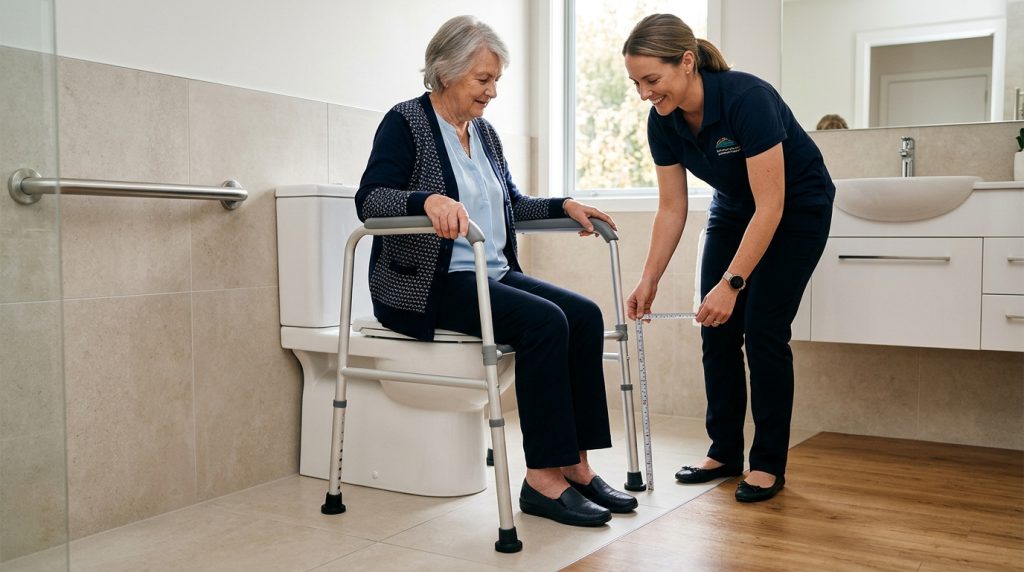
Toilet frames for seniors can provide stable hand support on both sides of the toilet when sitting down and standing up has become difficult.
They are particularly useful when a senior naturally pushes through both arms, when the bathroom wall is too far away for a useful grab bar, or when permanent wall-mounted rails are not practical.
However, the term “toilet frame” can be confusing.
Some products simply surround the existing toilet and provide armrests. Others include their own raised seat and sit over the toilet, increasing the final sitting height as well as providing bilateral support.
The best option depends on the senior’s leg strength, balance, body width, toilet height, bathroom space and whether extra seat height is actually needed.
This guide compares five practical toilet-frame options currently available in New Zealand and explains how to check height, width, weight capacity, bathroom clearance and transfer stability before buying.
Safety Note
A toilet frame is a transfer aid, not a substitute for individual assessment when toileting has become significantly difficult.
Professional advice may be appropriate when the senior:
- Has fallen near the toilet
- Has repeated near-falls
- Needs another person to lift or lower them
- Cannot stand using both arms safely
- Has major weakness on one side
- Uses a wheelchair for transfers
- Has severe hip or knee restrictions
- Has recently had surgery
- Cannot keep both feet supported
- Has rapidly changing mobility
- Has difficulty controlling the movement while sitting
- Becomes dizzy when standing
- Needs substantial caregiver assistance
An occupational therapist, physiotherapist or appropriate equipment specialist can assess the senior, toilet, frame, bathroom layout and transfer technique together.
Disclosure
This article may contain affiliate links in the future. If you buy through these links, Golden Vibe may earn a commission at no additional cost to you.
Golden Vibe has not personally tested or fitted every toilet frame discussed in this guide.
Product specifications, prices, availability and weight capacities can change. Always check the current retailer or manufacturer information before buying.
Quick Answer
The best toilet frames for seniors should provide stable arm support without making the bathroom too narrow or placing the user’s feet in an unstable position.
Before buying, check:
- Whether the senior needs arm support only or extra toilet height as well
- Height of the armrests
- Final seat height
- Width between the arms
- Overall frame width
- Maximum user weight
- Space around the toilet
- Non-slip feet
- Whether all four legs remain level
- Whether the frame moves or wobbles during transfers
Health New Zealand distinguishes between a toilet frame and a toilet surround.
An over-toilet frame includes a toilet seat that raises the sitting height and has armrests for support.
A toilet surround fits around the existing toilet and provides armrests without changing the toilet-seat height.
That distinction is important because a senior who mainly needs bilateral arm support may not need the toilet raised at all.
Toilet Frame vs Toilet Surround: What Is the Difference?
The names used by retailers are not always consistent.
For practical purposes, there are two main configurations.
| Type | Adds Height? | Provides Arms? | Main Use |
|---|---|---|---|
| Toilet surround | Usually no | Yes | Bilateral support around existing toilet |
| Over-toilet frame | Yes | Yes | Added seat height plus bilateral support |
Health New Zealand describes a toilet surround as a frame positioned around the toilet that gives the user armrests but does not change the seat height.
An over-toilet frame combines support arms with its own raised toilet seat.
Before buying, identify which problem needs solving.
If the existing toilet height is already comfortable but the senior needs both arms to stand, a surround may be enough.
If the toilet is also too low, an over-toilet frame may be more suitable.
5 Practical Toilet Frame Options in New Zealand
The products below represent several different configurations available through New Zealand mobility-equipment retailers.
Prices and stock can change, so use the specifications as a comparison rather than treating any current price as permanent.
1. Chevron Toilet Surround — Simple Freestanding Support
The Chevron Toilet Surround is a straightforward freestanding frame designed to provide bilateral arm support without adding a new toilet seat.
It may suit a senior who:
- Is comfortable with the existing toilet height
- Mainly needs something to push down on when standing
- Wants support on both sides
- Cannot conveniently install wall-mounted rails
- Wants a relatively simple freestanding design
Current specifications include:
- Adjustable armrest height: approximately 66–79cm
- Width inside arms: approximately 45cm
- Maximum user weight: 130kg
- Freestanding steel construction
- Non-permanent installation
What We Like
The simple design keeps the existing toilet seat unchanged.
That can be useful when the existing seat height is already correct and the senior only needs bilateral hand support.
The adjustable arm height also makes it easier to position the handles for different users.
Check Before Buying
The 45cm space between the arms will not suit every body size.
Measure the senior while seated and compare the usable width rather than only checking the overall bathroom space.
Also make sure the frame legs sit fully on a flat, dry floor.
Check current price and specifications at Mobility Centre.
2. Oakwood Toilet Surround — Adjustable Width and Height
The Oakwood Toilet Surround provides another approach.
Rather than being completely freestanding, it attaches at the rear of the toilet and provides moulded armrests on both sides.
Current specifications include:
- Adjustable height: approximately 65–75cm
- Adjustable width: approximately 45–55cm
- Maximum user weight: 100kg
- Aluminium construction
- Rear toilet attachment
What We Like
Adjustable width can be useful when the toilet sits in a narrow space or when the senior needs a different distance between the arm supports.
This makes the Oakwood worth considering when a fixed-width frame feels too narrow or too wide.
Check Before Buying
The maximum user weight is lower than several heavier-duty frames.
Also confirm that the rear attachment system works with the existing toilet.
Do not assume that every toilet shape or mounting arrangement is compatible.
Check current price and specifications at Mobility Centre.
3. Steel Toilet Frame With Arm Pads — Higher-Capacity Surround
The Steel Toilet Frame with Arm Pads is a freestanding height-adjustable surround that provides substantial bilateral support while leaving the existing toilet seat in place.
Current specifications include:
- Armrest height approximately 69.5–84.5cm
- Width between arms approximately 48.5cm
- Overall width approximately 58.5cm
- Depth approximately 46.5cm
- Maximum user weight listed at up to 160kg
- Slip-resistant rubber feet
- Powder-coated steel construction
What We Like
The higher weight capacity and taller adjustment range can make this type of frame more suitable for larger or taller users.
The 48.5cm internal width is also slightly more generous than some narrower toilet surrounds.
Check Before Buying
The frame is wider overall than the usable space between the arms.
Measure:
- Distance to the wall
- Vanity
- Shower screen
- Door swing
- Space for a walking aid
A frame that fits the user but blocks the bathroom is not a successful setup.
Check current price and specifications at Mobility Centre.
4. Viking Raised Over Toilet Frame — Height Plus Arm Support
The Viking Raised Over Toilet Frame differs from the three surrounds above because it includes its own raised toilet seat.
This means it can address two problems at once:
- The existing toilet is too low
- The senior needs support on both sides
Current retailer specifications include:
- Adjustable seat height approximately 44–59cm
- Seat width approximately 37cm
- Width between arms approximately 45cm
- Maximum user weight approximately 125kg
- Steel frame
- Non-slip rubber feet
- Removable seat and splashguard
What We Like
This is the type of product Health New Zealand describes as an over-toilet frame.
The senior can use the armrests while also reducing how far they need to lower towards the toilet.
It may be useful when a separate raised toilet seat plus separate frame would create too many individual pieces of equipment.
Check Before Buying
Do not automatically set the seat to the highest position.
The final height should allow the senior to sit comfortably with both feet securely on the floor.
Also check that all four adjustable legs are set to the same height.
For a detailed height-checking process, read our raised toilet seat height guide for seniors in NZ.
Check current price and specifications at Mobility Centre.
5. Waimauku Over Toilet Frame — Compact Multi-Use Option
The Waimauku Over Toilet Frame is another height-adjustable frame available in New Zealand.
It can be positioned over a toilet and can also be used in a commode-style configuration when appropriate.
Current specifications include:
- Overall width approximately 58cm
- Overall length approximately 46.5cm
- Seat height approximately 37–52cm
- Maximum user weight approximately 136kg
- Product weight approximately 4.8kg
- Non-slip foot pads
- Height-adjustable legs
What We Like
The relatively simple design gives the household flexibility when an over-toilet frame is needed without a large specialist installation.
The 136kg maximum user weight also provides a useful middle ground between lighter and heavier-duty frames.
Check Before Buying
The relatively low end of the seat-height range may not suit every toilet or every senior.
Measure the actual toilet and compare the final sitting height before assuming the frame will solve a low-toilet problem.
If the equipment is being considered as a bedside commode instead of over a toilet, the needs are different.
For dedicated bedside and mobile options, compare our commode chairs for seniors in NZ guide.
Check current price and specifications at Mobility Centre.
Quick Comparison of the 5 Options
| Option | Type | Height Adjustable | Internal Width | Max User Weight |
|---|---|---|---|---|
| Chevron Toilet Surround | Surround | Yes | About 45cm | 130kg |
| Oakwood Toilet Surround | Attached surround | Yes | Adjustable about 45–55cm | 100kg |
| Steel Toilet Frame with Arm Pads | Freestanding surround | Yes | About 48.5cm | Up to 160kg |
| Viking Raised Over Toilet Frame | Raised over-toilet frame | Yes | About 45cm | About 125kg |
| Waimauku Over Toilet Frame | Raised/multi-use frame | Yes | Check current model | About 136kg |
Always confirm current specifications before buying.
How to Choose the Right Toilet Frame
The best choice is not automatically the strongest-looking frame.
A suitable toilet frame needs to match:
- The senior
- The toilet
- The bathroom
- The transfer movement
Use the following checks before ordering.
1. Decide Whether You Need Extra Seat Height
This is the first decision.
Ask:
“Is the toilet actually too low, or does the senior mainly need something to push on?”
If the current toilet height is comfortable, a toilet surround may be sufficient.
If the senior:
- Drops heavily onto the toilet
- Struggles during the first part of standing
- Has substantial difficulty bending the knees
- Finds the current toilet noticeably low
a raised over-toilet frame may be more useful.
However, higher is not automatically safer.
The final seat should still allow stable foot support.
For 50mm, 100mm and 150mm height considerations, read our raised toilet seat height guide for seniors in NZ.
2. Check the Armrest Height
Armrests need to be high enough to provide useful leverage but low enough that the shoulders remain relaxed.
When the senior is sitting:
- The hands should reach the arms naturally
- The shoulders should not be raised excessively
- The senior should not need to lean sideways
- The elbows should remain in a comfortable position
When standing:
- The user should be able to push down rather than pull awkwardly
- Both hands should remain in control
- The frame should not tip or move
Health New Zealand advises using both hands on equipment with armrests where possible when moving from sitting to standing, which helps reduce the chance of the equipment tipping.
3. Measure the Width Between the Arms
This is one of the easiest measurements to overlook.
A product may fit physically around the toilet but still feel too narrow for the user.
Check the usable width between the armrests.
The senior should be able to:
- Sit without the hips pressing heavily against the arms
- Adjust clothing
- Reach both armrests
- Reposition comfortably
- Stand without becoming trapped between the arms
Do not compare body width with the total exterior frame width.
The internal usable width is what matters.
Wider Toilet Frames
A wider model may be needed when:
- The senior has a larger body size
- Clothing needs more clearance
- Standard frames feel restrictive
- Additional weight capacity is required
Do not select a bariatric or wider frame only from weight capacity.
It still needs to fit through the bathroom and around the actual toilet.
4. Measure the Bathroom
Toilet frames occupy floor space.
Measure:
- Space beside the toilet
- Distance to the wall
- Distance to the vanity
- Door opening
- Shower-screen movement
- Space in front of the toilet
- Position of the toilet-paper holder
- Walking-frame clearance
- Caregiver space if needed
Health New Zealand specifically advises checking that there is enough room around the toilet for equipment with armrests and enough room to manoeuvre mobility aids once the equipment is installed.
Small Bathrooms
A toilet frame may not be the best solution in a very narrow bathroom.
Possible alternatives can include:
- Raised toilet seat with arms
- One correctly positioned wall grab bar
- Fold-up grab rail
- Rear-mounted toilet surround
- Bathroom modification
The correct solution depends on the user and available structure.
For toilet and shower rail positioning, read our grab bar placement for seniors guide.
5. Check the Final Foot Position
For any height-adjustable toilet equipment, sit on the final setup.
Both feet should normally be able to rest securely on the floor.
Check:
- Full foot contact
- Comfortable knee position
- No dangling feet
- No sliding forward
- Enough room to reposition the feet before standing
If only the toes reach the floor, the equipment may be too high.
Health New Zealand recommends adjusting toilet equipment so the user can sit comfortably with their feet flat on the floor.
6. Check All Four Legs
Freestanding frames rely on their legs and floor contact.
Make sure:
- All four feet contact the floor
- All adjustable legs are set correctly
- Rubber tips are intact
- The bathroom floor is dry
- The frame does not rock
- No leg sits partly on a mat
- No leg is trapped against the toilet base
Health New Zealand advises that adjustable toilet equipment should have all four legs set to the same height unless the specific manufacturer instructs otherwise.
Correctly installed equipment should not move or wobble.
Do Not Put a Toilet Frame on a Loose Bath Mat
A soft or loose mat can affect stability.
It may:
- Compress under one leg
- Slide
- Create unequal leg height
- Curl around the rubber feet
The frame should normally sit on a firm, stable bathroom surface.
7. Check Maximum User Weight
Every product has its own maximum user weight.
Do not estimate this from:
- Tube thickness
- Product weight
- Price
- Appearance
Check the exact specification.
Also consider the force applied through the arms during standing.
A user does not simply sit passively inside the frame.
They may push considerable force through the armrests.
8. Test Sitting Down and Standing Up
A toilet frame should be evaluated during the real transfer.
Ask the senior to:
- Approach the toilet normally.
- Turn into position.
- Reach both arms if that is their usual technique.
- Lower themselves slowly.
- Sit comfortably.
- Check foot support.
- Reposition the feet.
- Lean forward appropriately.
- Push through the armrests.
- Stand.
- Regain balance before reaching for a walking aid.
The equipment should help control the movement.
If the senior still needs another person to physically lift them, the frame may not be enough.
Do Not Pull on a Walking Frame to Stand From the Toilet
A walking frame is mobile equipment.
It may slide or roll when pulled.
Where possible, use the fixed or appropriately positioned arm supports for the sit-to-stand movement.
Once the senior is standing and stable, the walking frame can then be taken for mobility support.
Toilet Frame vs Raised Toilet Seat
These products overlap but are not identical.
Raised Toilet Seat
Main purpose:
- Adds height
May suit a senior who:
- Mainly struggles because the toilet is low
- Has reasonable balance
- Can use a wall grab bar
- Does not need support on both sides
Toilet Surround
Main purpose:
- Adds bilateral arm support
Usually:
- Does not change existing toilet height
May suit a senior who:
- Is comfortable with the toilet height
- Needs two arms to control sitting and standing
Raised Over-Toilet Frame
Main purpose:
- Adds both height and bilateral support
May suit a senior who:
- Finds the toilet too low
- Also needs two-sided hand support
Do not buy an over-toilet frame simply because it appears to offer more features.
More equipment is not automatically better.
Toilet Frame vs Grab Bars
Grab bars are fixed to the wall or suitable structural support.
A toilet frame is usually freestanding or attached to the toilet.
Toilet Frame Advantages
A frame may be useful when:
- Both sides need support
- A suitable wall is unavailable
- Permanent drilling is not practical
- The household wants adjustable arm height
- A temporary setup is needed
Grab Bar Advantages
A correctly installed grab bar:
- Does not occupy as much floor space
- Cannot be moved away from the toilet
- May suit a small bathroom
- Can be positioned for the user’s natural reach
The correct solution depends on the bathroom and the senior’s transfer technique.
For detailed fixed-rail positioning, use our grab bar placement for seniors guide.
One Arm or Two Arms?
Some seniors naturally use one arm.
Others use both.
Health New Zealand advises that where toilet equipment has armrests, using two hands when pushing up from sitting where possible can help prevent tipping.
A frame may therefore be particularly useful for seniors who naturally prefer bilateral support.
However, one-sided weakness or recent surgery can change the safest technique.
Seek professional advice when the movement is not symmetrical.
Freestanding vs Toilet-Attached Frames
A freestanding frame sits independently around the toilet.
Advantages can include:
- No permanent toilet attachment
- Easy height adjustment
- Easy removal
- Wider range of designs
A toilet-attached surround may:
- Take up less floor space
- Remain aligned with the toilet
- Avoid four floor legs around the bowl
Neither design is universally better.
Check the actual bathroom.
Cleaning and Hygiene
Toilet equipment needs regular cleaning because it is exposed to moisture and body fluids.
Check:
- Armrests
- Frame tubing
- Rubber feet
- Seat
- Splashguard
- Adjustment holes
- Mounting points
If equipment is removed for cleaning, reinstall it properly before use.
Do not leave one leg at a different height after reassembly.
Inspect the Frame Regularly
Check for:
- Loose adjustment buttons
- Damaged rubber feet
- Cracked seats
- Bent tubing
- Corrosion
- Wobbling
- Loose armrests
- Movement around the toilet
Stop using the frame if it becomes unstable.
Toilet Frames After Surgery
Toilet frames are often considered during recovery because they can reduce the effort needed to sit and stand.
However, recovery instructions may include restrictions on:
- Hip movement
- Knee bending
- Weight bearing
- Twisting
- Which arm can be used
Follow the healthcare team’s advice rather than assuming a generic frame setup is appropriate.
Toilet Frames for Rental Homes
A freestanding frame may be attractive in a rental because it usually avoids drilling into bathroom walls.
However, equipment should not be selected only to avoid asking the landlord about modifications.
If fixed rails would be safer, appropriate housing or professional advice may be needed.
When a Commode May Be Better
A toilet frame assumes the senior can still reach the bathroom.
A commode may be more practical when:
- The bathroom is too far away
- Nighttime toileting is urgent
- Walking to the toilet is unsafe
- A bedside option is required
- Caregiver access is important
For bedside and mobile options, read our commode chairs for seniors in NZ guide.
Equipment Support in New Zealand
Some toilet equipment may be available through New Zealand disability-support pathways when it is needed because of a long-term disability.
Disability Support Services explains that Equipment and Modification Service assessors can recommend suitable equipment according to the person’s needs.
Examples of equipment supplied through these services include raised toilet seats and other personal-hygiene equipment.
Over-toilet frames are also listed within standard equipment categories used by New Zealand equipment services.
Eligibility and the appropriate pathway depend on the person’s circumstances.
Do not buy equipment privately expecting reimbursement unless funding has already been confirmed.
Common Toilet Frame Mistakes
Buying a Raised Frame When Height Is Already Correct
The senior may only need bilateral support.
Buying a Surround When the Toilet Is Too Low
Armrests may help, but the underlying seat-height problem remains.
Ignoring Width Between the Arms
The frame may fit the toilet but not the user.
Measuring Only the Bathroom Floor
Also check the senior’s body width and arm reach.
Setting the Frame Too High
Feet should remain securely supported.
Unequal Leg Adjustment
A frame should not rock.
Placing a Leg on a Loose Mat
All feet need firm floor contact.
Ignoring the Weight Limit
Frames have different maximum user weights.
Pulling a Walking Frame to Stand
A movable walking aid should not replace stable toilet support.
Buying Without Testing the Transfer
A product specification cannot show whether the senior can actually use it.
Forgetting Cleaning Access
The frame needs to remain practical around a frequently cleaned toilet.
Assuming More Support Is Always Better
The simplest equipment that safely solves the actual problem is often the better choice.
When to Seek Professional Advice
Consider professional assessment when the senior:
- Has fallen near the toilet
- Needs another person to help them stand
- Uses a wheelchair
- Has substantial weakness
- Has one-sided impairment
- Has major balance problems
- Has recently had surgery
- Cannot keep both feet supported
- Cannot fit comfortably inside standard frames
- Needs bariatric equipment
- Has an unusually small bathroom
- Requires several pieces of bathroom equipment
- Has rapidly changing mobility
- Is unsure whether a toilet frame or grab bar is more appropriate
An occupational therapist can assess the whole transfer rather than looking only at the product.
Official New Zealand Guidance
Health New Zealand provides specific guidance on toilet frames, toilet surrounds, raised toilet seats and commodes.
Its current guidance emphasises checking:
- Whether the equipment is height adjustable
- Whether the user’s feet remain flat on the floor
- Space between armrests
- Bathroom clearance
- Maximum user weight
- Stability
- Equal leg adjustment
- Regular cleaning
Health New Zealand also distinguishes a raised over-toilet frame from a toilet surround that only provides arm support.
For a broader review of shower seating, flooring, rails and other bathroom hazards, read our bathroom safety checklist for seniors in NZ.
Final Recommendation
Start by identifying the real problem.
If the existing toilet is already the right height but the senior needs support on both sides, consider a toilet surround.
If the toilet is too low and bilateral support is also needed, an adjustable over-toilet frame may be more suitable.
Then check:
- Armrest height
- Width between arms
- Overall frame width
- Final seat height
- Foot support
- Maximum user weight
- Bathroom clearance
- Rubber feet
- Stability
- Cleaning access
Among current New Zealand options, freestanding surrounds such as the Chevron and Steel Toilet Frame offer bilateral support without changing the seat itself.
The Oakwood offers adjustable width and a toilet-attached design.
Raised frames such as the Viking and Waimauku combine arm support with an adjustable sitting height.
The best toilet frame is not the model with the most features.
It is the frame that fits the senior, the existing toilet, the bathroom and the actual sitting-and-standing movement.
For raised-seat-only options, compare our raised toilet seats for seniors in NZ guide.
For a detailed height assessment, use our raised toilet seat height guide.
For wall-mounted support, read our grab bar placement for seniors guide.
Frequently Asked Questions
What is a toilet frame?
A toilet frame is support equipment used around or over a toilet to help a person sit down and stand up.
Some models only provide armrests, while over-toilet frames may also include a raised seat.
What is the difference between a toilet frame and a toilet surround?
Health New Zealand describes an over-toilet frame as having its own raised toilet seat and armrests.
A toilet surround provides armrests around the existing toilet without changing the seat height.
Are toilet frames good for elderly people?
They can be useful for older adults who need bilateral arm support during toilet transfers.
The frame still needs to match the person’s strength, balance, size and bathroom.
Does a toilet frame raise the toilet seat?
Some do and some do not.
An over-toilet frame generally includes a raised seat, while a toilet surround normally leaves the existing toilet seat at its original height.
How high should a toilet frame be?
The correct height depends on the user.
Armrests should be reachable comfortably, and any raised seat should still allow the user to keep both feet securely supported.
How wide should a toilet frame be?
The senior needs enough space to sit comfortably between the arms.
Measure the internal width rather than relying on the overall exterior width.
Should both feet touch the floor?
Yes.
Height-adjustable toilet equipment should normally allow comfortable foot support while sitting.
Should all four toilet-frame legs be the same height?
Health New Zealand advises adjusting all four legs to the same height and following the manufacturer’s instructions.
Should a toilet frame wobble?
No.
Correctly fitted toilet equipment should remain stable and should not move or wobble during normal use.
Can a toilet frame be used instead of grab bars?
Sometimes.
A frame can provide bilateral support without wall installation, but fixed grab bars may be more suitable in some bathrooms.
Can I use a walking frame to pull myself off the toilet?
A movable walking frame should not normally be used as the main object for pulling up from the toilet.
Use appropriate stable supports for the transfer.
What is the best toilet frame for a small bathroom?
It depends on the available clearance.
A narrower or toilet-attached surround may occupy less floor space than a large freestanding frame.
Are toilet frames height adjustable?
Many are, but adjustment ranges vary.
Check the exact model.
What weight can a toilet frame hold?
Weight capacities differ substantially between products.
Current examples range from around 100kg to 160kg or more.
Check the exact manufacturer specification.
Can toilet frames be funded in New Zealand?
Some toileting equipment may be supplied through disability-support equipment pathways when a person meets eligibility requirements and the equipment is recommended through an appropriate assessment.
When should I ask an occupational therapist?
Professional advice is especially useful after falls, major surgery, wheelchair transfers, significant weakness, one-sided impairment, bariatric needs or when it is unclear which type of toilet support is appropriate.