Choosing a walking frame for elderly parent support can be harder than it first appears.
Two walking frames may look almost identical online but work very differently in real life. One may be too wide for the bathroom, another too heavy to lift into a car, while a four-wheel rollator may move too quickly for a parent who needs slower and more controlled support.
The best walking frame is therefore not automatically the most expensive model or the one with the most features.
It should match your parent’s balance, strength, walking environment, hand control, fatigue level, home layout and everyday routine.
Health New Zealand’s walking-frame guidance recommends considering where the frame will be used, the type of wheels, brakes, seat, folding design and correct fit before buying.
If you are already comparing specific models sold in New Zealand, start with our walking frames for seniors in NZ guide.
This guide takes a different approach. It focuses on the decisions families should make before buying a walking frame for an older parent.
Safety Note
A walking frame should match the user’s actual mobility needs.
Professional assessment may be especially useful if your parent has recently fallen, has sudden changes in mobility, significant weakness, difficulty using brakes, problems standing from a chair, or needs to place substantial body weight through the frame.
A physiotherapist or occupational therapist can assess walking pattern, strength, balance, frame height and the home environment.
Do not assume that a larger or more supportive-looking walking frame is automatically safer.
Disclosure
This article may contain affiliate links in the future. If you buy through these links, Golden Vibe may earn a small commission at no additional cost to you.
Golden Vibe does not recommend choosing mobility equipment from specifications alone. The walking frame needs to suit the individual user and the environment where it will actually be used.
Quick Answer: What Should You Check First?
If you are choosing a walking frame for elderly parent use, start with these nine checks:
- Why your parent needs the frame
- Whether it will be used indoors, outdoors or both
- Correct handle height and posture
- Overall width and home clearance
- Wheel type and brake control
- Whether a built-in seat is genuinely useful
- Frame weight, folding and transport
- User weight, grip comfort and practical accessories
- Whether your parent is comfortable and willing to use it
The last point is easy to underestimate.
A technically excellent walking frame provides little benefit if your parent finds it too heavy, embarrassing, difficult to control or inconvenient enough that they avoid using it.
1. Start With Why Your Parent Needs a Walking Frame
Before comparing brands, decide what problem the walking frame is supposed to solve.
For example, is your parent:
- Feeling mildly unsteady?
- Needing support on both sides?
- Becoming tired during longer walks?
- Struggling mainly inside the home?
- Finding outdoor paths difficult?
- Recovering after surgery or injury?
- Using furniture for support while walking?
- Needing somewhere to sit and rest?
Different problems can require very different walking aids.
A parent who only needs occasional light balance support may not need a full walking frame at all. A walking stick could be easier to carry and use.
Someone who needs support from both hands, however, may benefit from a frame.
If you are unsure where that line is, our walking stick vs walking frame guide explains the practical differences.
Do not buy a four-wheel rollator simply because it looks modern or convenient. If your parent cannot reliably control the brakes or the frame rolls away too easily, a different design may be more appropriate.
2. Decide Where the Walking Frame Will Be Used
Indoor and outdoor walking place different demands on a frame.
For Mainly Indoor Use
Prioritise:
- Narrow overall width
- Small turning radius
- Easy manoeuvring around furniture
- Compatibility with carpet, timber or tile floors
- Easy access through bathroom and bedroom doors
- Controlled movement
- Low overall weight
A very large rollator may feel comfortable in a showroom but become frustrating inside a smaller home.
For Mainly Outdoor Use
Prioritise:
- Larger wheels
- Reliable brakes
- Stable steering
- A seat if rest breaks are needed
- Suitable tyres for the intended surface
- Storage for small personal items
- Folding if the frame will travel by car
If your parent regularly walks on gravel, grass, uneven driveways or rough paths, a standard indoor walker may not be ideal.
Our off-road walking frames for seniors in NZ guide looks specifically at larger-wheel outdoor models.
Do You Need One Frame or Two?
Some families try to find one walking frame that does everything.
That is not always the most practical solution.
A compact indoor frame may work better around furniture and bathrooms, while a larger four-wheel rollator may be more suitable for shopping centres and outdoor walks.
For some seniors, two specialised frames can be more practical than one compromise model.
3. Get the Handle Height Right
Incorrect handle height can make even a high-quality walking frame uncomfortable to use.
If the handles are too low, your parent may start leaning forward.
If they are too high, the shoulders may rise and the arms may not provide comfortable support.
Health New Zealand advises that when a person is standing upright with the walking frame, the shoulders should remain relaxed and the elbows should be slightly bent.
For a complete measurement process, including handle height, frame width, seat dimensions and doorway clearance, see our walking frame size guide for seniors in NZ.
Do Not Buy Only From the User’s Height
Two people of similar height can have different:
- Arm lengths
- Posture
- Shoulder position
- Leg proportions
- Walking patterns
That means a product described as suitable for a certain height range still needs to be adjusted and tested.
4. Measure the Home Before Buying
This is one of the most important checks families skip.
Measure the actual places where your parent will use the frame.
At minimum, check:
- The narrowest doorway
- Bedroom entrance
- Bathroom entrance
- Space beside the bed
- Space around the toilet
- Hallway width
- Kitchen pathways
- Turning space near chairs
- Door thresholds
Do not compare doorway width only with the width between the handles.
You need the walking frame’s total exterior width.
A wide outdoor rollator may fit your parent comfortably but still be unable to reach the bathroom.
Check Turning Space
Passing through a doorway is only part of the problem.
Your parent also needs enough room to:
- Turn around
- Approach a chair
- Approach the toilet
- Move beside the bed
- Change direction without hitting furniture
This is one reason buying a walking frame from photos alone can be risky.
5. Choose Wheels and Brakes Your Parent Can Actually Control
Walking frames range from non-wheeled frames to two-wheel walkers and four-wheel rollators.
More wheels usually make a frame easier to move, but easier movement is not automatically better.
Standard or Non-Wheeled Frame
A standard frame may suit someone who needs slower and more controlled support.
However, the user generally needs enough upper-body control to advance the frame.
Two-Wheel Frame
A two-wheel design can reduce the need to lift the entire frame while still providing resistance through the rear legs or glides.
Four-Wheel Rollator
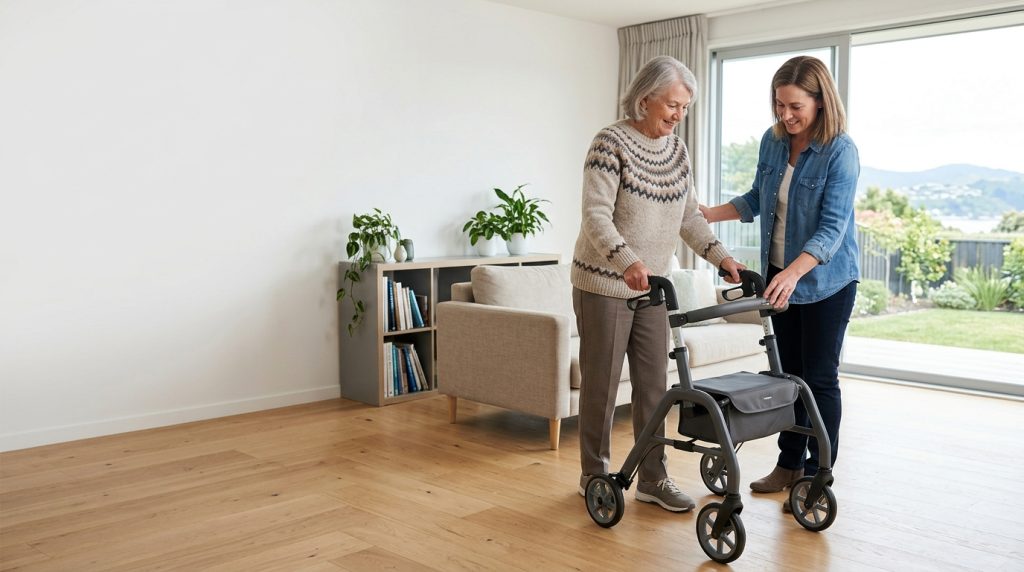
A four-wheel rollator usually moves more freely and can be practical for longer distances.
However, your parent should be able to:
- Reach the brake levers comfortably
- Squeeze the brakes
- Slow the frame gradually
- Stop it reliably
- Lock the parking brakes
- Release the brakes again
- Turn without losing control
Do not assume hand brakes will be easy for everyone.
Reduced grip strength, painful hands or poor coordination can make some brake systems difficult to operate.
Whenever possible, let your parent test the brakes before buying.
6. Decide Whether a Seat Is Really Needed
A built-in seat is one of the most attractive rollator features.
It can be extremely useful when your parent becomes tired while:
- Shopping
- Attending appointments
- Walking around retirement villages
- Visiting parks
- Waiting in queues
- Walking longer hallways
But a seat also adds size, weight and complexity.
A rollator with a seat is not automatically better than a simpler walking frame.
If you are deciding between the two, read our walking frame with seat vs standard frame comparison.
Before Choosing a Seat, Check
- Can your parent lock both brakes?
- Can they turn safely before sitting?
- Can they lower themselves in a controlled way?
- Is the seat height suitable?
- Can they stand up again without pulling the frame dangerously?
- Will they actually use the seat?
A seat that is never used may simply make the frame heavier and harder to transport.
7. Check Frame Weight, Folding and Car Transport
Walking-frame weight matters for a different reason than user weight capacity.
Ask who will regularly:
- Fold the frame
- Carry it down steps
- Lift it into a car boot
- Remove it from the vehicle
- Store it at home
A strong outdoor rollator may feel excellent while walking but weigh too much for your parent to lift independently.
If a family member always transports the frame, this may be less important.
If your parent drives or travels independently, it can become one of the most important specifications.
Do Not Trust the Word “Foldable” Alone
A product can technically fold and still be:
- Heavy
- Wide when folded
- Difficult to collapse
- Awkward to lift
- Too large for a small car boot
Check the actual folded dimensions and product weight.
8. Check Weight Capacity, Handles and Everyday Features
A walking frame should have a stated maximum user weight or safe working load.
Do not estimate this from how thick or strong the frame looks.
Check the manufacturer’s or retailer’s stated specification.
Handle Comfort
Your parent may hold the handles for long periods.
Check whether:
- The grip feels comfortable
- The handle is too thick or too narrow
- The brake lever is within easy reach
- The wrist remains in a comfortable position
- Hand pain develops after several minutes
Storage Bag or Basket
Storage can be very useful for carrying:
- A phone
- Wallet
- Water bottle
- Small shopping items
- Personal belongings
However, accessories also add weight and bulk.
A useful rule is to choose features your parent will actually use rather than buying the model with the longest specification list.
9. Make Sure Your Parent Actually Wants to Use It
This is one of the most overlooked parts of choosing a walking frame for elderly parent support.
Families often focus entirely on technical specifications.
But your parent may care about:
- How the frame looks
- Whether it feels medical
- Colour
- Weight
- Noise
- How easily it folds
- Whether friends use something similar
- Whether it feels like increased independence or increased disability
Those preferences are not trivial.
If two products are both appropriate and safe, the frame your parent feels comfortable using consistently may be the more practical choice.
Style Can Matter
Walking frames no longer need to look identical.
Some models use:
- Modern colours
- Cleaner tubing designs
- Hidden or integrated storage
- Lightweight aluminium
- Carbon-fibre construction
- Less clinical styling
A more attractive design should never replace correct fit or safe operation, but appearance can influence whether someone is willing to use a mobility aid regularly.
Common Mistakes When Children Buy a Walking Frame for a Parent
Buying Without Measuring the House
The frame fits the parent but not the bathroom.
Choosing the Largest Wheels Possible
Large wheels can help outdoors but may add size and weight indoors.
Assuming a Seat Is Always Better
A seat is useful only when the parent needs it and can use it safely.
Ignoring Brake Strength
A brake lever that feels easy to a younger family member may be difficult for someone with reduced hand strength.
Choosing Only by Price
The cheapest frame may be unsuitable, but the most expensive frame may also include unnecessary features.
Buying What the Child Likes Instead of What the Parent Can Use
The person using the walking frame should be involved in the decision whenever possible.
Trying to Make One Frame Do Everything
An indoor frame and outdoor rollator solve different problems.
Not Testing the Frame After Setup
Height adjustment, brakes, folding mechanisms and accessories should all be checked before regular use.
How to Test a Walking Frame Before You Commit
If possible, let your parent test the frame in person.
Ask them to:
- Stand naturally with the frame.
- Check that the shoulders feel relaxed.
- Walk several metres.
- Turn in both directions.
- Stop.
- Use the brakes if fitted.
- Approach a chair.
- Sit and stand using the correct technique.
- Walk through a narrow space.
- Fold the frame if they will need to transport it.
Do not judge the product only from the first few steps.
Some problems become obvious only when turning, braking, sitting or moving through tight spaces.
For step-by-step operating guidance, see our guide to using a walking frame safely.
When a Walking Frame May Not Be the Right Next Step
A walking frame is not the correct solution for every mobility problem.
If your parent needs only light occasional balance support, a cane may be more practical.
If walking even short distances is becoming extremely difficult, a wheelchair or another form of mobility support may need to be considered.
If longer outdoor distances are the main problem but your parent still walks safely around the home, a mobility scooter may solve a different problem from a walking frame.
For a broader overview of these choices, see our mobility aids for seniors in New Zealand guide.
Can You Get a Walking Frame Funded in New Zealand?
Some New Zealanders may be eligible for funded mobility equipment depending on their needs and circumstances.
Health New Zealand advises that a person who cannot walk safely within their own home may be able to receive a walking frame following assessment. A healthcare provider can refer the person to a physiotherapist for advice and assessment.
You can read the current information on the Health New Zealand walking frames page.
If the mobility need is related to an injury covered by ACC, ACC may also provide or contribute to appropriate aids and equipment depending on the individual claim and assessed need.
See ACC’s information about aids and equipment for current details.
Do not buy equipment privately assuming it will later be reimbursed. Check eligibility and the required assessment process first.
Walking Frame for Elderly Parent: Buying Checklist
Before ordering, confirm:
- Why your parent needs walking support
- Whether a walking stick would still provide enough support
- Whether the frame is mainly for indoor or outdoor use
- Correct handle-height range
- Total exterior width
- Width of the narrowest doorway at home
- Turning space
- Wheel size and type
- Whether brakes are needed
- Whether your parent can operate the brakes
- Whether a seat is genuinely needed
- Seat height if applicable
- Maximum user weight
- Total product weight
- Folded dimensions
- Whether it fits the car boot
- Handle comfort
- Useful storage
- Replacement parts or service availability
- Whether your parent actually likes and feels confident using it
This checklist is more useful than simply comparing the number of features.
Final Recommendation
When choosing a walking frame for elderly parent use in New Zealand, start with the person’s real daily routine rather than the product catalogue.
For mainly indoor use, width, turning space and controlled movement may matter most.
For outdoor walking, wheels, brakes, fatigue, seating and folding may become more important.
If your parent travels independently, frame weight can be just as important as walking performance.
If hand strength is limited, brake design may matter more than storage or styling.
And if your parent dislikes the frame enough that they will not use it, even an excellent specification sheet will not solve the problem.
The best walking frame is the one that your parent can use safely, comfortably and consistently in their real environment.
Once you have identified the right type, compare specific products in our best walking frames for seniors in New Zealand guide.
Frequently Asked Questions
What type of walking frame is best for an elderly parent?
It depends on why the frame is needed. A standard or two-wheel frame may provide more controlled indoor support, while a four-wheel rollator may be more practical for longer walks when the user can safely control the brakes.
How do I know if my parent needs a walking frame instead of a walking stick?
A walking frame may be more appropriate when the person needs support through both hands, feels significantly unsteady or requires more stability than a single walking stick provides. Professional assessment can help when the choice is unclear.
Should I buy a walking frame with a seat?
A seat can be useful when your parent becomes tired during longer walks and can safely stop, lock the brakes, turn and sit. If rest breaks are not needed, the seat may simply add weight and size.
What size walking frame should I buy?
The handles should allow relaxed shoulders and slightly bent elbows, but height is only one measurement. Also check overall frame width, user space, seat dimensions where applicable, maximum user weight and home doorway clearance.
Are larger wheels better on a walking frame?
Larger wheels are generally more useful on outdoor and uneven surfaces, but they can make a frame larger and heavier. Small indoor spaces may favour a more compact design.
How heavy should a walking frame be?
There is no single ideal weight. It needs to feel stable while walking but remain manageable for whoever will regularly fold, carry and transport it.
Can my parent sit on a four-wheel walking frame?
Only use a built-in seat according to the manufacturer’s instructions. Parking brakes normally need to be locked before sitting, and a standard rollator should not be used to transport a seated person unless it was specifically designed for that purpose.
Can walking frames be funded in New Zealand?
Some people may qualify for funded equipment following assessment through New Zealand health or disability services. Injury-related mobility equipment may also be available through ACC in eligible cases. Check the current eligibility and assessment process before purchasing privately.