Introduction
Walking frame with seat vs standard frame is an important comparison for seniors in NZ who need more walking support but are unsure which type will suit their mobility, home and daily routine.
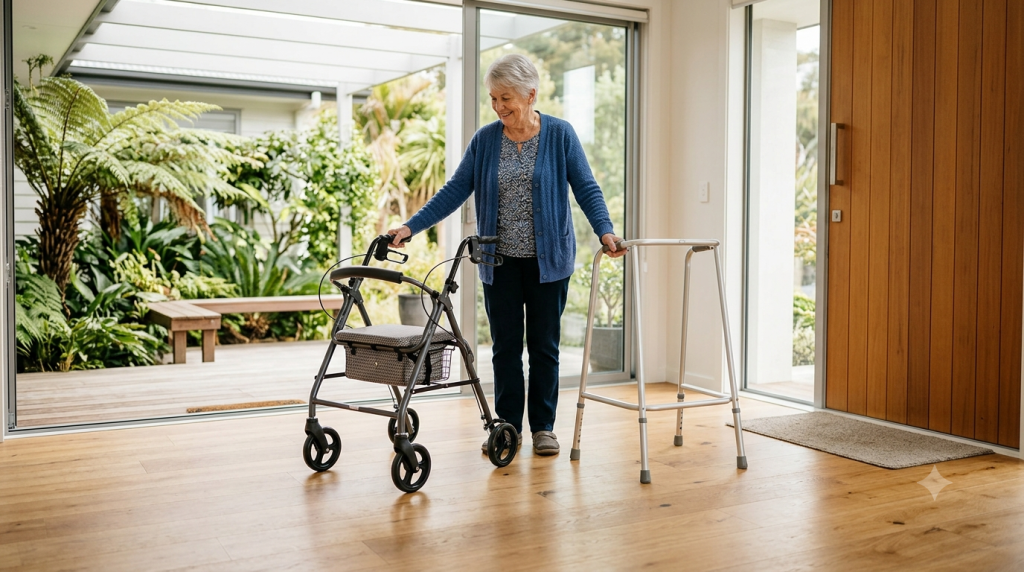
A walking frame with a seat is usually a wheeled rollator with hand brakes, storage and a place to rest. A standard walking frame is generally simpler and may have no wheels or two front wheels. It can provide more controlled support for seniors who need stability rather than speed or outdoor convenience.
Neither option is automatically better. The right choice depends on the senior’s balance, strength, ability to use brakes, walking distance, fatigue, home layout and whether a seat is genuinely needed.
This guide compares walking frames with seats and standard walking frames, explains the main safety and practical differences, and helps families decide which design may be more suitable.
Safety Note
A walking frame should match the user’s balance, strength and walking pattern.
A frame with wheels and a seat may move too freely for someone who needs strong weight-bearing support or cannot operate the brakes safely. A standard frame may provide more controlled movement but may also require enough arm strength to lift or advance it.
Professional advice may be useful if the senior has frequent falls, sudden mobility changes, one-sided weakness, difficulty using brakes, or uncertainty about which frame is appropriate.
Disclosure
This article may contain affiliate links in the future. If you buy through these links, Golden Vibe may earn a small commission at no extra cost to you. We only recommend products that are relevant to senior safety, comfort, mobility and everyday living.
Walking Frame With Seat vs Standard Frame: Quick Comparison
| Feature | Walking Frame With Seat | Standard Walking Frame |
|---|---|---|
| Common design | Three-wheel or four-wheel rollator | No wheels or two front wheels |
| Seat | Usually included | Usually not included |
| Brakes | Hand brakes normally required | Usually no hand brakes |
| Best for | Longer walks, fatigue and outdoor use | Controlled indoor support and stability |
| Movement | Rolls forward continuously | Lifted or advanced in smaller steps |
| Storage | Often includes a bag or basket | Usually limited or unavailable |
| Indoor use | Can be wide in small homes | Often more compact |
| Outdoor use | Better on paths with suitable wheels | Limited on rough surfaces |
| Resting | Built-in seat may allow short rests | Separate chair required |
| Transport | Usually heavier | Often lighter |
| User control | Requires brake and steering control | Requires lifting or pushing control |
| Typical cost | Usually higher | Usually lower |
What Is a Walking Frame With a Seat?
A walking frame with a seat is usually called a rollator.
Most models have:
- Three or four wheels
- Hand brakes
- A built-in seat
- Adjustable handles
- A storage bag or basket
- A folding frame
- A back support strap on some models
This type of walking frame is designed for seniors who can continue walking but need additional balance support, a place to rest, or help carrying small items.
Because the wheels roll continuously, the user needs enough balance, judgement and hand control to steer and brake safely.
What Is a Standard Walking Frame?
A standard walking frame is a simpler mobility aid without a built-in seat.
It may have:
- No wheels
- Two small front wheels
- Four rubber tips
- Height-adjustable handles
- A lightweight aluminium frame
- A folding design
A frame without wheels is usually lifted and placed forward before the senior steps into it.
A two-wheel frame can be pushed forward more easily because the front wheels roll while the rear rubber tips provide resistance.
Standard frames may suit seniors who need slower, more controlled support rather than a fast-moving rollator.
For more detailed guidance on handle height, frame width, seat dimensions and home clearance, read our walking frame size and fit guide for seniors in NZ.
When a Walking Frame With Seat May Be Better
A walking frame with a seat may be more suitable when the senior can walk but becomes tired during longer distances.
The built-in seat allows the person to stop and rest without needing to find a nearby chair. This can be useful during shopping trips, appointments, retirement-village walks or community outings.
Four-wheel rollators may also feel smoother outdoors than standard frames, especially when they have larger wheels.
A Walking Frame With Seat May Suit Seniors Who:
- Become tired during longer walks
- Need a seat for regular rest breaks
- Walk outdoors or in shopping centres
- Can operate hand brakes safely
- Want storage for small items
- Can steer and turn confidently
- Need more support than a walking stick
- Still have reasonable walking ability
Be Careful If:
- The senior cannot use the brakes
- The frame rolls away too easily
- The user leans heavily onto the handles
- Balance is significantly reduced
- The senior forgets to lock the brakes before sitting
- The frame is too wide for the home
- The seat height is unsuitable
A rollator seat should only be used when the brakes are fully locked and the frame is on a stable, level surface.
When a Standard Walking Frame May Be Better
A standard walking frame may be better when the senior needs controlled support for short movements around the home.
Because it does not roll freely, it may feel more stable for seniors who need to move slowly and deliberately. A non-wheeled frame can provide four points of floor contact, while a two-wheel frame may be easier to move without becoming as fast as a four-wheel rollator.
This type of frame may suit seniors moving between a bedroom, bathroom, kitchen and living room.
A Standard Walking Frame May Suit Seniors Who:
- Need stronger stability
- Walk mainly indoors
- Move short distances
- Need support on both sides
- Cannot safely operate hand brakes
- Prefer slower and more controlled movement
- Live in a smaller home
- Do not need a built-in seat
Be Careful If:
- The senior lacks enough arm strength to move the frame
- The frame catches on rugs or door thresholds
- The user steps too far behind the frame
- Longer outdoor walking is required
- A seat is needed for fatigue
- The frame is the wrong height
A standard frame should not be positioned too far ahead of the user. The senior should remain within the support area of the frame.
Which Option Provides More Stability?
A standard non-wheeled walking frame generally offers more controlled floor contact because it does not roll continuously.
This may make it more suitable for some seniors who need strong stability and move slowly.
A walking frame with a seat can still provide useful balance support, but the wheels make it easier to move. The user must control the speed, steering and brakes.
The most stable option therefore depends on the user.
A standard frame may be more stable for someone who needs strong, deliberate support.
A rollator may be more practical for someone who walks reasonably well but needs balance assistance and rest breaks.
Which Option Is Better for Fatigue?
A walking frame with a seat is usually more practical when fatigue is a major concern.
The seat can provide a place to rest during:
- Shopping
- Medical appointments
- Outdoor walks
- Retirement-village activities
- Community events
- Longer hallways
- Waiting periods
However, the senior must be able to:
- Stop on a level surface
- Lock both brakes
- Turn safely
- Sit in a controlled way
- Stand again without the frame moving
If the senior cannot complete these steps safely, the seat may not provide the expected benefit.
Which Option Is Better Indoors?
A standard walking frame is often more practical in smaller indoor spaces.
It may be:
- Narrower
- Lighter
- Easier to position beside furniture
- Easier to use in bedrooms
- More controlled near bathrooms
- Less likely to roll away
A rollator may still work indoors when the home has wide hallways, clear paths and enough turning space.
Before buying, measure:
- Doorways
- Hallways
- Bathroom entrances
- Space beside the bed
- Space around the toilet
- Kitchen pathways
- Turning areas
A frame that does not fit the home will not provide reliable daily support.
Which Option Is Better Outdoors?
A walking frame with a seat is usually better for outdoor walking on smooth or moderately uneven paths.
Four-wheel rollators often have larger wheels than standard walking frames, making them more suitable for:
- Footpaths
- Shopping centres
- Retirement villages
- Parks
- Community areas
- Longer outdoor trips
For gravel, grass, lifestyle blocks or rougher paths, a specialised outdoor or off-road walking frame may be more suitable.
A standard non-wheeled frame is usually less practical outdoors because the rubber tips may catch on uneven surfaces and the user may need to repeatedly lift the frame.
Brakes: The Most Important Rollator Skill
A walking frame with a seat normally uses bicycle-style hand brakes.
The senior should be able to:
- Squeeze both brakes
- Slow the walker gradually
- Stop the walker
- Lock the brakes
- Release the brakes
- Keep control while turning
Hand weakness, arthritis, poor coordination or confusion can make brake use difficult.
Before buying, test:
- How much hand pressure is required
- Whether the brake levers are easy to reach
- Whether both brakes engage evenly
- Whether the parking brakes lock clearly
- Whether the senior understands when to use them
A rollator should not be used as a seat unless both parking brakes are locked. For a complete operating sequence, including standing, slowing, turning and sitting, read our guide on how to use a walking frame safely.
Seat Height and Sitting Safety
The seat should allow the senior to sit with reasonable comfort and foot support.
A seat that is too high may make sitting difficult. A seat that is too low may make standing up harder.
Before sitting, the senior should:
- Stop on a flat surface.
- Lock both brakes.
- Turn slowly.
- Feel the seat behind their legs.
- Reach for stable handles if appropriate.
- Lower themselves in a controlled way.
The rollator should not be used as a wheelchair unless the product was specifically designed and approved for transporting a seated person.
Most standard rollators are resting seats, not transport chairs.
Frame Weight and Transport
Walking frames with seats are normally heavier than standard frames.
The extra weight comes from:
- Wheels
- Brakes
- Seat
- Storage bag
- Backrest
- Stronger frame components
A heavier rollator may feel stable while walking but can be difficult to lift into a car.
Before buying, check:
- Product weight
- Folded size
- Folding mechanism
- Car boot dimensions
- Whether the senior can lift it
- Whether a caregiver will transport it
- Whether parts can be removed
A lightweight standard frame may be easier for home use and occasional transport.
Wheels and Floor Surfaces
Wheel size affects how a walking frame moves.
Small wheels may be suitable for smooth indoor floors.
Larger wheels generally handle outdoor paths and minor surface changes more easily.
Check the main surfaces where the frame will be used:
- Carpet
- Timber
- Vinyl
- Tiles
- Door thresholds
- Concrete paths
- Gravel
- Grass
- Uneven driveways
A rollator that works well in a shopping centre may not be suitable for rough rural ground.
Storage Bags and Carrying Items
Many walking frames with seats include a bag or basket.
This can help seniors carry:
- A phone
- Wallet
- Small shopping items
- Water bottle
- Medication
- Personal belongings
Items should be stored in the designed bag rather than hung from the handles.
Heavy bags hanging from the handles can affect steering, braking and stability.
A standard walking frame usually has less storage, although compatible frame bags may be available.
Walking Frame With Seat vs Standard Frame for Small Homes
In a small home, size can be more important than features.
A large rollator may:
- Block narrow hallways
- Make bathroom access difficult
- Catch on furniture
- Reduce turning space
- Become difficult to store
A compact standard or two-wheel frame may be easier to manage indoors.
However, some seniors use two different walking aids:
- A compact standard frame indoors
- A rollator with a seat outdoors
This can be practical when each device is used in the environment it suits best.
Walking Frame With Seat vs Standard Frame After Surgery
After surgery or injury, the best walking frame should follow professional advice.
Some people may need a standard frame because they need controlled support or have restrictions on how much weight they can place through a leg.
Others may later progress to a rollator as their balance, strength and walking distance improve.
Do not choose a wheeled frame simply because it is easier to push. The safest option depends on the recovery plan and mobility instructions.
When Neither Option Is Enough
If the senior only needs light balance support, our walking stick vs walking frame guide may help clarify whether a full frame is necessary.
A walking frame may not provide enough support if the senior:
- Cannot walk safely even with assistance
- Has severe fatigue
- Falls frequently
- Cannot use the brakes or move the frame
- Needs another person to push them
- Cannot stand from the rollator seat
- Cannot manage longer community distances
- Has significant weakness or poor judgement
Depending on the situation, alternatives may include:
- A wheelchair
- A transit chair
- A mobility scooter
- A caregiver-assisted walking device
- A transfer aid
- Professional rehabilitation equipment
The aim is not to keep using a walking frame at all costs. The aim is to choose the safest practical mobility option.
What to Look For Before Buying
1. User Stability
Decide whether the senior needs controlled support or convenient mobility.
2. Brake Ability
A rollator requires reliable hand-brake control.
3. Need for a Seat
Choose a seated model only when rest breaks are genuinely useful and sitting can be done safely.
4. Indoor Space
Measure the home before buying.
5. Outdoor Routine
Consider whether the senior walks on smooth paths, grass, gravel or uneven ground.
6. Handle Height
Handles should allow a comfortable arm position without excessive bending.
7. Seat Height
The senior should be able to sit and stand safely.
8. Frame Width
Check doorways, bathrooms and turning space.
9. Product Weight
Consider storage, folding and car transport.
10. Maximum User Weight
The frame should safely support the intended user.
11. Wheel Size
Larger wheels generally suit outdoor use better.
12. Professional Advice
Seek advice when mobility needs are complex or changing.
Buying Checklist
Before choosing between a walking frame with a seat and a standard frame, ask:
- Does the senior need strong stability or easier movement?
- Will the frame be used mainly indoors or outdoors?
- Does the senior become tired while walking?
- Is a seat needed?
- Can the senior lock and release hand brakes?
- Can they stand safely from the seat?
- Does the frame fit through home doorways?
- Is the frame easy enough to turn?
- Can it be folded and transported?
- Are the wheels suitable for the walking surface?
- Is the handle height adjustable?
- Is the maximum user weight suitable?
- Would two different frames be useful?
- Is professional assessment needed?
Common Mistakes
Choosing a Seat Without Checking Brake Ability
A seat is only useful when the senior can stop and lock the frame safely.
Assuming More Wheels Means More Stability
Wheels improve movement but can reduce controlled resistance.
The right design depends on the user.
Buying a Large Rollator for a Small Home
A frame that cannot move through the bathroom or bedroom becomes impractical.
Measure first.
Using the Rollator as a Wheelchair
Most rollators are not designed to transport someone while seated.
Follow the manufacturer’s instructions.
Hanging Bags From the Handles
Extra weight on the handles can affect balance and steering.
Use the designed storage area.
Ignoring Frame Height
Incorrect handle height can affect posture, comfort and control.
Choosing Based Only on Price
A lower-cost frame is not good value if it does not match the senior’s needs.
When to Seek Professional Advice
Professional advice may be useful if the senior:
- Has frequent falls or near-falls
- Has sudden mobility changes
- Is recovering from surgery or injury
- Needs strong weight-bearing support
- Cannot use rollator brakes safely
- Has weakness on one side
- Struggles to stand from the rollator seat
- Uses furniture for additional support
- Is unsure whether to choose a frame, wheelchair or scooter
- Needs funded or specialist equipment
- For a broader comparison of walking aids, wheelchairs, scooters and home mobility products, read our guide to mobility aids for seniors in NZ.
A physiotherapist, occupational therapist, doctor, nurse or mobility equipment specialist can help match the walking aid to the senior’s abilities and environment.
For a wider review of lighting, bathroom safety, footwear and walking support, see our guide to fall prevention products for seniors in NZ.
For New Zealand information about walking and standing equipment assessment, visit Enable New Zealand.
FAQ
Is a walking frame with a seat better than a standard frame?
A walking frame with a seat is usually better for seniors who can walk reasonably well but become tired and need rest breaks. A standard frame may be better for seniors who need slower, more controlled support.
Are walking frames with seats safe for elderly people?
They can be safe when the senior can steer, brake, turn and sit correctly. Both parking brakes should be locked before sitting.
Is a standard walking frame more stable?
A non-wheeled standard frame may provide more controlled floor contact because it does not roll continuously. However, the safest option depends on the senior’s strength and walking pattern.
Can a rollator be used indoors?
Yes, provided it fits through doorways and has enough space to turn. A compact standard frame may be easier in very small homes.
Can someone be pushed while sitting on a rollator?
Most rollators are not designed to carry a seated person while being pushed. A transit chair or combination rollator-transport chair is more appropriate when seated transport is needed.
Should seniors use two different walking frames?
Some seniors use a compact standard frame indoors and a rollator with a seat outdoors. This can be practical when each frame suits its intended environment.
Final Recommendation
A walking frame with a seat is usually the better option for seniors who can walk safely, use hand brakes and need rest breaks during longer indoor or outdoor trips.
A standard frame may be more suitable when the senior needs controlled stability, walks mainly around the home and does not need a built-in seat.
Do not choose based only on the number of features. The best frame is the one that matches the senior’s balance, brake ability, fatigue, walking surfaces, home layout and ability to use it consistently.
For specific models, wheel sizes and product options, read our guide to walking frames for seniors in NZ.