Introduction
A bath board for seniors can make a shower-over-bath easier to use when stepping fully into the bathtub or standing for the entire shower has become difficult.
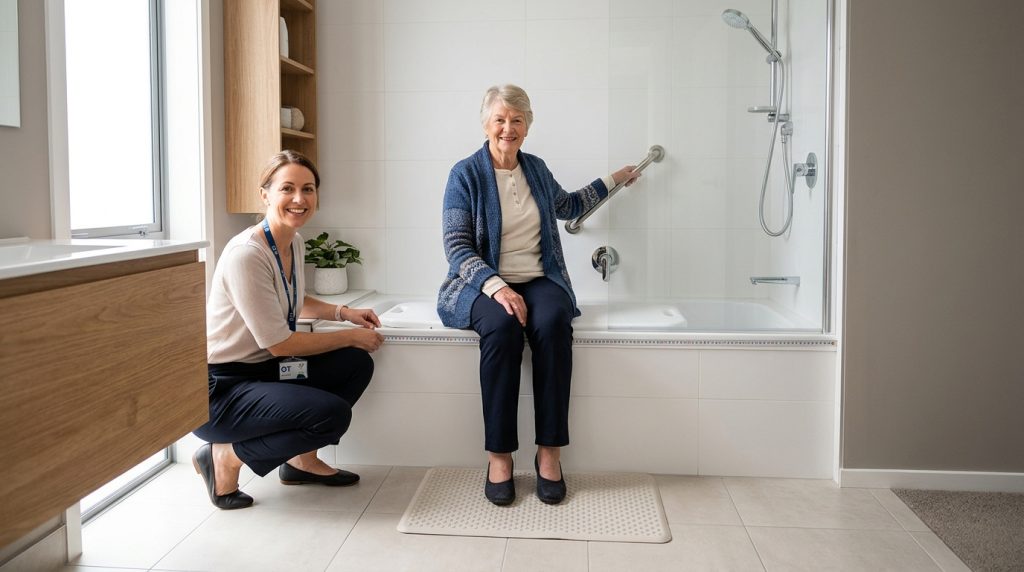
A bath board sits across the top of the bath and provides a stable surface for the user to sit on before moving the legs over the side.
This can reduce the need to stand while lifting one leg over a high bath edge.
However, a bath board is only useful when it fits the bath correctly.
The board must match the bath width, sit securely on suitable bath rims, remain stable during transfers and support the user’s weight.
Some bath shapes, shower-door tracks and freestanding baths may not be suitable for a standard bath board at all.
This guide explains seven practical checks New Zealand seniors and families can use before choosing and using a bath board.
Safety Note
Bath transfers can involve significant balance, hip and leg movement.
Professional advice may be appropriate when the senior:
- Has fallen in or beside the bath
- Needs another person to lift or lower them
- Cannot move the legs over the bath edge
- Has major weakness on one side
- Uses a wheelchair
- Has severe hip or knee restrictions
- Has recently had surgery
- Cannot sit unsupported
- Has significant pain during transfers
- Has rapidly changing mobility
- Has confusion or difficulty following instructions
- Is unsure whether the bath can safely accept a board
An occupational therapist can assess the user, bath, board, grab rails and transfer technique together.
Disclosure
This article may contain affiliate links in the future. If you buy through these links, Golden Vibe may earn a commission at no additional cost to you.
Golden Vibe has not personally fitted every bath board available in New Zealand.
Always check the exact product dimensions, maximum user weight, bath compatibility and manufacturer installation instructions before buying.
Quick Answer
A correctly fitted bath board should:
- Match the width of the bath
- Sit securely on both bath rims
- Remain flat and stable
- Not extend dangerously beyond the bath edge
- Match the user’s weight
- Leave enough room for the transfer
- Work with appropriate hand support
- Allow the user to shower while seated
- Be inspected regularly for movement or wear
Health New Zealand advises that a bath generally needs a suitable rim on both sides for a standard bath board to be fitted securely.
The board also needs to match the bath rather than simply being chosen by its advertised length.
The 7 Main Bath Board Fit and Use Checks
| Check | What to Review | Why It Matters |
|---|---|---|
| 1. Correct use | Shower-over-bath and transfer needs | A bath board does not solve every bathing problem |
| 2. Bath rim | Suitable support on both sides | The board needs a stable surface |
| 3. Board length | Match the measured bath width | Prevents poor fit and overhang |
| 4. Bath shape | Straight sides, tracks and rim design | Some baths are incompatible |
| 5. User weight | Product maximum capacity | Prevents overloading |
| 6. Support equipment | Grab rails, handheld shower and non-slip surface | Makes the full routine more practical |
| 7. Transfer and inspection | Safe technique and regular checks | Confirms the setup remains stable |
1. Check Whether a Bath Board Solves the Right Problem
A bath board is mainly useful when the home has a shower over a bath and the senior finds the bath edge difficult to step over.
Instead of stepping into the bathtub while standing, the user can sit on the board first and then bring the legs over the side.
This may help someone who:
- Has difficulty lifting the legs
- Has reduced hip or knee movement
- Becomes tired while standing
- Feels unsteady stepping over the bath edge
- Wants to shower while seated
- Is recovering from an injury
- Needs a simpler solution than a full bathroom renovation
A bath board does not turn every bath into an accessible shower.
The senior still needs enough movement and control to sit, reposition and bring the legs across the bath side.
Bath Board vs Shower Chair
A bath board and shower chair solve different bathroom layouts.
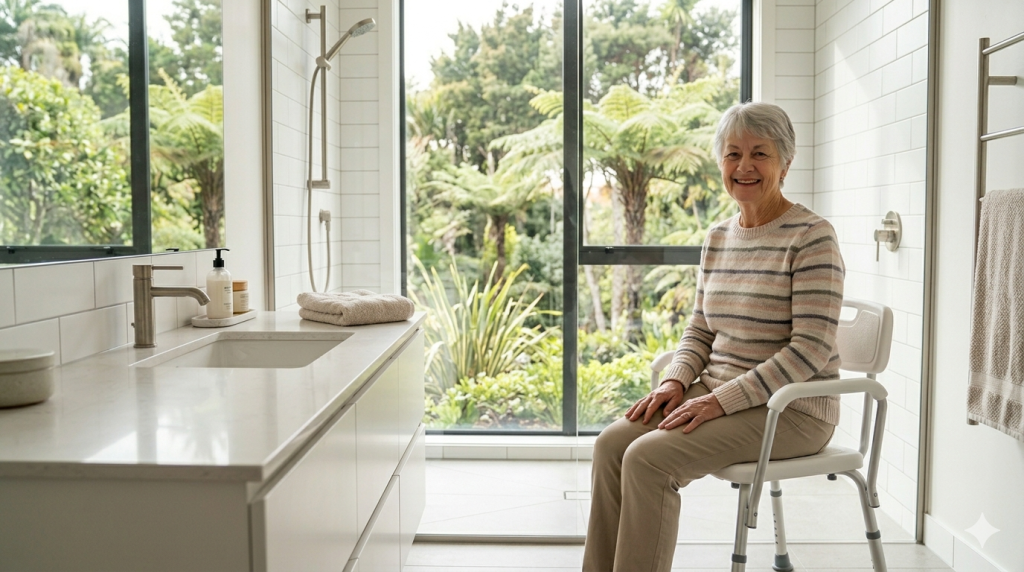
A shower chair normally sits on the floor inside a walk-in shower or shower enclosure.
A bath board spans across a bathtub.
A bath board is therefore more relevant when:
- The shower is located over the bath
- There is no separate shower enclosure
- Standing inside the bath feels difficult
- The senior cannot comfortably step fully into the bath
If the home has a conventional walk-in shower, a shower chair or shower stool may be more appropriate.
For current seating options for separate showers, read our shower chairs for seniors in NZ guide.
Bath Board vs Bath Seat
A bath board sits across the top of the bath.
A bath seat may sit lower inside the bath.
The lower position can require more movement when sitting down and standing again.
A board is commonly used for seated showering rather than lowering the user deep into bathwater.
The right option depends on what the senior is trying to do.
2. Check the Bath Rim Before Buying
The bath needs enough solid rim on both sides to support the board.
Health New Zealand advises that, for the type of bath board covered in its guidance, the bath should have a rim of at least approximately 2cm on both sides.
That rim provides the surface on which the board rests.
Before buying, look carefully at both long sides of the bathtub.
Check whether the rim is:
- Wide enough
- Flat enough
- Strong
- Continuous
- Free from obstructions
- Similar on both sides
Do not assume that every bathtub has a suitable rim.
What If the Rim Is Very Narrow?
A narrow rim may not provide enough support for a standard bath board.
Do not compensate by allowing the board to balance partly on an unsuitable edge.
If the rim is too narrow or unusual, ask an occupational therapist or appropriate equipment supplier about other options.
Shower-Door Tracks
Some shower-over-bath setups have a glass screen or sliding shower-door track mounted along the bath edge.
Health New Zealand advises against installing a standard bath board where a shower-door track interferes with the side of the bath.
The track can prevent the board from sitting flat and securely.
Check both sides before ordering.
3. Measure the Bath Width Correctly
Do not buy a bath board from a product photograph or by guessing that the bath is a “standard size”.
Measure first.
Health New Zealand recommends measuring the bath across its width so the selected board is appropriate for the real bath.
Depending on the bath design, measure across the usable top area where the board will actually sit.
Use a firm measuring tape.
Record the measurement in millimetres.
Then compare it with:
- Overall board length
- Manufacturer adjustment range
- Position of the fixing brackets
- Minimum and maximum bath width
- Required rim width
Do Not Use the Board Length Alone
A board listed as 700mm long does not automatically mean it fits every bath that appears to be around 700mm wide.
The fixing system matters too.
The underside brackets usually need to sit securely against the inside of the bath.
Check the complete fitting range.
Board Overhang
Health New Zealand warns against installing a bath board that sticks out beyond the edge of the bath in an unstable way.
The board should sit securely across the bath rather than acting like an unsupported shelf.
If the product does not match the bath dimensions, choose another size.
Do not improvise.
How to Measure a Bath for a Board
Use this sequence:
- Remove loose items from around the bath.
- Identify the exact location where the board will sit.
- Check that both bath rims are usable.
- Measure across the bath.
- Check the product’s compatible bath-width range.
- Check the underside bracket adjustment.
- Confirm that the board will not interfere with taps or the shower screen.
- Confirm the board does not project unsafely beyond the bath.
- Check the maximum user weight.
- Follow the manufacturer’s fitting instructions.
Take photographs of the bath measurements if discussing compatibility with a retailer.
4. Check the Bath Shape
Bath shape is just as important as width.
A standard rectangular built-in bath with straight sides is generally easier to match with a bath board than an unusual designer bath.
Health New Zealand identifies several layouts that need extra caution.
Curved Baths
A bath with strongly curved edges or sides may not allow the board’s brackets to grip correctly.
The board may:
- Rock
- Slide
- Sit at an angle
- Fail to contact the bath properly
Do not force a standard rectangular board onto a curved bath.
Freestanding Baths
Freestanding baths vary widely in shape and rim design.
Health New Zealand advises speaking with an occupational therapist about whether a bath board can be used with this type of bath.
Some may require a different solution.
Baths With Uneven Rims
Check for:
- Raised decorative edges
- Sloping rims
- Built-in handles
- Shower tracks
- Taps positioned in the board area
- Different rim heights
The board needs a stable, predictable support surface.
Bath Board in a Small Bathroom
Bath boards do not take up floor space in the same way as a freestanding shower chair.
That can be useful in a compact bathroom.
However, you still need enough space beside the bath for the senior to:
- Approach
- Turn
- Stand with the back to the bath
- Sit down
- Move the legs
- Stand again afterwards
- Reach a walking aid if used
Do not focus only on whether the board itself fits.
The transfer space must also fit.
5. Check the Maximum User Weight
Every bath board has a maximum user-weight specification.
Check the exact product.
Do not assume all boards have the same capacity because they look similar.
The user should remain within the manufacturer’s stated limit.
Also inspect whether the bath itself and surrounding fittings are in good condition.
If the bath is damaged, poorly supported or unusually flexible, seek appropriate advice before relying on additional equipment.
Do Not Modify the Board
Avoid improvised changes such as:
- Cutting the board
- Drilling new holes
- Adding household blocks
- Using extra rope or straps
- Removing brackets
- Attaching unapproved handles
These changes may affect stability or the product’s rated performance.
Use a board designed to fit the actual bath.
6. Set Up the Rest of the Showering Equipment
A bath board works best as part of a complete shower-over-bath setup.
Health New Zealand recommends combining a bath board with practical supporting equipment such as:
- A handheld shower
- Non-slip matting
- Handrails
These products solve different parts of the routine.
Handheld Shower Head
A handheld shower allows the senior to remain seated on the board while directing water where needed.
The handset should be reachable without:
- Standing unexpectedly
- Stretching overhead
- Twisting sharply
- Leaning far into the bath
The hose also needs enough length to reach the seated position without lying dangerously across the transfer route.
For hose length, handset grip and seated-showering options, read our handheld shower heads for seniors in NZ guide.
Add Proper Hand Support
A bath board itself should not automatically be treated as a grab rail.
The senior may need a properly installed rail for:
- Approaching the bath
- Sitting down
- Moving the legs
- Repositioning
- Standing again
The best rail position depends on the senior’s natural reach and transfer direction.
For bath, shower and toilet positioning, read our grab bar placement for seniors guide.
Use a Non-Slip Surface
A bath board reduces standing time, but the user’s feet may still contact the bath floor during parts of the routine.
A suitable non-slip mat can improve footing when it is compatible with the bath surface.
The mat should:
- Sit flat
- Grip correctly
- Drain
- Remain clean
- Not curl
- Not interfere with the board transfer
For current mat types and grip considerations, read our non-slip bathroom mats for seniors in NZ guide.
Keep the Shower Controls Reachable
The senior should not need to stand from the board simply to turn the water on or off.
Check whether the user can reach:
- Mixer controls
- Handheld shower
- Soap
- Shampoo
- Towel
from a stable position.
A complete bathroom setup should reduce unnecessary reaching and twisting.
7. Test the Complete Bath Board Transfer
The board should be tested during the actual sequence the senior will use.
Health New Zealand describes a transfer where the user begins standing with the back towards the bath, sits onto the board and then brings the legs over the side.
The exact technique may vary for the individual.
Getting Onto the Bath Board
A typical sequence may include:
- Approach the bath.
- Turn so the back is towards the bath.
- Step backwards until the bath can be felt behind the legs.
- Reach for appropriate support.
- Sit onto the bath board.
- Move farther onto the board.
- Bring one leg over the bath edge.
- Bring the other leg over.
- Reposition toward the middle of the board.
The user should move slowly.
Do not rush the leg movement.
Getting Off the Bath Board
When finished:
- Bring the leg nearest the outside of the bath over the side.
- Place the foot securely on the bathroom floor.
- Move the body toward the edge.
- Bring the second leg over.
- Position both feet.
- Use appropriate hand support.
- Stand in a controlled way.
- Pause before walking away.
The bathroom floor outside the bath should be dry and clear.
After Hip, Knee or Other Surgery
The normal transfer technique may not be appropriate after surgery.
The senior may have restrictions on:
- Hip movement
- Weight bearing
- Twisting
- Leg lifting
- Sitting position
Health New Zealand advises discussing bath-board use with an occupational therapist when the person has recently had surgery or injury.
Follow the healthcare team’s instructions rather than a generic online transfer sequence.
Check the Board Before Every Use
Before sitting down, check that the bath board:
- Is in the correct position
- Does not rock
- Does not slide
- Has not moved sideways
- Still fits tightly
- Has no obvious damage
- Has no loose brackets
A few seconds of checking is worthwhile.
Weekly Inspection
Health New Zealand recommends checking the condition and fit of a bath board regularly and specifically advises at least weekly inspection.
Check for:
- Loose fittings
- Wobbling
- Cracks
- Damage
- Worn adjustment parts
- Loss of grip
- Movement on the bath rim
If the board becomes loose or unstable, stop using it until the problem is resolved.
Cleaning the Bath Board
Soap residue can make bathroom equipment slippery.
Clean:
- Top surface
- Underside
- Brackets
- Grip points
- Handle if fitted
Dry the board after use.
Avoid abrasive cleaning products when the manufacturer advises against them.
Regular cleaning also makes it easier to notice damage.
Bath Board With a Handle
Some bath boards include an integrated handhold.
This may help with repositioning.
However, an integrated handle does not automatically replace a properly installed wall grab rail.
Check:
- Maximum load
- Handle position
- User reach
- Product instructions
The senior should not need to twist excessively to use it.
Bath Board for Shorter Seniors
A shorter senior may have more difficulty reaching the floor when sitting on a high bath setup.
Check whether:
- The outside foot can reach the bathroom floor during transfer
- The user can sit far enough onto the board
- The legs can move over the bath edge
- The board position suits the person’s reach
Do not assume the bath board works simply because it fits the bathtub.
Bath Board for Taller Seniors
A taller senior may find leg movement easier in some baths but may need more room outside the bath to turn and sit.
Check:
- Knee clearance
- Distance to the wall
- Shower-screen position
- Tap position
- Board width
- Grab-rail reach
Body size and bathroom fit both matter.
Bath Board and Walking Frames
A walking frame can help the senior reach the bathroom, but it should not be used as an unstable object to pull on while lowering onto the bath board.
Position the frame so it:
- Does not block the transfer
- Does not roll away into the wet area
- Is available again after the senior stands
- Does not become a trip hazard
Use fixed appropriate hand support when the senior needs something to hold during the transfer.
Bath Board in Rental Homes
A bath board can be attractive in a rental because the board itself may not require permanent structural changes.
However, other equipment such as fixed grab rails may require landlord approval.
Do not substitute an unreliable support product simply to avoid permanent installation.
If the senior needs significant transfer support, discuss appropriate options with an occupational therapist.
Bath Board vs Bathroom Renovation
A bath board can be a practical relatively simple option when:
- The current shower-over-bath can still be used
- The senior can perform the seated transfer
- The bath is compatible
- Major renovation is not necessary
A bathroom modification may be more appropriate when:
- The senior cannot move the legs over the bath
- Wheelchair access is needed
- A caregiver needs substantial space
- The bath is incompatible with safe equipment
- Mobility is expected to decline significantly
- A level-access shower is required
Equipment should solve the real problem rather than delay a necessary bathroom review.
Common Bath Board Mistakes
Buying Without Measuring the Bath
Board length alone does not guarantee fit.
Ignoring the Bath Rim
The board needs suitable support on both sides.
Installing Over a Shower-Door Track
The board may not sit securely.
Using a Board on a Curved Bath
The brackets may not grip correctly.
Letting the Board Hang Over the Edge
An unsupported overhang can make the setup unstable.
Ignoring the Weight Limit
Check the exact product rating.
Assuming the Board Is a Grab Rail
Use appropriate hand support where needed.
Standing on the Bath Board
A bath board is designed as seating equipment, not a step.
Skipping Regular Checks
Fittings can loosen and equipment can wear.
Leaving Soap Residue
A dirty board can become slippery.
Using the Same Technique After Surgery
Transfer instructions may need to change.
Assuming a Bath Board Works for Everyone
Some seniors need different equipment or a level-access shower.
When to Seek Professional Advice
Consider an occupational therapist or appropriate healthcare professional when the senior:
- Has fallen
- Has frequent near-falls
- Cannot lift the legs over the bath
- Needs physical assistance
- Uses a wheelchair
- Has significant one-sided weakness
- Has severe hip or knee limitations
- Has recent surgery
- Uses unusual bathing equipment
- Has a curved or freestanding bath
- Has a shower-door track that affects the rim
- Cannot find a stable board fit
- Has cognitive changes
- Needs bathroom renovation
An occupational therapist can assess both the equipment and the way the senior actually moves.
Official New Zealand Guidance
Health New Zealand provides specific guidance on choosing, fitting and using bath boards.
Its current guidance explains that suitability depends on the bath style and dimensions, the user’s weight and the way the board fits across the bath.
It also recommends:
- Appropriate bath-rim support
- Measuring before choosing a board
- Avoiding unstable overhang
- Avoiding unsuitable bath shapes and shower tracks
- Correct transfer technique
- Regular fitting checks
- Cleaning and drying the board
For a broader review of flooring, shower seating, rails, toilets, lighting and bathroom transfers, read our bathroom safety checklist for seniors in NZ.
Final Recommendation
A bath board for seniors can be a practical solution when a shower-over-bath is still usable but stepping fully into the bathtub has become difficult.
Before buying, check:
- Whether a bath board solves the actual problem
- Bath rim width
- Bath shape
- Bath width
- Board adjustment range
- Maximum user weight
- Shower-door tracks
- Hand support
- Non-slip surface
- Handheld shower reach
- Transfer space
The board should sit firmly and remain stable during the complete transfer.
Do not force a standard bath board onto an incompatible curved, freestanding or obstructed bath.
For separate walk-in showers, compare our shower chairs for seniors in NZ guide.
For bathroom rail positioning, use our grab bar placement for seniors guide.
For shower-over-bath water reach, see our handheld shower heads for seniors in NZ guide.
The best bath board is not simply the longest or strongest-looking model.
It is the board that fits the actual bath, supports the user and works safely with the complete bathing routine.
Frequently Asked Questions
What is a bath board?
A bath board is a seat that spans across the top of a bathtub so a person can sit while showering and transfer the legs over the bath edge from a seated position.
Are bath boards safe for seniors?
They can be useful when correctly fitted to a compatible bath and used by someone who can perform the transfer safely.
How do I measure for a bath board?
Measure the bath where the board will sit and compare the measurement with the board’s stated bath-width and bracket-adjustment range.
How wide should the bath rim be?
Health New Zealand advises that the type of bath board described in its guidance needs a bath rim of at least approximately 2cm on both sides.
Can I use a bath board on a curved bath?
Health New Zealand advises against installing a standard board where curved edges or sides prevent secure fitting.
Can a bath board be used on a freestanding bath?
Some freestanding baths may require another solution. Health New Zealand recommends discussing suitability with an occupational therapist.
Can I install a bath board over a shower-door track?
A shower-door track can prevent secure fitting and is identified by Health New Zealand as a reason not to install a standard bath board in that position.
Should a bath board stick out past the bath?
The board should not create an unstable unsupported overhang.
Choose a size that fits the bath correctly.
Can I stand on a bath board?
No.
A bath board is seating equipment and should not be used as a step.
Do I still need a non-slip mat?
A non-slip surface may still be useful because the user’s feet can contact the bath during showering and transfers.
Is a handheld shower useful with a bath board?
Yes.
A handheld shower allows the senior to direct the water while remaining seated.
Is a bath board better than a shower chair?
They suit different bathrooms.
A bath board is designed for shower-over-bath setups, while a shower chair usually sits inside a separate shower area.
How often should a bath board be checked?
Health New Zealand advises regular checking and recommends checking its condition and fit at least weekly.
When should I ask an occupational therapist?
Professional advice is useful when the bath is unusual, the senior has fallen, transfers are difficult, surgery has occurred or the board cannot be fitted confidently.