Introduction
Daily living aids for seniors can make small everyday tasks easier when bending, reaching, gripping or getting dressed becomes uncomfortable or difficult.
Not every useful mobility product needs to be a walking frame, wheelchair or large piece of home equipment.
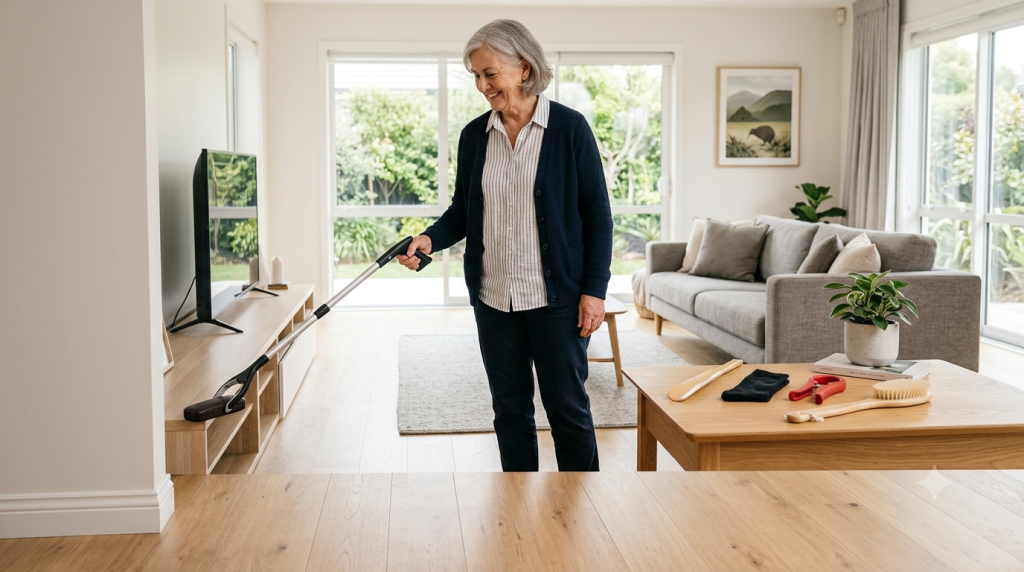
A lightweight reacher may help pick something up from the floor. A sock aid or long shoe horn can reduce the need to bend towards the feet. A simple jar opener can reduce the grip and twisting effort needed in the kitchen.
These products are often inexpensive, compact and easy to introduce into an existing routine.
This guide compares practical daily living aids available in New Zealand and explains which type may help with reaching, dressing, footwear, grooming and kitchen tasks.
Safety Note
A daily living aid should make a task easier without creating a new risk.
Do not use a reacher to lift heavy, hot, sharp or fragile objects unless the product is specifically designed for that task.
A long-handled aid can reduce bending, but it should not be used as a substitute for walking support, a grab bar or a transfer aid.
If a senior has suddenly lost strength, is falling frequently, cannot safely dress or move independently, or experiences significant pain while completing everyday tasks, professional assessment may be more appropriate than simply buying more equipment.
Disclosure
This article may contain affiliate links in the future. If you buy through these links, Golden Vibe may earn a commission at no additional cost to you.
Golden Vibe has not physically tested every daily living aid listed below.
Product information is based on publicly available information from New Zealand mobility and independent-living retailers. Prices, stock and specifications may change, so confirm current details before purchasing.
How We Selected These Daily Living Aids
We looked for products that solve a clear everyday problem rather than simply adding more equipment to the home.
We considered:
- Ease of use
- Amount of bending or reaching reduced
- Grip requirements
- Product length
- Product weight
- Ease of cleaning
- Storage
- Suitability for common home tasks
- Simplicity of setup
- New Zealand availability
- Current retailer information
- Whether a simpler option could solve the same problem
The best daily living aid is usually the one that solves one specific task reliably and is simple enough to use every day.
Quick Recommendations
| Product | Best For | Price Guide | Why It May Help | Where to Check |
|---|---|---|---|---|
| Aluminium Reacher | Best overall reacher | Around $34 | Lightweight, 66cm or 81cm length, reduces bending and high reaching | Mobility Plus |
| Pistol Grip Reacher | Best for easier trigger control | Around $40 | Wide jaw, pistol-style grip, hook and magnetic tip | Mobility Plus |
| Sock Aid | Best dressing aid | Around $30 | Helps put socks on from a seated position without reaching the feet | Mobility Plus |
| Super Strong Long Metal Shoe Horn | Best footwear helper | Around $25 | 60cm handle reduces bending when putting on shoes | Mobility Plus |
| Long-Handled Comb & Brush Set | Best grooming aid | Around $40 | Longer handles reduce shoulder and arm reach during hair care | Mobility Plus |
| JarKey Jar Opener | Best low-cost kitchen helper | Around $13 | Releases the vacuum seal before the lid is unscrewed | Mobility Centre |
Best Overall Reacher: Aluminium Reacher
A lightweight aluminium reacher is one of the most versatile daily living aids for seniors.
It can help retrieve light items from:
- The floor
- Low shelves
- High shelves
- Behind furniture
- Under a bed
- The back of a cupboard
The current Mobility Plus model is available in approximately 66cm and 81cm lengths.
The shorter version may feel easier to control, while the longer model provides greater reach.
A reacher can be particularly useful when repeated bending is difficult.
For example, instead of bending to retrieve a dropped piece of clothing, the senior may be able to pick it up while remaining upright.
Good For
- Picking up light dropped items
- Reaching into low cupboards
- Reaching higher shelves
- Retrieving clothing
- Reducing repeated bending
- Bedroom and living-room use
- Seniors with reasonable hand control
Be Careful If
- The item is heavy
- The object is hot
- Glass or sharp objects are involved
- The senior tries to use the reacher for balance
- The trigger is difficult to squeeze
- The senior overreaches while standing
- A stool is used at the same time
A reacher should extend the user’s reach, not encourage them to stretch beyond a stable standing or seated position. Check the current lengths, price and availability of the Aluminium Reacher at Mobility Plus NZ.
Best for Easier Trigger Control: Pistol Grip Reacher
The Pistol Grip Reacher uses a contoured trigger-style handle and a wider gripping jaw.
The current model is available in approximately 60cm and 75cm lengths.
It also includes a hook and magnetic tip, which can be useful for retrieving small lightweight items such as keys.
The pistol-style trigger may suit someone who prefers using several fingers together rather than operating a narrow lever.
However, hand comfort varies considerably between users.
A person with weak grip, painful fingers or reduced hand movement should ideally test the trigger rather than assuming one handle design will be easiest.
Good For
- Everyday household objects
- Keys
- Clothing
- Remote controls
- Light items behind furniture
- Users wanting a wider jaw
- People who prefer a pistol-style trigger
Be Careful If
- Hand pain makes the trigger difficult
- The senior wants to lift heavy objects
- The magnetic tip is assumed to work on every metal
- The reacher is used for support
- The longest model feels difficult to control
- The item could break if dropped
A longer reacher gives more range but can also make precise control more difficult. View the current 60cm and 75cm Pistol Grip Reacher options at Mobility Plus NZ.
Best Dressing Aid: Sock Aid
A sock aid helps a person put on socks without needing to bend all the way towards their feet.
The sock is placed over the aid while the user is seated.
The device is then lowered towards the foot using the long handles, allowing the foot to slide into the sock before the aid is pulled away.
The current Mobility Plus model has an overall length of approximately 90cm and uses a terrycloth-covered flexible frame with a smoother interior.
This type of aid may be useful when the senior has difficulty:
- Reaching their toes
- Bending at the waist
- Bringing one leg upwards
- Maintaining balance while dressing
- Putting on socks after surgery or reduced mobility
Good For
- Dressing while seated
- Seniors with reduced flexibility
- People who struggle to reach their feet
- Everyday socks
- Reducing bending during morning routines
- Maintaining more independence when dressing
Be Careful If
- The senior cannot position the sock on the aid
- Hand coordination is limited
- Compression socks are being used
- The user attempts to dress while standing
- The sock catches or twists
- Another person is still required for safe dressing
Compression garments may need different equipment or professional advice because they can require substantially more force to apply than normal socks. Check the current price and product details of the Sock Aid at Mobility Plus NZ.
For seniors who also need safer indoor footwear, our non-slip slippers for seniors in NZ guide explains grip, heel support and easier-to-fit designs. If you are unsure whether slippers, indoor shoes or grip socks are more suitable, see our safe indoor footwear for seniors guide.
Best Footwear Helper: Super Strong Long Metal Shoe Horn
A long shoe horn can reduce the amount of bending needed when putting on shoes.
The current Mobility Plus metal shoe horn is approximately 60cm long.
Instead of reaching directly towards the heel, the senior can remain more upright while guiding the foot into the shoe.
This can be particularly useful after socks are already on and the main problem is getting the heel inside the shoe.
Good For
- Reduced flexibility
- Difficulty bending towards the feet
- Closed-back footwear
- Dressing while seated
- Everyday shoes
- Seniors who want a simple tool without moving parts
Be Careful If
- The senior stands on one leg while using it
- The shoe itself is too tight
- The footwear has complicated laces
- The shoe horn slips away
- The user forces the foot into an unsuitable shoe
- Balance is already poor
Whenever possible, put shoes on while sitting in a stable chair rather than standing and balancing on one foot.
A shoe horn makes access easier, but the footwear still needs to fit correctly. Check the current price and availability of the 60cm Long Metal Shoe Horn at Mobility Plus NZ.
Best Grooming Aid: Long-Handled Comb & Brush Set
Limited shoulder movement can make brushing or combing the back of the hair difficult.
A long-handled grooming tool extends the user’s reach so the arm does not need to move as far overhead or behind the head.
The current Mobility Plus set lists a brush length of approximately 35cm and comb length of approximately 38cm.
The handles are curved and designed to be easy to grip.
Good For
- Reduced shoulder movement
- Difficulty reaching the back of the head
- Seated grooming
- Seniors wanting greater independence with personal care
- Everyday hair brushing and combing
- Users who prefer a lightweight aid
Be Careful If
- Shoulder movement causes significant pain
- The senior has very limited hand control
- The handle becomes slippery
- The tool is too long to control
- Hair tangles require substantial force
Longer does not automatically mean easier.
The tool should provide enough reach without making hand control awkward. View the Long-Handled Comb & Brush Set and current availability at Mobility Plus NZ.
Best Low-Cost Kitchen Helper: JarKey Jar Opener
Opening a jar can require two different actions.
First, the vacuum seal needs to be released.
Then the lid needs to be unscrewed.
The JarKey uses a simple lever to lift the edge of a jar lid and release the vacuum seal. Once the seal is released, the lid may require considerably less twisting force.
The current Mobility Centre listing states that it works with jar lids up to approximately 100mm in diameter.
It is a small, low-cost product that may be useful for someone whose main difficulty is opening vacuum-sealed jars.
Good For
- Vacuum-sealed food jars
- Reduced hand grip
- Reduced twisting strength
- Small kitchens
- Simple low-cost support
- Right- or left-handed use
Be Careful If
- The lid is not a compatible vacuum-sealed design
- The jar is slippery
- The senior cannot stabilise the container
- The lid is damaged
- The tool is used on unsuitable containers
- More significant hand weakness is present
A non-slip mat underneath the jar may also help when the main problem is keeping the container stable. Check the current online price and availability of the JarKey at Mobility Centre.
What Are Daily Living Aids?
Daily living aids are small products designed to make routine tasks easier.
They may also be described as:
- Independent living aids
- Activities of daily living aids
- Dressing aids
- Reaching aids
- Household mobility aids
- Kitchen aids
- Personal-care aids
- Assistive products
Unlike a wheelchair or walking frame, many daily living aids do not help the person move around the home.
Instead, they help complete individual tasks with less bending, reaching, gripping or twisting.
Common examples include:
- Reachers
- Sock aids
- Long shoe horns
- Dressing sticks
- Long-handled grooming tools
- Jar openers
- Easy-grip utensils
- Kettle tippers
- Cup holders
- Long-handled washing aids
- Leg lifters
- Overbed tables
- Car access aids
A senior may use only one or two of these products rather than needing an entire collection.
Start With the Task, Not the Product
Before buying daily living aids, identify the exact problem.
For example:
“I Keep Dropping Things and Cannot Bend to Pick Them Up”
Consider a reacher.
“I Cannot Reach My Feet to Put Socks On”
Consider a sock aid.
“I Can Put Socks On but Struggle With Shoes”
Consider a long shoe horn.
“Opening Jars Hurts My Hands”
Consider a jar opener or non-slip gripping aid.
“I Cannot Comfortably Reach the Back of My Hair”
Consider a long-handled comb or brush.
This approach avoids buying multi-purpose gadgets that look impressive but do not solve the senior’s actual problem.
Reaching Aids: What Length Should You Choose?
Longer is not always better.
A short-to-medium reacher may provide better control for items:
- Around the bedroom
- Beside a chair
- On the floor
- Inside cupboards
A longer reacher may be useful for:
- Deeper cupboards
- Higher shelves
- Items behind furniture
- Under beds
However, the further an object is from the user’s hand, the more difficult it can become to control.
A lightweight object at the end of an 81cm reacher can feel very different from the same object held directly in the hand.
Choose enough length to solve the task without making the tool unnecessarily difficult to control.
Dressing Aids Work Best With a Stable Chair
Many dressing aids are most useful when the senior is seated.
Use a chair that:
- Does not move easily
- Has a firm seat
- Is not extremely low
- Provides back support
- Has armrests if needed
- Allows both feet to reach the floor
- Has enough space around it
Trying to use a sock aid or shoe horn while balancing on one leg can remove much of the benefit.
The goal is to make dressing easier while maintaining a stable position.
Daily Living Aids for the Bedroom
Small aids can make morning and evening routines easier.
Useful examples may include:
- Reachers
- Sock aids
- Shoe horns
- Bedside organisers
- Overbed tables
- Long-handled grooming aids
- Leg lifters
Keep frequently used aids where the senior can reach them without leaning over the side of the bed.
If getting into or out of bed is the main problem rather than reaching or dressing, a different type of support may be needed. Our bed rails for seniors in NZ guide compares bed handles, support rails and other bedroom transfer options.
Daily Living Aids for the Kitchen
Reduced hand grip and wrist movement can make kitchen tasks frustrating.
Possible aids include:
- Jar openers
- Bottle openers
- Electric can openers
- Non-slip mats
- Easy-grip cutlery
- Rocker knives
- Cups with larger handles
- Kettle tippers
The right aid depends on the exact movement that is difficult.
For example, a jar opener does not necessarily solve the problem if the senior cannot hold the jar steady.
A non-slip mat, jar-opening aid or different container may be more appropriate depending on the task.
Hot water, sharp knives and heavy cookware require extra caution. A small aid should not encourage a senior to continue a kitchen task that they can no longer perform safely.
Daily Living Aids for Personal Care
Long-handled aids may help with:
- Hair care
- Washing
- Applying lotion
- Reaching the feet
- Dressing
The main advantage is reducing the amount of shoulder movement, bending or twisting required.
However, a very long handle can reduce control.
Choose the shortest tool that comfortably reaches the intended area.
Grip Strength Matters
Many assistive products are marketed as easier to use, but they still require some hand strength.
Check whether the senior can comfortably:
- Squeeze a reacher trigger
- Hold a shoe horn
- Pull the straps of a sock aid
- Turn or lever a jar opener
- Grip a grooming handle
- Manipulate small buttons or clips
Large, textured or contoured handles can sometimes be easier than narrow smooth handles.
When hand weakness is significant, look for products designed specifically for reduced grip rather than simply buying a longer version of a normal tool.
Lightweight Is Usually Better
Daily living aids are designed to reduce effort.
An unnecessarily heavy reacher or grooming tool may simply move the workload from one part of the body to another.
Check:
- Product weight
- Handle comfort
- Balance
- Required grip force
- Length
- How often it will be used
A tool used several times per day should feel comfortable rather than tiring.
Storage Matters More Than It Seems
An aid only helps when the user can reach it.
Do not store a reacher on a high shelf.
Do not store a shoe horn at the opposite end of the house.
Consider keeping:
- Sock aids near the dressing chair
- Shoe horns beside footwear
- Reachers near the main chair or bedroom
- Jar openers in an accessible kitchen drawer
- Grooming tools near the mirror or dressing area
The aid should have a consistent location so the senior does not need to search for it.
Low-Cost Equipment and Support in New Zealand
Many daily living aids are relatively inexpensive compared with larger mobility equipment.
Examples include:
- Reachers
- Dressing aids
- Special cutlery
- Shoe horns
- Jar openers
- Long-handled grooming tools
Some New Zealand disability-support pathways distinguish low-cost equipment from larger assessed equipment.
Eligibility and funding depend on the person’s circumstances, the type of equipment and why it is needed.
Do not assume that a product will be funded before purchasing it. Disability Support Services provides further information about low-cost equipment, including reachers, dressing aids, special cutlery and other everyday assistive products.
If the senior has a long-term disability and needs broader equipment support, an Equipment and Modification Service assessor may be able to assess what equipment is appropriate.
If the need is related to an injury covered by ACC, different equipment-support pathways may apply.
Daily Living Aids Are Not a Substitute for Fall Prevention
Reducing bending can be useful, but the rest of the environment still matters.
For example, a reacher does not fix:
- Loose rugs
- Poor lighting
- Slippery floors
- Unsafe footwear
- Clutter
- Poor balance
- An unsuitable walking aid
A daily living aid should be part of a practical home setup rather than a reason to reach further from an unstable position.
For a broader room-by-room approach, read our fall prevention products for seniors in NZ guide.
Common Buying Mistakes
Buying a Large Kit Before Identifying the Problem
A 10-piece dressing kit is poor value if the senior only needs a shoe horn.
Start with the task.
Choosing the Longest Reacher
Extra length may reduce control.
Choose the length needed for the real environment.
Using a Reacher for Heavy Objects
Most everyday reachers are intended for light household objects.
Do not use them to lift heavy cookware, large bottles or other items beyond the manufacturer’s intended use.
Standing While Dressing
A dressing aid is often safer and easier when used from a stable seated position.
Assuming “Easy Grip” Means No Grip Strength Is Required
Most products still require some hand control.
Check the actual movement required.
Buying Without Considering Which Hand Will Be Used
Some products work equally well in either hand. Others may be easier with a particular hand or grip pattern.
Storing the Aid Out of Reach
Equipment in a cupboard that the senior cannot open independently is unlikely to help.
Keeping Equipment That Is Not Used
If the senior consistently avoids an aid, find out why.
It may be uncomfortable, difficult to operate, incorrectly sized or solving the wrong problem.
Replacing Human Assistance With the Wrong Tool
A daily living aid should support independence where appropriate.
It should not be used to avoid necessary assistance with tasks the senior cannot perform safely.
When to Seek Professional Advice
Consider speaking with an occupational therapist, physiotherapist or other healthcare professional if the senior:
- Has suddenly lost strength or mobility
- Has frequent falls
- Cannot dress safely
- Cannot reach the floor without becoming unsteady
- Has significant hand weakness
- Has severe shoulder or joint pain
- Has difficulty using both hands
- Is recovering from surgery
- Has experienced a stroke or neurological change
- Needs several aids for basic everyday tasks
- Is becoming increasingly dependent on another person
- Needs larger mobility or home-modification equipment
- Is unsure which equipment is appropriate
An occupational therapist can look at the task itself rather than simply recommending a product.
Sometimes changing the chair, storage location, clothing, kitchen setup or daily routine is more useful than buying another device.
If the need relates to an injury covered by ACC, ACC provides information about assessments and aids or equipment that may be available as part of recovery support.
Final Recommendation
For most seniors, the best approach is to start with one everyday task that has become unnecessarily difficult.
Choose an aluminium reacher when repeated bending or reaching is the main problem.
Choose a sock aid when reaching the feet makes putting on socks difficult.
Add a long shoe horn when the main challenge is guiding the heel into a shoe.
A long-handled comb or brush may help when shoulder movement limits grooming, while a simple JarKey can make vacuum-sealed jars easier to open when grip and twisting strength are reduced.
Do not buy a large collection of equipment simply because it is marketed for older adults.
The best daily living aid is the one that solves a real daily problem, is simple enough to use consistently and helps the senior remain comfortable and independent.
For a wider comparison of walking aids, bathroom equipment, bedroom support and everyday independence products, read our mobility aids for seniors in NZ guide.
Frequently Asked Questions
What are daily living aids for seniors?
Daily living aids are products that make common everyday tasks easier.
Examples include reachers, sock aids, long shoe horns, jar openers, easy-grip cutlery, long-handled grooming tools and other assistive products.
What is the most useful daily living aid for an elderly person?
There is no single best product.
A reacher is very versatile when bending is difficult, while a sock aid may be more useful for someone whose main challenge is getting dressed.
Choose based on the actual task.
Are reacher grabbers useful for seniors?
Yes, a reacher can help retrieve light objects without bending or stretching as far.
The senior still needs enough hand control to operate the trigger and should not use a reacher as a balance aid.
What length reacher should I buy?
A medium reacher may provide better control for everyday indoor use.
A longer reacher provides greater range but may be harder to control.
Choose according to the places and objects the senior actually needs to reach.
How does a sock aid work?
The sock is placed over the aid.
The user lowers the aid towards the foot using long straps or handles, slides the foot into the sock and then pulls the aid away.
It is usually used while seated.
Can a sock aid be used with compression socks?
A standard sock aid may not be suitable for compression garments because they can require considerably more force and a different application technique.
Check the product instructions or seek professional advice.
Is a long shoe horn useful for seniors?
Yes, particularly when the senior can manage their shoes but finds bending towards the feet difficult.
It should ideally be used while seated.
What helps elderly people open jars?
Different products solve different parts of the problem.
A JarKey-style lever can release a vacuum seal, while non-slip gripping aids may help with twisting and stabilising the container.
Are daily living aids expensive?
Many simple products are relatively inexpensive.
Reachers, sock aids, shoe horns and jar openers are often much less expensive than larger mobility equipment, although prices vary by product and retailer.
Can daily living aids reduce the need for caregivers?
They may help some seniors complete specific tasks more independently.
However, they should not replace necessary assistance when a task cannot be completed safely.
Can I get daily living aids funded in New Zealand?
Support depends on the type of equipment, eligibility and why the equipment is needed.
Disability Support Services has specific rules for low-cost equipment and assessed equipment, while ACC may support aids and equipment when the need relates to an accepted injury.
Check the applicable pathway before purchasing equipment with the expectation of reimbursement.