Introduction
Raised toilet seats for seniors in NZ can make sitting down and standing up from the toilet easier for older adults who find a standard toilet too low. They may be helpful for seniors with reduced leg strength, limited mobility, knee or hip discomfort, or difficulty controlling the movement between standing and sitting.
The best raised toilet seat is not simply the tallest or cheapest model. The correct choice depends on the senior’s height, toilet shape, bathroom space, weight, balance, transfer ability, and whether arm support is needed.
This guide compares practical 2-inch, 4-inch and 6-inch raised toilet seats, models with armrests, and freestanding over-toilet frames available through New Zealand retailers. It also explains what to measure before buying and when professional advice may be useful.
Safety Note
A raised toilet seat must fit the toilet securely and remain stable during sitting and standing.
If the senior has frequent falls, severe balance problems, difficulty transferring, sudden mobility changes, or needs physical assistance, a raised seat alone may not provide enough support. A toilet frame, grab bars, commode, or professional assessment may be more appropriate.
Disclosure
This article may contain affiliate links in the future. If you buy through these links, Golden Vibe may earn a small commission at no extra cost to you. We only recommend products that are relevant to senior safety, comfort, mobility, and everyday living.
How We Selected These Raised Toilet Seats
Golden Vibe has not physically tested every product listed below.
We compared publicly available information from New Zealand mobility and health retailers, including:
- Added seat height
- Maximum user weight
- Armrest design
- Toilet compatibility
- Fixing method
- Ease of cleaning
- Availability through New Zealand retailers
- Suitability for different mobility needs
Prices, stock levels and product specifications may change. Always confirm the current details and toilet compatibility with the retailer before buying.
Quick Recommendations
| Product | Best For | Price Guide | Why It May Suit Seniors | Where to Check |
|---|---|---|---|---|
| Viscount Raised Toilet Seat 4″ With Lid | Best simple everyday option | Around $95 | Adds approximately 4 inches, includes lid, fits many toilet-bowl shapes | Independent Living NZ |
| Raised Toilet Seat 2″ | Best lower-rise and high-capacity option | Around $131 | 60 mm rise, contoured design, adjustable brackets, 190 kg capacity | Mobility Centre |
| Feilding Raised Toilet Seat With Armrests | Best seat with arm support | Around $155 | Adds approximately 4 inches, removable swing-up arms, tool-free fitting | Independent Living NZ |
| Peak 6″ Raised Toilet Seat With Lid | Best for greater added height | Around $110 | Adds approximately 6 inches, secure clips, useful when a larger height increase is needed | Mobility Centre |
| Viking Raised Over Toilet Frame | Best freestanding frame option | Around $175 | Height-adjustable frame with arms, does not rely only on a seat attached to the bowl | Mobility Centre |
| Wagner Raised Toilet Seat | Best mainstream budget option | Around $80 | Widely accessible retail option for buyers comparing a basic raised seat | Chemist Warehouse NZ |
Best Simple Everyday Option: Viscount Raised Toilet Seat 4″ With Lid
The Viscount Raised Toilet Seat 4″ With Lid is a practical option for seniors who need a noticeable increase in toilet height but do not require armrests or a separate toilet frame.
The approximately 4-inch rise can reduce the distance the senior needs to lower themselves. This may make the toilet easier to use when a standard seat feels too low.
The integrated lid helps the product look more like a conventional toilet seat. It is also designed to fit many common toilet-bowl shapes, although buyers should still measure their toilet and confirm compatibility.
Good For
- Seniors who need a moderate height increase
- Bathrooms without enough room for a wide frame
- Users who do not need arm support
- Households wanting a seat with a lid
- Straightforward everyday use
Be Careful If
- The senior needs something to push on when standing
- A 4-inch rise makes the user’s feet lose firm floor contact
- The toilet shape is unusual
- The seat moves after installation
- Stronger transfer support is required
Best Lower-Rise and High-Capacity Option: Raised Toilet Seat 2″
The Raised Toilet Seat 2″ from Mobility Centre may suit seniors who need only a small increase in toilet height.
It adds approximately 60 mm, or 2 inches. This can be useful when a 4-inch or 6-inch seat would feel too high. A smaller rise may also help taller seniors or users who still have reasonable leg strength but find the original toilet slightly uncomfortable.
The seat has a contoured design, a wide front opening for personal hygiene, adjustable side brackets and a maximum recommended user weight of 190 kg.
Good For
- Seniors needing a smaller height increase
- Taller users
- People who still have reasonable leg strength
- Users requiring a higher weight capacity
- Bathrooms where a tall seat would be uncomfortable
Be Careful If
- The senior needs a substantial reduction in sitting distance
- Arm support is required
- The brackets do not fit the toilet securely
- The user still struggles to stand after the height increase
- A toilet frame would provide better support
Best With Arm Support: Feilding Raised Toilet Seat With Armrests
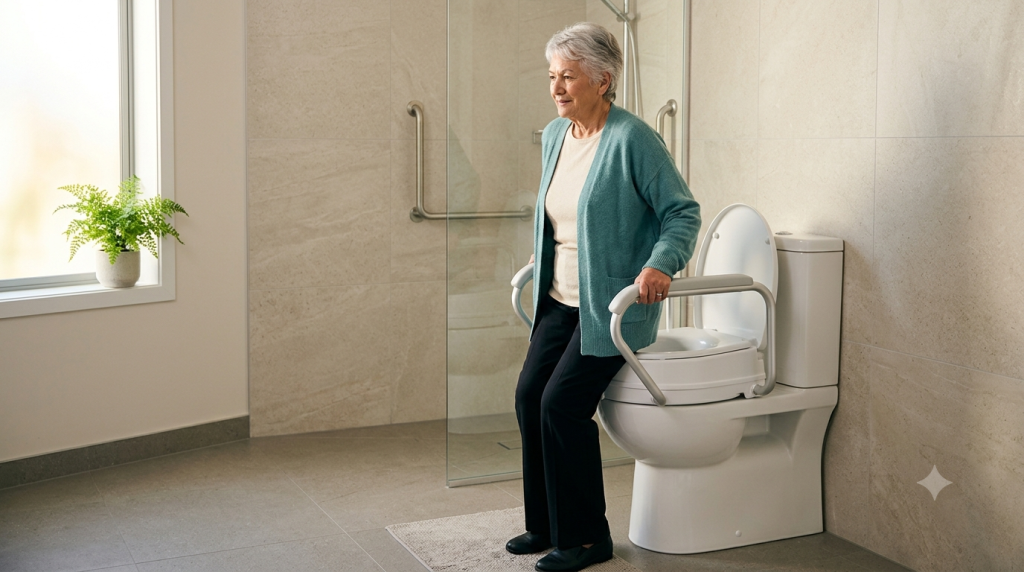
The Feilding Raised Toilet Seat With Armrests combines an approximately 4-inch seat rise with removable swing-up armrests.
The arms may help some seniors control the movement when lowering themselves and provide a surface to push against when standing. Swing-up arms can also make side access or cleaning easier.
This model uses multiple clips for fixation, can be installed without tools and has a maximum user weight of 100 kg.
The relatively low weight limit means it is especially important to confirm that the model is suitable for the intended user.
Good For
- Seniors who need arm support
- Users who struggle to stand from a low toilet
- People who want removable or swing-up arms
- Bathrooms without room for a separate wide frame
- Users under the stated weight limit
Be Careful If
- The user weighs close to or above 100 kg
- The arm spacing is too narrow
- The senior pushes unevenly on one arm
- The clips do not fit securely
- A freestanding frame would feel more stable
Best for Greater Added Height: Peak 6″ Raised Toilet Seat With Lid
The Peak 6″ Raised Toilet Seat With Lid adds more height than common 2-inch and 4-inch models.
A 6-inch rise may suit shorter seniors or people who find it particularly difficult to lower themselves onto a standard toilet. It may reduce strain during sitting and standing when the height is correctly matched to the user.
However, taller is not automatically safer. If the seat is too high, the senior’s feet may not remain firmly supported on the floor. This can affect comfort and stability.
Good For
- Seniors who need a larger height increase
- Users who find standard toilets extremely low
- People who prefer a model with a lid
- Temporary recovery situations when professionally recommended
- Bathrooms where the seat fits securely
Be Careful If
- The user’s feet do not sit flat on the floor
- The senior is tall
- The seat feels unstable
- Arm support is also needed
- The added height has not been assessed properly
Best Freestanding Frame Option: Viking Raised Over Toilet Frame
The Viking Raised Over Toilet Frame is different from a seat raiser attached directly to the toilet bowl.
It is a height-adjustable frame that sits over the toilet and includes arm supports. This may be useful for seniors who need both a higher sitting position and stronger support when lowering or raising themselves.
A freestanding frame can also be easier to remove or reposition than permanent wall-mounted equipment. However, it takes up more floor space and must fit around the toilet without rocking or obstructing the bathroom.
Good For
- Seniors who need support on both sides
- Users who want adjustable height
- Bathrooms where wall-mounted grab bars are not available
- People who need more support than a basic raised seat
- Temporary or changing mobility needs
Be Careful If
- The bathroom is very small
- The frame blocks the doorway or shower
- The senior pushes unevenly on the arms
- The frame is not adjusted evenly
- The toilet shape or surrounding space prevents correct placement
Best Mainstream Budget Option: Wagner Raised Toilet Seat
The Wagner Raised Toilet Seat is a comparatively affordable option sold through Chemist Warehouse NZ.
It may suit families who want to compare a basic raised seat through a mainstream retailer rather than a specialist mobility store.
Because detailed dimensions, added height and fitting requirements should be confirmed before purchase, buyers should not select it based only on price or availability.
Good For
- Budget-conscious households
- Buyers wanting a mainstream retail option
- Seniors who need a basic seat raiser
- People who can confirm compatibility before purchase
- Short-term or straightforward needs
Be Careful If
- Exact height information is unclear
- The toilet shape is unusual
- The senior needs arm support
- Maximum user weight is not confirmed
- A specialist assessment is needed
2-Inch vs 4-Inch vs 6-Inch Raised Toilet Seats
The correct height depends on the senior and the existing toilet.
A 2-inch seat gives a modest increase. It may suit taller users or seniors who only need a small amount of help.
A 4-inch seat is a common middle option. It provides a noticeable reduction in the distance required to sit down.
A 6-inch seat gives a larger increase and may suit users who find the toilet particularly low.
The goal is not to make the seat as high as possible. The senior should be able to sit comfortably, keep their feet supported and stand without feeling unstable.
Raised Toilet Seat vs Toilet Frame
A raised toilet seat mainly increases the sitting height.
A toilet frame provides arm supports and may also be height-adjustable. It can help the user control both sitting and standing.
A seat with integrated armrests combines some features of both products.
A basic raised seat may be enough when height is the main issue. A frame may be better when balance, leg strength or hand support is also important.
Raised Toilet Seat vs Commode Chair
A raised toilet seat is used on an existing toilet.
A commode chair can be used beside the bed or in another suitable area when reaching the bathroom is difficult. Some commodes can also be positioned over a toilet.
A commode may be more suitable when:
- The bathroom is too far away
- Nighttime walking is unsafe
- The toilet area has insufficient space for assistance
- The senior needs caregiver support
- Transfers to the existing toilet are too difficult
For seniors who also find standing during bathing difficult, our guide to shower chairs for seniors in NZ may be helpful.
A commode requires careful cleaning, positioning and privacy considerations. For a detailed comparison of bedside and mobile shower models, read our guide to commode chairs for seniors in NZ.
Who Should Consider Raised Toilet Seats for Seniors?
Raised toilet seats for seniors may be useful for older adults who:
- Find the standard toilet too low
- Have reduced leg strength
- Experience knee or hip discomfort
- Find sitting down difficult
- Struggle to stand from the toilet
- Are recovering from surgery or injury
- Need a temporary bathroom aid
- Want to maintain more independence
A raised seat may also reduce how much physical assistance a family member needs to provide, provided the product is stable and appropriate.
Who May Need More Than a Raised Seat?
A raised toilet seat alone may not be enough if the senior:
- Has frequent falls
- Cannot control the movement when sitting
- Needs to pull on another person
- Cannot stand without arm support
- Has severe balance problems
- Uses a wheelchair
- Needs help transferring sideways
- Has confusion or difficulty following instructions
- Cannot place their feet securely
- Has very limited bathroom space
A toilet frame, grab bars, commode, transfer equipment or professional assessment may be more appropriate.
What to Look For When Buying Raised Toilet Seats for Seniors
1. Correct Added Height
Choose the smallest height that solves the problem safely.
Too little height may provide no meaningful benefit. Too much height may leave the user’s feet unsupported.
2. Toilet-Bowl Compatibility
Toilets vary in shape and size.
Check whether the seat fits round, oval, elongated or unusually shaped bowls.
3. Secure Fixing System
Common fixing systems include:
- Adjustable brackets
- Side clamps
- Rear clips
- Multiple locking points
- Frames that sit independently over the toilet
The seat should not twist, lift or slide.
4. Maximum User Weight
Check the stated maximum weight.
Products can differ substantially. Some support approximately 100 kg, while others may support significantly more.
5. Armrests
Armrests may help with sitting and standing.
Check:
- Height
- Width between the arms
- Grip comfort
- Whether they swing up
- Whether they can be removed
- Whether the user can push evenly
6. Seat Opening
The opening should provide enough room for comfort and personal hygiene.
A front cut-out may make cleaning easier for some users.
7. Lid or No Lid
A lid may improve appearance and allow the toilet to look more conventional when not in use.
It does not necessarily improve safety, so fit and stability remain more important.
8. Cleaning
The seat should be easy to remove or clean without disturbing the fixing system.
Look for smooth, sealed surfaces that resist stains and odours.
9. Bathroom Space
Measure the area around the toilet.
A frame with arms may be too wide for bathrooms where the toilet is close to a wall, vanity or shower.
10. Transfer Method
Consider how the senior actually uses the toilet.
Do they approach with a walking frame? Do they need support on one side or both sides? Do they transfer from a wheelchair? Is a caregiver present?
The product should match the real movement pattern.
Measuring Before Buying
Before ordering, measure:
- Toilet-bowl width
- Toilet-bowl length
- Existing seat height from the floor
- Space on both sides of the toilet
- Distance to walls or vanity units
- Doorway and bathroom access
- The senior’s lower-leg height when seated
- Required width between armrests
- Space needed for a walking frame or caregiver
Also check whether the existing toilet seat must be removed during installation.
Buying Checklist
Before choosing a raised toilet seat, ask:
- Does the senior need 2, 4 or 6 inches of added height?
- Can both feet remain flat on the floor?
- Does the seat fit the toilet shape?
- Is the fixing method secure?
- Is the maximum user weight suitable?
- Are armrests needed?
- Is there enough space for the arms or frame?
- Can the product be cleaned easily?
- Will the senior approach with a walking frame?
- Is a commode or toilet frame more appropriate?
- Does the senior need professional assessment?
- Can the product be returned if it does not fit?
Common Mistakes When Buying Raised Toilet Seats
Choosing the Tallest Seat
A taller seat is not always better.
Excessive height may reduce foot support and make the senior feel unstable.
Ignoring Toilet Shape
A seat can look suitable online but fail to fit the actual toilet.
Measure and check compatibility first.
Assuming Armrests Fit Every Bathroom
Armrests increase the overall width.
They may collide with walls, vanities or shower doors.
Pulling on a Walking Frame
A walking frame should not normally be used as something to pull on when standing from the toilet.
A properly positioned toilet frame, grab bar or armrest may provide more controlled support.
Ignoring Weight Limits
Maximum user weights vary between products.
Never assume that every raised seat has the same capacity.
Keeping a Loose Seat in Use
Stop using the product if it twists, rocks, lifts or slides.
Loose fittings should be corrected before the seat is used again.
Toilet Safety Tips
Helpful steps include:
- Keep the floor dry
- Use appropriate grab bars where needed
- Keep toilet paper within easy reach
- Use good nighttime lighting
- Keep the walking path clear
- Avoid loose rugs beside the toilet
- Check seat fittings regularly
- Keep the senior’s feet supported
- Do not use towel rails as hand supports
- Position walking aids safely
- Seek help if transfers remain difficult
A raised seat works best as part of a complete bathroom safety setup.
When to Seek Professional Advice
Professional advice may be useful if the senior:
- Has frequent falls or near-falls
- Cannot sit or stand safely
- Needs physical assistance
- Transfers from a wheelchair
- Has recently had hip or knee surgery
- Has significant weakness
- Uses a walking frame but cannot release it safely
- Has sudden mobility changes
- Needs a commode or specialist frame
- Is unsure which seat height is appropriate
An occupational therapist, physiotherapist, nurse, doctor or mobility equipment specialist may help assess the bathroom and transfer method.
ACC New Zealand’s home movement guide also discusses raised toilet seats, over-toilet frames and other toileting equipment that may help in appropriate situations.
FAQ
What are the best raised toilet seats for seniors in NZ?
The best raised toilet seat depends on the senior’s height, leg strength, toilet shape, bathroom space and need for arm support. A simple 2-inch or 4-inch model may suit some users, while others may need armrests or a height-adjustable frame.
Is a 2-inch or 4-inch raised toilet seat better?
A 2-inch model gives a smaller height increase and may suit taller users or people needing mild assistance. A 4-inch model provides more lift. The correct choice should still allow the user’s feet to remain supported.
Are raised toilet seats with arms safer?
Armrests may help some seniors control sitting and standing. They are only helpful when the seat is secure, the bathroom has enough space and the user can push evenly on the arms.
Do raised toilet seats fit every toilet?
No. Toilet bowls vary in shape, width and length. Check the product’s measurements and fixing system before buying.
Can a raised toilet seat be used after hip surgery?
Raised seats are sometimes used during recovery, but the correct height and transfer method should follow advice from the senior’s healthcare professional.
Is a toilet frame better than a raised toilet seat?
A frame may be better when the senior needs support on both sides or adjustable arm height. A raised seat may be enough when the main problem is simply that the toilet is too low.
Final Recommendation
For most seniors in New Zealand, the best raised toilet seat is the lowest model that provides enough assistance while still allowing stable foot contact and comfortable transfers.
The Viscount 4-inch model is a practical everyday option with a lid. The 2-inch Mobility Centre seat may suit seniors needing a smaller rise or higher weight capacity. The Feilding model provides arm support, while the Peak 6-inch model offers a larger height increase. A Viking over-toilet frame may be better when the senior needs support on both sides.
The best choice is not based on height alone. It must fit the toilet, bathroom, senior’s body size, weight and transfer ability.
For a broader review of shower, floor, toilet and lighting risks, read our bathroom safety checklist for seniors in NZ.