Introduction
Safe indoor footwear for seniors should provide reliable grip, fit securely and remain comfortable enough to wear during normal movement around the home.
Soft slippers may feel comfortable but can become unstable when they are loose, backless or worn smooth underneath. Indoor shoes can provide more support but may be harder to put on. Grip socks are simple and lightweight, but they do not provide the same structure or heel support as properly fitted footwear.
The best choice depends on the senior’s balance, foot shape, strength, swelling, ability to bend and the type of flooring in the home.
This guide compares non-slip slippers, indoor shoes and grip socks for New Zealand seniors and explains the seven main things to check before choosing indoor footwear.
Safety Note
Footwear is only one part of fall prevention.
A senior who has frequent falls, sudden weakness, dizziness, significant foot pain, reduced sensation or major balance problems should not rely on non-slip footwear alone.
Professional advice may be appropriate when the senior:
- Has fallen recently
- Has repeated near-falls
- Has significant swelling
- Has painful feet
- Has reduced sensation
- Cannot put footwear on safely
- Drags or catches one foot
- Has rapidly changing mobility
- Uses a walking aid but remains unstable
- Has difficulty finding footwear that fits
A physiotherapist, podiatrist or other appropriate healthcare professional may be able to identify problems that footwear alone cannot solve.
Disclosure
This article may contain affiliate links in the future. If you buy through these links, Golden Vibe may earn a commission at no additional cost to you.
Golden Vibe has not personally fitted every footwear product available in New Zealand.
Always check the exact size, closure, sole, heel design and manufacturer information before buying.
Quick Answer
For many independent seniors, a supportive non-slip slipper with a secure heel is a practical indoor option.
A lightweight indoor shoe may provide more structure and support when the senior:
- Walks frequently around the house
- Uses a walking frame
- Needs stronger heel support
- Finds loose slippers unstable
Grip socks may be useful for short periods, sleeping environments or situations where conventional footwear is uncomfortable, but they provide less structure and should not automatically replace properly fitted shoes or slippers.
Health New Zealand advises older adults to wear safe, well-fitting shoes or slippers with non-slip soles and to avoid walking on slippery floors in ordinary socks or tights.
Slippers vs Indoor Shoes vs Grip Socks
| Feature | Non-Slip Slippers | Indoor Shoes | Grip Socks |
|---|---|---|---|
| Sole grip | Good when rubber sole is suitable | Usually good with appropriate outsole | Depends on grip pattern |
| Heel support | Varies greatly | Usually strongest | Minimal |
| Easy to put on | Usually easiest | May require more effort | Very easy |
| Structure | Moderate | Highest | Very low |
| Warmth | Usually high | Moderate | High |
| Walking-frame use | Can be suitable | Often more supportive | Less structured |
| Swollen feet | Adjustable styles can help | Needs careful fitting | Flexible but less supportive |
| Outdoor use | Usually limited | Some models suitable | No |
| Main risk | Loose or backless fit | Difficult fastening or poor fit | Sliding inside sock or low support |
The 7 Main Indoor Footwear Checks
Before choosing footwear, check:
- Sole grip
- Heel security
- Overall fit
- Toe space
- Fastening
- Weight and flexibility
- Suitability for the home floor
A product that performs well in only one area may still be unsuitable overall.
1. Check the Sole Grip
The outsole is the part of the footwear that contacts the floor.
A senior walking on:
- Timber
- Laminate
- Vinyl
- Smooth tiles
- Polished surfaces
may need reliable traction.
Look for a sole that:
- Has a textured tread
- Does not feel excessively hard and smooth
- Remains flat on the floor
- Is not badly worn
- Does not have damaged edges
A slipper labelled “non-slip” still needs to be checked periodically.
The tread can wear down with use.
Dust, polish, cleaning products and moisture can also change how the sole behaves on the floor.
Do Not Assume More Rubber Is Always Better
A very sticky or deeply patterned sole may grip strongly but can sometimes catch unexpectedly when the senior shuffles or has difficulty lifting the feet.
The aim is controlled traction rather than maximum resistance.
How the senior actually walks matters.
2. Heel Support Matters
One of the most important differences between footwear styles is what happens around the heel.
A secure heel helps keep the footwear attached to the foot during walking.
More supportive designs may include:
- A closed heel
- A heel cup
- An adjustable rear strap
- A secure upper that prevents excessive movement
Loose backless slippers can move independently from the foot.
The senior may then:
- Shuffle to keep them on
- Curl the toes
- Slide partially out
- Catch the slipper on the floor
- Lose the slipper while turning
For someone with balance concerns, ease of slipping the footwear on should not be prioritised over secure fit.
Are Backless Slippers Always Bad?
Not necessarily.
Some independent seniors can use a well-fitting backless slipper comfortably.
However, extra caution is appropriate when the person:
- Has poor balance
- Shuffles
- Has reduced foot sensation
- Uses a walking aid
- Frequently loses slippers while walking
- Has previously tripped in loose footwear
In these situations, a closed-back or adjustable style may be more practical.
3. Check the Overall Fit
Footwear should remain on the foot without squeezing it.
Signs that footwear may be too loose include:
- Heel movement
- Foot sliding forward
- Toes gripping to hold the shoe
- Footwear rotating while walking
- Slipper falling off during stairs or transfers
Signs it may be too tight include:
- Pressure marks
- Rubbing
- Toe compression
- Pain
- Difficulty fastening
- Increased discomfort later in the day
Do not rely only on the printed shoe size.
Sizes vary between brands and styles.
Whenever possible, the senior should try the footwear while standing and walking.
Feet Can Change Size During the Day
Feet may become slightly larger later in the day.
Swelling can also change footwear fit.
A pair that feels comfortable first thing in the morning may feel restrictive in the evening.
When swelling is a regular issue, adjustable footwear may provide more flexibility than a fixed narrow opening.
4. Leave Enough Toe Space
The toes should not be compressed tightly together.
A wider toe area can be useful for seniors whose feet:
- Have become wider
- Have bunions
- Have toe deformities
- Swell
- Feel sensitive in narrow shoes
The footwear should also not be so long that the senior catches the front on the floor.
Fit needs to balance space with control.
Health New Zealand recommends properly fitting footwear and advises people not to rely on size alone because shoe sizing varies between brands.
5. Choose a Fastening the Senior Can Actually Use
A secure shoe is only useful if the senior can put it on and remove it reliably.
Common options include:
- Hook-and-loop straps
- Elastic openings
- Zips
- Laces
- Slip-on designs
Hook-and-Loop Closures
These may suit seniors who need:
- Adjustable width
- Easy opening
- Less finger dexterity than laces require
- Accommodation for mild swelling
Laces
Laces can provide a secure fit but may be difficult for someone with:
- Reduced finger strength
- Arthritis
- Difficulty bending
- Reduced vision
Loose laces can also become a trip hazard.
Slip-On Footwear
Slip-ons are convenient.
However, convenience should not result in footwear that moves excessively around the heel.
6. Check Weight and Flexibility
Indoor footwear should not feel unnecessarily heavy.
A heavy shoe can be tiring for someone who already has difficulty lifting the feet.
At the same time, extremely soft footwear may provide too little structure.
A useful indoor design often balances:
- Lightweight construction
- Stable sole
- Comfortable upper
- Enough flexibility for normal walking
- Enough structure to remain securely on the foot
Foldable, extremely soft slippers may feel cosy but may not provide the stability some seniors need.
7. Match the Footwear to the Floor
The same footwear can behave differently on different surfaces.
Check it on the floors the senior actually uses:
- Bedroom carpet
- Timber hallway
- Kitchen vinyl
- Bathroom tiles
- Rugs
- Thresholds
Pay particular attention to transitions between surfaces.
A senior may move comfortably across carpet but catch the toe when stepping onto a rug or hard floor.
Footwear should be evaluated throughout the normal route through the home.
Non-Slip Slippers: When Are They a Good Choice?
Non-slip slippers may be suitable when the senior:
- Mainly walks indoors
- Wants warm footwear
- Has relatively stable walking
- Needs something easy to put on
- Chooses a secure fitting style
- Has appropriate heel support
- Uses a genuine grippy sole
They can be especially convenient:
- Beside the bed
- In the living room
- During winter
- For short indoor routines
For current slipper options and buying considerations, read our non-slip slippers for seniors in NZ guide.
What to Look For in Non-Slip Slippers
Prioritise:
- Secure heel fit
- Full non-slip sole
- Low-profile tread
- Wide enough toe area
- Easy fastening
- Lightweight construction
- Washable or easy-clean materials
- No loose decorative parts
Avoid choosing only by softness.
A very plush slipper can still be a poor walking shoe.
Indoor Shoes: When Are They Better?
A lightweight indoor shoe may be better than a slipper when the senior:
- Walks around the house frequently
- Uses a walking frame
- Needs more heel support
- Has unstable slippers
- Wants a firmer sole
- Moves between indoors and sheltered outdoor areas
- Needs more structured footwear
An indoor shoe can provide more control around the heel and midfoot.
The main disadvantage is that it may be harder to put on.
A wide opening, adjustable strap or long-handled shoe horn can help.
Do Seniors Need Separate Indoor Shoes?
Not necessarily.
Some seniors prefer one pair of clean supportive shoes for indoor use.
Others prefer slippers because they are warmer and easier to use.
The important distinction is not whether the product is marketed as a “slipper” or “shoe”.
It is whether it:
- Fits securely
- Provides appropriate grip
- Matches the person’s walking ability
- Can be put on safely
- Works with the home environment
Grip Socks: When Can They Be Useful?
Grip socks have textured material on the sole designed to increase friction.
They may be useful for:
- Short periods around the bedroom
- Keeping feet warm in bed
- Situations where normal footwear cannot immediately be worn
- Some supervised care environments
However, grip socks provide very little structure.
They do not normally provide:
- Heel support
- Midfoot support
- A protective outsole
- The same resistance to floor hazards as footwear
The sock itself must also fit securely.
An oversized sock can twist around the foot so that the grip section is no longer underneath.
Ordinary Socks on Smooth Floors
Health New Zealand specifically advises against walking on slippery floors in socks or tights.
Ordinary socks provide little traction on many smooth household surfaces.
This is particularly relevant during nighttime trips between:
- Bed
- Bathroom
- Hallway
- Kitchen
If the senior gets out of bed regularly during the night, suitable footwear should be positioned somewhere easy to reach.
Safe Footwear for Nighttime Bathroom Trips
Nighttime movement deserves special attention.
The senior may be:
- Sleepy
- Moving in low light
- In a hurry to reach the toilet
- Less steady immediately after standing
Keep suitable footwear:
- Beside the bed
- Facing the correct direction
- Clear of clutter
- Easy to put on while seated
The senior should not need to stand on one leg in the dark to put on footwear.
For other bedroom transfer considerations, read our bed height for seniors guide.
Footwear and Walking Frames
A walking frame cannot compensate for unstable footwear.
When using a frame indoors, check whether:
- The sole grips securely
- The heel stays inside the footwear
- The toe does not catch the floor
- The slipper does not twist
- The senior can take normal steps
Loose slippers may encourage short shuffling steps.
For seniors who already use a frame, more structured indoor footwear may sometimes be easier to control.
For complete standing, walking, turning and braking technique, read our guide on how to use a walking frame safely.
Putting Shoes On Safely
Footwear selection includes the process of getting dressed.
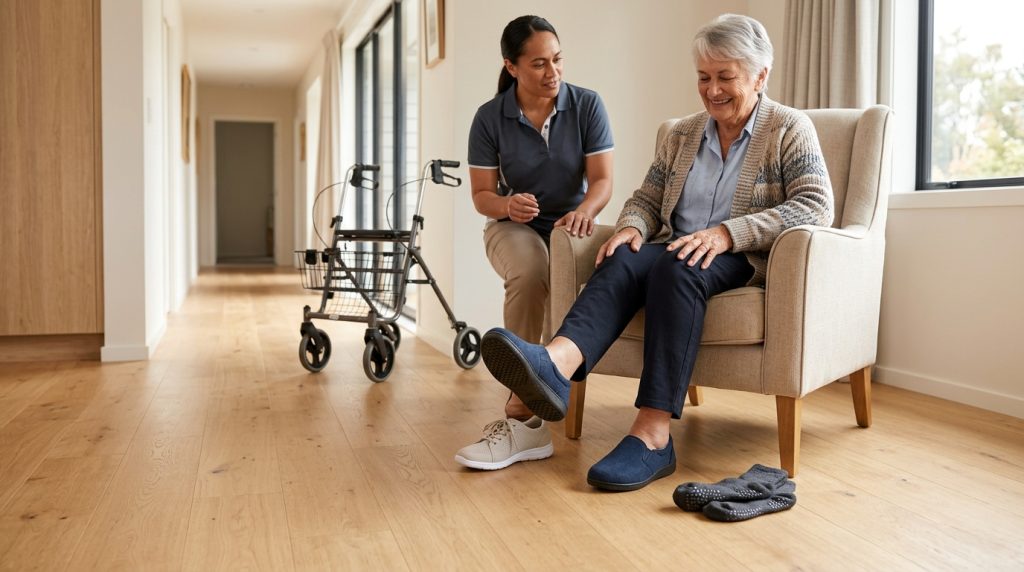
Whenever possible, put shoes or slippers on while sitting on a stable chair.
Avoid standing on one leg while trying to:
- Insert a foot
- Pull up a heel
- Fasten a strap
- Tie laces
Seniors who have difficulty reaching their feet may benefit from:
- A long shoe horn
- A reacher
- Elastic laces
- A sock aid
- Easier fastening
For dressing and reaching tools, read our daily living aids for seniors in NZ guide.
Swollen Feet
Foot swelling can make normal footwear difficult.
Adjustable openings can help accommodate small changes in foot volume.
Check that straps:
- Do not cut into the foot
- Still close securely
- Have enough adjustment
- Do not leave loose material that catches
Do not simply buy a much larger size to make room for swelling.
Oversized footwear can become unstable.
Persistent or significant swelling should be discussed with an appropriate healthcare professional.
Foot Pain or Reduced Sensation
Foot pain can change walking patterns.
Reduced sensation can also make it harder for the senior to notice:
- Pressure
- Rubbing
- Foreign objects
- Heat
- Skin damage
If the senior has ongoing pain, major changes in sensation or recurring skin problems, individual footwear advice may be more appropriate than selecting slippers online.
Bathroom Footwear
Non-slip slippers are intended mainly for dry indoor movement.
They should not automatically be worn:
- Inside a wet shower
- In a bath
- On a flooded bathroom floor
Wet footwear can behave differently from dry footwear.
Bathroom safety may require a combination of:
- Suitable flooring
- Shower mat or treatment
- Grab bars
- Shower chair
- Clear dry route outside the shower
Do not treat slippers as a replacement for wet-area safety equipment.
Carpet, Rugs and Thresholds
Good sole grip does not remove trip hazards.
Check whether the footwear catches on:
- Thick rugs
- Curling rug edges
- Door thresholds
- Carpet transitions
- Electrical cords
- Low furniture
A senior who has difficulty lifting the feet may benefit from removing unnecessary rugs even when footwear has a non-slip sole.
When Should Slippers Be Replaced?
Inspect indoor footwear regularly.
Replace or review it when:
- The tread is worn smooth
- The sole separates
- The upper stretches
- The heel becomes loose
- The cushioning collapses
- Fastenings stop working
- The senior begins sliding inside the footwear
A slipper that fitted well when new may become loose after months of use.
Common Indoor Footwear Mistakes
Choosing the Softest Slipper
Softness alone does not provide stability.
Wearing an Oversized Pair
Extra room can cause the foot to slide.
Using Backless Slippers Despite Repeated Slipping
A secure heel may be more suitable.
Walking in Ordinary Socks
Smooth floors can become difficult to grip.
Ignoring Worn Soles
A product labelled non-slip can lose traction as it wears.
Wearing Outdoor Shoes With Mud or Wet Soles Indoors
Wet soles can reduce traction and bring water onto the floor.
Buying Shoes That Are Difficult to Fasten
The senior may eventually leave them loose.
Choosing a Shoe Only by Size Number
Different brands and styles fit differently.
Standing While Putting Footwear On
Dressing while seated is usually more stable.
Treating Footwear as the Entire Fall-Prevention Plan
Balance, lighting, floors, mobility aids and home layout also matter.
When to Seek Professional Advice
Consider professional advice if the senior:
- Has repeated falls
- Trips frequently
- Has significant foot pain
- Has major swelling
- Has reduced sensation
- Has skin breakdown
- Cannot find footwear that fits
- Develops a new walking pattern
- Drags one foot
- Needs specialist orthotics
- Has major balance problems
- Cannot put footwear on independently
A podiatrist may help with foot and footwear concerns.
A physiotherapist may help when balance, walking or mobility is the main problem.
Official New Zealand Guidance
Health New Zealand recommends safe, well-fitting shoes and slippers for older adults and specifically advises choosing non-slip soles.
It also advises against walking on slippery floors in ordinary socks or tights.
ACC’s fall-prevention programme for people over 65 emphasises that reducing falls requires attention to strength, balance and the home environment rather than relying on one product alone.
For a broader review of flooring, lighting, walking aids, bathroom safety and bedroom hazards, read our fall prevention products for seniors in NZ guide.
Final Recommendation
For most independent seniors, start with footwear that:
- Fits securely
- Has a non-slip sole
- Keeps the heel controlled
- Provides enough toe space
- Is easy to fasten
- Feels lightweight
- Works on the home’s actual floors
A supportive non-slip slipper can be a good everyday option when warmth and easy use matter.
A lightweight indoor shoe may be better when stronger heel support and structure are needed.
Grip socks can be useful in selected situations, but they should not automatically replace properly fitted footwear.
For specific slipper options currently available in New Zealand, compare our non-slip slippers for seniors in NZ guide.
The safest indoor footwear is not necessarily the softest or the most expensive.
It is the footwear that stays securely on the senior’s foot, provides appropriate grip and allows them to walk naturally around their real home.
Frequently Asked Questions
What is the safest indoor footwear for seniors?
A secure, well-fitting shoe or slipper with a non-slip sole and appropriate heel support is a practical starting point.
The exact choice depends on the senior’s balance, foot shape and mobility.
Are slippers safe for elderly people?
They can be when they fit securely, have good grip and do not move excessively around the heel.
Loose backless slippers may be less suitable for seniors with balance problems.
Are indoor shoes safer than slippers?
They can provide more structure and heel support.
However, a properly fitted supportive slipper may be completely appropriate for an independent senior.
Should seniors wear backless slippers?
Backless slippers are convenient but can move around the foot.
Seniors who shuffle, have poor balance or regularly lose their slippers may be better suited to closed-back or adjustable footwear.
Are grip socks safe for seniors?
Grip socks may provide more traction than ordinary socks, but they offer less structure and heel support than shoes or slippers.
The sock must also fit securely.
Should elderly people walk around in socks?
Health New Zealand advises people not to walk on slippery floors in socks or tights.
Suitable non-slip footwear is generally a better option.
Should slippers have rubber soles?
A textured, slip-resistant outsole can provide useful grip on indoor floors.
The actual tread and condition of the sole matter more than the material name alone.
How tight should slippers be?
They should remain securely on the foot without squeezing, rubbing or restricting the toes.
The heel should not repeatedly slide out.
Are Velcro slippers good for seniors?
Hook-and-loop fastening can be useful because it allows the fit to be adjusted and is often easier to operate than laces.
What footwear is best for seniors with swollen feet?
Adjustable footwear with a wide opening may help accommodate mild changes in swelling.
Significant or persistent swelling should be professionally assessed.
Should seniors wear shoes inside the house?
Some seniors may benefit from lightweight supportive indoor shoes, especially when slippers feel unstable.
There is no requirement that indoor footwear must be a slipper.
How often should senior slippers be replaced?
Replace them when the sole loses grip, the upper stretches, the heel becomes loose, fastenings fail or the overall fit changes.