
Introduction
What size recliner chair does a senior need? The right answer depends on the person’s height, leg length, body width, strength, mobility and the amount of space available in the living room.
A recliner can look comfortable in a showroom but still be difficult to use at home.
If the seat is too low, standing may require more leg strength. If it is too high, the senior’s feet may not rest securely on the floor. A seat that is too deep can make it difficult to sit with the back supported, while a chair that is too narrow can feel restrictive around the hips and armrests.
The complete chair must also fit the room when fully reclined.
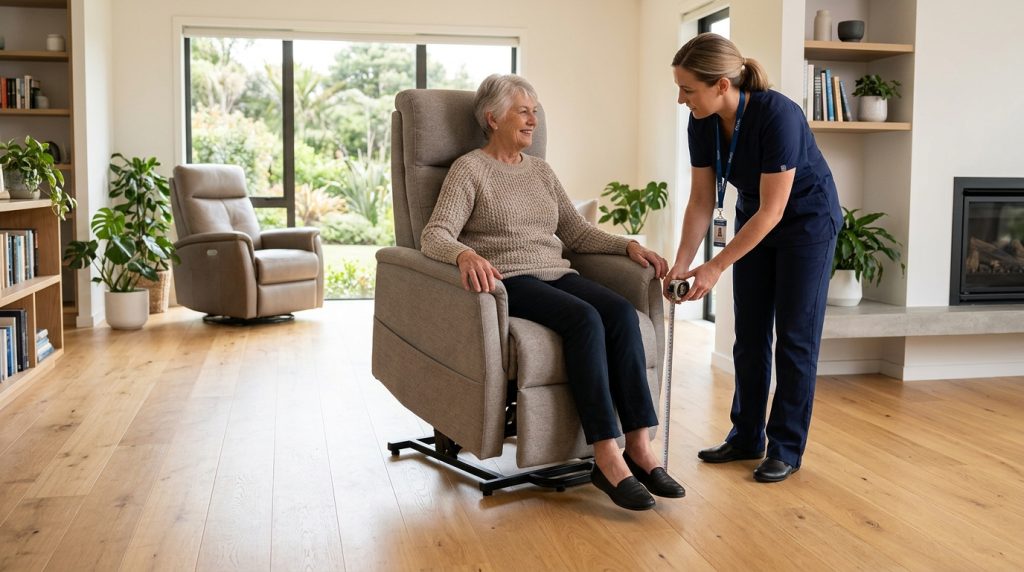
This guide explains how New Zealand seniors and families can check seat height, width, depth, back support, foot position, weight capacity and room clearance before buying a recliner chair.
Safety Note
Chair fit should match the senior’s actual mobility and transfer ability.
A general measuring guide does not replace individual professional advice when the senior:
- Has recently fallen
- Needs physical assistance to stand
- Cannot control sitting down
- Has weakness on one side
- Has significant hip or knee pain
- Uses a wheelchair for transfers
- Becomes dizzy when standing
- Is recovering from surgery
- Has rapidly changing mobility
- Cannot remain comfortably seated
- Needs specialist pressure-relief seating
A physiotherapist or occupational therapist can assess the complete sitting and standing movement rather than looking only at furniture dimensions.
Disclosure
This article may contain affiliate links in the future. If you buy through these links, Golden Vibe may earn a commission at no additional cost to you.
Golden Vibe has not personally fitted every recliner chair available in New Zealand.
Always confirm current dimensions, weight capacity, controls and specifications with the retailer or manufacturer before buying.
Quick Answer
A correctly fitted recliner chair should allow the senior to:
- Sit with both feet supported
- Keep the knees in a comfortable position
- Sit back against the backrest
- Avoid excessive pressure behind the knees
- Rest the arms comfortably on the armrests
- Stand without excessive effort
- Operate the controls easily
- Recline without hitting furniture or walls
- Remain within the chair’s maximum user weight
The best recliner is therefore not simply small, medium or large.
It must fit both the senior and the room.
The 7 Main Recliner Fit Checks
| Fit Check | What to Check | Why It Matters |
|---|---|---|
| 1. Seat height | Floor to top of seat | Affects foot support and standing |
| 2. Seat width | Space between armrests | Affects comfort and movement |
| 3. Seat depth | Front of seat to backrest | Determines whether the back and legs are supported |
| 4. Backrest height | Shoulder, neck and head support | Important during longer periods of reclining |
| 5. Armrest height | Natural elbow position | Helps comfort and transfers |
| 6. Weight capacity | Exact product limit | Prevents overloading |
| 7. Room clearance | Upright and fully reclined dimensions | Confirms the chair actually fits the home |
1. Start With Seat Height
Seat height is one of the most important measurements for an older adult.
Health New Zealand recommends choosing a chair that is the right height for the person and checking that the feet can be placed comfortably on the floor.
For a recliner, use the same principle.
When sitting upright, the senior should ideally be able to:
- Place both feet firmly on the floor
- Keep the knees comfortably bent
- Sit without sliding forward
- Lean slightly forward before standing
- Push through the armrests when appropriate
Do not judge seat height while the footrest is raised.
Test the chair in its normal upright sitting position.
Signs a Recliner Is Too Low
The chair may be too low if the senior:
- Sits with the hips well below the knees
- Struggles during the first part of standing
- Rocks several times to gain momentum
- Pushes very heavily through the arms
- Pulls on nearby furniture
- Needs another person to lift them
- Experiences increased knee or hip discomfort
- Avoids getting out of the chair
A very soft seat can create the same problem even when the advertised seat height looks suitable.
The senior may sink several centimetres into the cushion.
Always test the chair under the user’s actual body weight.
Signs a Recliner Is Too High
The chair may be too high if:
- The feet do not rest securely on the floor
- Only the toes make contact
- The senior slides forward
- Pressure develops behind the thighs
- The user feels unstable when preparing to stand
- The senior cannot move the feet into a good standing position
A higher chair is not automatically safer simply because standing feels easier.
Stable foot contact remains important.
Can Chair Raisers Help?
Purpose-designed chair raisers may help when an otherwise suitable chair is slightly too low.
Health New Zealand notes that raising a chair can make sitting down and standing up easier for some people.
However, raisers must be compatible with the chair.
Recliners can be more complicated than ordinary fixed chairs because they may contain:
- Moving footrests
- Motors
- Cables
- Uneven base structures
- Swivel mechanisms
Do not place a heavy powered recliner on improvised blocks or household objects.
If the chair genuinely needs a major height change, a better-sized recliner or lift chair may be the safer solution.
2. How Wide Should a Recliner Seat Be?
Seat width is normally measured across the usable sitting area between the armrests.
The senior should have enough room to sit comfortably without:
- Hips pressing against the arms
- Clothing becoming trapped
- Difficulty repositioning
- Excessive unused space on both sides
A chair that is too narrow can feel restrictive.
A chair that is excessively wide can also create problems because the armrests may become difficult to reach.
Armrests are particularly important for seniors who use their arms while sitting or standing.
How to Check Seat Width
Ask the senior to sit naturally on a firm chair.
Measure across the widest seated part of the hips.
Then compare this measurement with the recliner’s usable seat width.
Do not compare body width with the recliner’s total exterior width.
A recliner may look very wide because of:
- Thick armrests
- Side panels
- Controls
- Upholstery
- Frame construction
but still have a relatively narrow usable seat.
3. Check Seat Depth
Seat depth is measured from the front edge of the seat cushion to the backrest.
This measurement is frequently overlooked.
When the senior sits back properly:
- The back should contact the backrest
- The thighs should be supported
- The front edge should not press heavily behind the knees
- The feet should still reach the floor when upright
Signs the Seat Is Too Deep
The seat may be too deep if:
- The senior cannot sit against the backrest while keeping the feet supported
- The user slides forward
- A large gap remains behind the lower back
- The seat edge presses behind the knees
- The senior needs cushions behind the back simply to reach the floor
A deep oversized recliner can be especially problematic for a shorter senior.
Signs the Seat Is Too Shallow
The seat may be too shallow if:
- Only a small part of the thighs is supported
- The senior feels pushed towards the front
- Longer legs feel unsupported
- The chair becomes uncomfortable during longer periods of sitting
Taller seniors may need greater seat depth, but deeper is not automatically better.
4. Check Backrest and Head Support
Recliners are often used for:
- Reading
- Watching television
- Resting
- Napping
- Elevating the legs
Backrest height therefore matters more than it does on some ordinary chairs.
When sitting upright and reclining, check whether:
- The lower back feels supported
- The shoulders remain comfortable
- The neck is not pushed excessively forward
- The head has appropriate support when desired
Some people prefer a high-back recliner.
Others may find a very large headrest uncomfortable.
Test both the upright and reclined positions.
Lumbar Support
A recliner should not force the senior into a deeply rounded sitting posture.
Too much soft cushioning can allow the pelvis and lower back to sink.
A firmer supportive backrest may be more comfortable for someone who spends several hours in the chair each day.
However, individual comfort varies significantly.
Try the actual chair whenever possible.
5. Check Armrest Height
Armrests affect both comfort and transfers.
When seated naturally, the senior should be able to rest the forearms without:
- Raising the shoulders
- Leaning heavily to one side
- Reaching down excessively
When standing, suitable armrests may also provide a surface to push from.
The senior should not need to grab:
- Side tables
- Walking frames
- Television cabinets
- Other unstable furniture
to stand from the recliner.
Recliner Chair vs Lift Chair
A standard recliner is primarily designed for sitting and reclining.
A lift chair uses a powered mechanism to raise and tilt the seat forward to assist the user towards standing.
A lift chair may be more suitable when:
- Standing from a normal chair is consistently difficult
- Leg strength is reduced
- The senior repeatedly needs help to rise
- A correctly sized standard recliner is still difficult to exit
However, a lift mechanism does not make chair fit irrelevant.
Seat height, width and depth still need to match the senior.
For current rise-and-recline products available in New Zealand, read our lift chairs for seniors in NZ guide.
6. Check the Weight Capacity
Every recliner has a maximum user-weight specification.
Check the exact model.
Do not estimate capacity based on:
- Chair size
- Upholstery
- Price
- Appearance
- Another similar model
The user should remain comfortably within the stated limit.
A bariatric or heavy-duty recliner may provide:
- Greater weight capacity
- Wider seating
- Stronger frame construction
but it may also be much larger.
Always check both body fit and room fit.
7. Measure the Living Room
A recliner needs more space than its upright footprint suggests.
Measure:
- Chair width
- Chair depth when upright
- Chair depth when fully reclined
- Space behind the chair
- Space in front of the footrest
- Walking route around the chair
- Distance from side tables
- Position of power points
- Cable routes
- Nearby doors
Do not measure only the empty corner where the chair will sit.
Measure the space required while someone is actually using it.
Recliner Clearance From the Wall
Traditional recliners may need considerable clearance behind the backrest.
Wall-hugger or wall-saver recliners use a different mechanism designed to recline with less rear clearance.
A wall-hugger may be helpful when:
- The living room is small
- The chair needs to sit closer to a wall
- A large traditional recliner blocks the walking route
Still check the manufacturer’s actual required clearance.
“Wall hugger” does not mean the chair can always sit directly against the wall.
Footrest Clearance
The area in front of the chair must also remain clear.
Check for:
- Coffee tables
- Foot stools
- Walking frames
- Rugs
- Power cables
- Pets
- Other chairs
The footrest should be able to open and close without hitting another object.
The senior also needs enough space to stand when the footrest is fully closed.
Manual vs Electric Recliners
Manual recliners often use:
- A side lever
- Handle
- Body pressure
Electric recliners use buttons or a remote.
For a senior, check whether they can operate the mechanism independently.
Manual Recliner
May suit someone who:
- Has reasonable arm strength
- Understands the mechanism
- Can safely close the footrest
Electric Recliner
May be easier when:
- Hand strength is reduced
- Smooth gradual adjustment is preferred
- A powered footrest is easier than pushing one closed manually
However, electric models introduce:
- Power cables
- Motors
- Controls
- Power-point requirements
The controls should remain easy to reach from the seated position.
Check the Recliner in Upright Position First
A common mistake is testing only how comfortable a recliner feels when fully reclined.
Before reclining, check the chair as an ordinary sitting chair.
Ask the senior to:
- Sit fully back.
- Put both feet on the floor.
- Rest both arms.
- Lean forward slightly.
- Stand.
- Sit down again in a controlled way.
If the chair does not work well in its upright position, the reclining feature will not solve the basic fit problem.
How to Test a Recliner Before Buying
Whenever possible, the senior should personally try the chair.
Do not rely only on measurements.
Test 1: Sitting Down
Can the senior:
- Approach the chair safely?
- Turn without losing balance?
- Reach the armrests?
- Lower themselves slowly?
Test 2: Normal Sitting
Check:
- Both feet on floor
- Back against backrest
- Comfortable knees
- Armrest reach
- Seat width
- Seat depth
Test 3: Standing
Can the senior:
- Move towards the seat edge?
- Position both feet?
- Lean forward?
- Push from the armrests?
- Stand without pulling on furniture?
Test 4: Reclining
Can the senior:
- Operate the controls?
- Raise the footrest?
- Return to upright?
- Remain comfortable?
- Reach essential items?
Test 5: Getting Out Again
The senior should be able to return the chair fully upright before standing.
Do not attempt to stand while the recliner is still significantly reclined.
Recliners for Shorter Seniors
Shorter seniors often need:
- Lower seat height
- Shallower seat depth
- Reachable armrests
- Appropriate head support
An oversized recliner may prevent the user from simultaneously sitting back and keeping the feet on the floor.
Do not buy a large chair simply because it looks more luxurious.
Recliners for Taller Seniors
Taller seniors may need:
- Higher seat position
- Greater seat depth
- Taller backrest
- Longer leg support
A short footrest may leave the lower legs unsupported.
Check where the footrest contacts the legs in the reclined position.
Comfort should be evaluated with the senior actually sitting in the chair.
Soft vs Firm Recliners for Seniors
Very soft recliners can feel comfortable at first.
However, deep cushions may allow the senior to sink lower into the chair.
This can make standing more difficult.
A moderately supportive seat may be easier for transfers.
The ideal firmness also depends on:
- Body weight
- Pain
- Pressure sensitivity
- Time spent sitting
- Personal preference
For a senior who sits for long periods because of significant mobility limitations, professional seating advice may be appropriate.
Recliners and Walking Frames
A walking frame should have a safe storage position near the chair without blocking:
- The footrest
- Standing space
- The walking route
The senior should not normally pull on the walking frame to rise from the chair.
Stand from the chair first using an appropriate technique, regain balance and then take hold of the frame.
For standing, walking, braking and sitting technique, read our guide on how to use a walking frame safely.
Recliners and Side Tables
Frequently used items should be reachable without excessive twisting.
Consider placement of:
- Phone
- Water
- Remote controls
- Glasses
- Medication
- Reading material
- Lamp switches
Avoid placing a table so close that it blocks the senior from standing or interferes with the footrest.
For seniors who need a larger stable surface over or beside the chair, read our overbed tables for seniors in NZ guide.
Power Recliner Cable Safety
Electrical cables should not cross the main walking route.
Position cables:
- Behind furniture where appropriate
- Away from walking-frame wheels
- Away from the moving recliner mechanism
- Away from the footrest
- Away from places where they can be pulled or damaged
Do not route a cable underneath a moving mechanism unless the manufacturer specifically designed it that way.
Common Recliner Sizing Mistakes
Buying by Overall Chair Size
A large exterior does not necessarily mean a large usable seat.
Check internal seat dimensions.
Ignoring Seat Depth
A deep recliner can be difficult for shorter seniors.
Choosing a Very Low Soft Chair
The user may sink into the seat and struggle to stand.
Buying the Highest Chair Possible
Feet still need secure support.
Measuring Only the Upright Chair
Check the fully reclined dimensions.
Forgetting the Footrest
Coffee tables and walking aids may block it.
Ignoring Armrest Reach
The senior should not need to spread or stretch the arms excessively.
Buying Without Trying the Chair
Two chairs with similar dimensions can feel very different.
Assuming a Lift Chair Fits Everyone
Lift assistance does not compensate for poor seat dimensions.
Forgetting the User-Weight Limit
Always check the exact specification.
Ignoring Cables
Powered recliners need safe cable management.
When to Consider a Lift Chair Instead
A properly sized recliner may still be difficult to stand from when leg strength is substantially reduced.
Consider comparing lift chairs when:
- Standing repeatedly requires several attempts
- Another person regularly helps the senior up
- The senior pulls heavily on furniture
- Knee or hip weakness makes standing difficult
- The senior is otherwise able to operate powered controls safely
A lift chair should still be fitted carefully.
The lifting mechanism is an assistance feature, not a replacement for correct sizing.
When to Seek Professional Advice
Professional advice may be useful when the senior:
- Falls when sitting or standing
- Has frequent near-falls
- Needs physical assistance
- Has significant one-sided weakness
- Uses a wheelchair
- Has pressure-care needs
- Has recently had surgery
- Cannot keep the feet supported
- Cannot control lowering into the chair
- Has severe pain
- Spends most of the day seated
- Is unsure whether a standard recliner or lift chair is appropriate
An occupational therapist or physiotherapist can assess strength, transfers, chair fit and the home environment together.
Official New Zealand Guidance
Health New Zealand recommends choosing a chair that is the right height for the individual and checking that the feet can be comfortably positioned on the floor when seated.
It also provides information about purpose-designed chair raisers for people who find low chairs difficult to stand from.
The most important principle is to fit the chair to the person rather than choosing furniture by appearance alone.
Final Recommendation
Start with the senior rather than the recliner.
Check:
- Seat height
- Foot contact
- Seat width
- Seat depth
- Armrest position
- Back and head support
- Standing ability
- Weight capacity
- Full recline clearance
A suitable recliner should support both comfortable resting and safe everyday transfers.
For seniors who stand reasonably well, a correctly sized standard recliner may be enough.
For seniors who repeatedly struggle to stand even from a properly fitted chair, a lift chair may be worth comparing.
For recliner options currently available in New Zealand, read our recliner chairs for seniors in NZ guide.
The best recliner chair is the one that fits the senior’s body, fits their mobility needs and fits the room when fully in use.
Frequently Asked Questions
What size recliner chair does a senior need?
The right size depends on the senior’s leg length, hip width, body height and room space.
The chair should allow the feet to rest securely on the floor while the back remains supported.
How high should a recliner chair be for an elderly person?
There is no single universal height.
The correct seat height should allow comfortable foot contact and make sitting and standing manageable for the individual.
Should your feet touch the floor in a recliner?
When the recliner is upright, the senior should normally be able to place both feet comfortably on the floor.
How wide should a recliner seat be?
The seat should comfortably accommodate the senior’s hips without pressing against the armrests while keeping the arms easy to reach.
How deep should a recliner seat be?
The senior should be able to sit against the backrest without excessive pressure behind the knees and while maintaining good foot support when upright.
Is a higher recliner better for seniors?
Not automatically.
A higher seat can make standing easier, but excessive height can leave the feet unsupported.
Is a soft recliner good for elderly people?
Comfort matters, but very soft cushioning may allow the senior to sink deeply and make standing more difficult.
A supportive seat is often more practical.
What is the difference between a recliner and a lift chair?
A standard recliner changes sitting position and raises the legs.
A lift chair also uses a powered mechanism to raise and tilt the seat to assist the user towards standing.
How much space does a recliner need?
Measure the chair in both upright and fully reclined positions.
Allow space behind the backrest, in front of the footrest and around the chair for safe walking.
What is a wall-hugger recliner?
A wall-hugger or wall-saver recliner is designed to recline using less rear clearance than many conventional recliners.
Check the manufacturer’s exact clearance requirement.
Should a senior try a recliner before buying?
Whenever possible, yes.
Actual sitting, standing, reclining and control use provide information that product dimensions alone cannot show.
When should a senior consider a lift chair?
A lift chair may be worth considering when standing from an appropriately sized standard chair remains consistently difficult or requires assistance.