Introduction
Bathroom scales for seniors in NZ can make home weight tracking simpler, clearer, and more consistent. For older adults, the most useful scale is usually one with a stable platform, a large readable display, straightforward operation, and enough weight capacity for the intended user.
The best bathroom scale is not necessarily the model with the most body-composition measurements or smartphone features. Some seniors only need a reliable step-on scale with large numbers. Others may benefit from voice announcements, higher weight capacity, automatic record keeping, or a scale that can be shared by several household members.
This guide compares practical digital, talking, high-capacity, and smart bathroom scales available through New Zealand retailers. It also explains which features matter most for seniors and how to create a safer weighing setup at home.
Medical Note
A bathroom scale can help track changes over time, but it cannot diagnose a health condition. Seniors should follow instructions from their doctor, nurse, dietitian, pharmacist, or other healthcare professional if they have been asked to monitor their weight.
Unexpected or unexplained changes should be discussed with a healthcare professional rather than interpreted from the scale alone.
Disclosure
This article may contain affiliate links in the future. If you buy through these links, Golden Vibe may earn a small commission at no extra cost to you. We only recommend products that are relevant to senior safety, comfort, health, and everyday living.
How We Selected These Bathroom Scales
Golden Vibe has not physically tested every scale listed below.
We compared publicly available retailer information, including:
- Display size and readability
- Platform dimensions
- Maximum user weight
- Step-on or tap-on operation
- Voice functions
- Automatic switch-off
- User memory and App features
- Availability through New Zealand shopping channels
- Suitability for older adults with different needs
Prices, availability, warranties, and specifications can change. Always confirm the current details with the retailer before buying.
Quick Recommendations
| Product | Best For | Price Guide | Why It May Suit Seniors | Where to Check |
|---|---|---|---|---|
| Weight Watchers Bathroom Scale | Best overall large-display scale | Around $60 | 3.8 cm digital readout, wide platform, 182 kg capacity | Noel Leeming |
| mBeat actiVIVA Talking Bathroom Scale | Best for reduced vision | Check current price | Announces weight aloud, automatic step-on operation | The Warehouse Marketplace |
| Beurer GS11 Digital Glass Scale | Best simple value option | Around $35 | 25 mm digits, 150 kg capacity, tap-on start | Noel Leeming |
| Salter Glass Electronic Bathroom Scale | Best high-capacity simple scale | Check current price | Easy-read display, 180 kg capacity, long warranty | Briscoes |
| Beurer BF500 Bluetooth Body Fat Scale | Best smart option with large display | Around $130 | 40 mm display, eight user memories, optional App tracking | Noel Leeming |
Best Overall Large-Display Scale: Weight Watchers Bathroom Scale
The Weight Watchers Bathroom Scale is a strong everyday option for seniors who mainly want a clear, simple body-weight reading.
Its main senior-friendly feature is the high-visibility 3.8 cm digital readout. Larger numbers can reduce the need to bend forward or struggle to see a small display. The scale also has a broad 31.5 × 31.5 cm platform and a maximum capacity of 182 kg.
This model focuses on body weight rather than presenting many extra measurements. That can make it more practical for older adults who want a straightforward scale without smartphone setup or complicated menus.
Good For
- Seniors who need a large display
- Simple body-weight tracking
- People who do not want an App
- Users needing capacity above 150 kg
- Households wanting a wide platform
Be Careful If
- The display is still difficult to see from standing height
- Voice announcements are needed
- Automatic digital record keeping is important
- The glass platform feels slippery or insecure
- The scale will be left on a wet bathroom floor
Best Talking Scale: mBeat actiVIVA Voice Bathroom Scale
The mBeat actiVIVA talking bathroom scale may be helpful for seniors who have reduced vision or difficulty reading a display while standing.
The scale announces the result aloud in English. This can reduce the need to lean forward, step off quickly, or ask another person to read the result. It also uses automatic step-on operation and can display kilograms or pounds.
A talking scale is only helpful if the user can clearly hear and understand its voice. Volume, pronunciation, household noise, and hearing ability should therefore be considered.
This product is listed through The Warehouse Marketplace rather than necessarily being stocked in physical Warehouse stores, so buyers should check the seller, delivery terms, returns, and current availability.
Good For
- Seniors with reduced vision
- People who find displays difficult to read
- Users who prefer spoken results
- Simple step-on operation
- Independent home weighing
Be Careful If
- Hearing is reduced
- The spoken voice is difficult to understand
- Other household members need privacy
- The product is supplied by a marketplace seller
- The user needs a wider or heavier-duty scale
Best Simple Value Option: Beurer GS11 Digital Glass Scale
The Beurer GS11 is a simple digital scale with a 30 × 30 cm safety-glass platform, 25 mm display digits, tap-on operation, automatic switch-off, and a maximum capacity of 150 kg.
This model may suit seniors who want a recognised scale brand without paying for Bluetooth, body-composition tracking, or multiple user profiles.
Its basic operation is an advantage for older adults who only want to step on, obtain the result, and step off. The scale can also change between kilograms, pounds, and stones.
Good For
- Seniors wanting a basic digital scale
- Budget-conscious households
- Users who do not need smart features
- Simple occasional weighing
- People comfortable with a 150 kg capacity
Be Careful If
- A larger display is needed
- Capacity above 150 kg is required
- The user needs voice announcements
- The glass surface feels unsafe
- The scale will be placed on carpet
Best High-Capacity Simple Scale: Salter Glass Electronic Bathroom Scale
The Salter Glass Electronic Bathroom Scale may suit seniors who want a straightforward digital scale with a higher maximum user weight.
It has an easy-to-read display and a capacity of up to 180 kg. Salter also lists a long warranty for this model, which may add reassurance for users who expect to keep the scale for several years.
This is still a glass bathroom scale, so the weighing area must remain dry, stable, and free from trip hazards.
Good For
- Seniors requiring up to 180 kg capacity
- Users wanting a simple digital result
- Households that value a longer warranty
- People who do not need App tracking
- Shared household use
Be Careful If
- The platform feels too narrow
- The senior has poor standing balance
- The scale is placed close to a shower or bath
- A talking function is required
- Bluetooth records are needed
Best Smart Option With a Large Display: Beurer BF500
The Beurer BF500 is a more advanced option for seniors or caregivers who want body-weight records and additional body-composition information.
It has an extra-large display with approximately 40 mm digits, eight user memories, automatic user recognition, and optional Bluetooth transfer to the Beurer HealthManager Pro App. The scale can also be used without the App.
This may suit a technology-confident senior, couple, or caregiver-supported household. However, the extra measurements and App functions are not essential for ordinary body-weight tracking.
Body-fat, water, muscle, and other calculated values should be treated as estimates rather than medical diagnoses.
Good For
- Seniors wanting a very large display
- Couples or shared households
- Caregivers helping keep records
- Users comfortable with Bluetooth
- People who want optional body-composition tracking
Be Careful If
- The senior wants one simple number only
- App setup would cause frustration
- Extra body measurements may create confusion
- The scale is significantly more expensive than needed
- A healthcare professional has given specific monitoring instructions
Digital vs Mechanical Bathroom Scales
Digital scales display the result as numbers on a screen. They are often easier to read precisely and may include automatic start, memory, Bluetooth, or voice features.
Mechanical scales use a dial and do not require batteries. However, small dial markings may be harder for some seniors to read.
For most older adults, a digital scale with a large display is usually the more practical starting point. A talking scale may be better when vision is limited.
Simple Scale vs Smart Scale
A simple scale measures body weight and displays the result.
A smart scale may also calculate body fat, muscle percentage, water percentage, BMI, or other estimates. It may transfer results to a smartphone App.
Smart features can be useful when someone genuinely wants to monitor long-term trends. They can also make the scale harder to set up and use.
For many seniors, a simple large-display scale is enough. A smart model is more appropriate when the senior or caregiver will use the additional records.
Talking Scale vs Large-Display Scale
A large-display scale may be enough for seniors who can see larger numbers clearly.
A talking scale may be more useful when reading any floor-level display is difficult. The spoken result can reduce the need to bend or reposition while standing.
The choice depends on vision, hearing, privacy, and whether the voice is easy to understand.
What to Look For When Buying Bathroom Scales for Seniors
1. Large, High-Contrast Display
The result should be visible without excessive bending or squinting.
Look at digit height, contrast, backlighting, and the position of the display.
2. Stable Platform
A wider platform may feel more secure.
The senior should be able to place both feet comfortably without standing close to the edges.
3. Maximum User Weight
Check the stated weight capacity before buying.
A scale should have enough capacity for the intended user without operating near its maximum limit.
4. Automatic Start
Step-on activation can make the scale easier to use.
The senior does not need to bend down, press a small button, or remember a complicated startup process.
5. Voice Function
A talking function can help users with reduced vision.
Check whether the language, volume, and speech are suitable.
6. Units
Most New Zealand users will want kilograms.
Check that the scale can be set to kilograms and that the setting will not change accidentally.
7. Surface and Grip
Glass scales can be easy to clean, but they must remain dry.
Look for stable feet underneath and avoid using the scale where water can collect.
8. Weight Capacity
Common capacities include 150 kg, 180 kg, and 182 kg.
Choose a model that comfortably supports the user.
9. Memory or App Tracking
Memory can be useful when several people share the scale.
App tracking is useful only when the senior or caregiver will actually use it.
10. Battery Type
Check which batteries are required and how easy they are to replace.
Coin-cell batteries can be small and difficult for some seniors to handle. AAA batteries may be easier to find and replace.
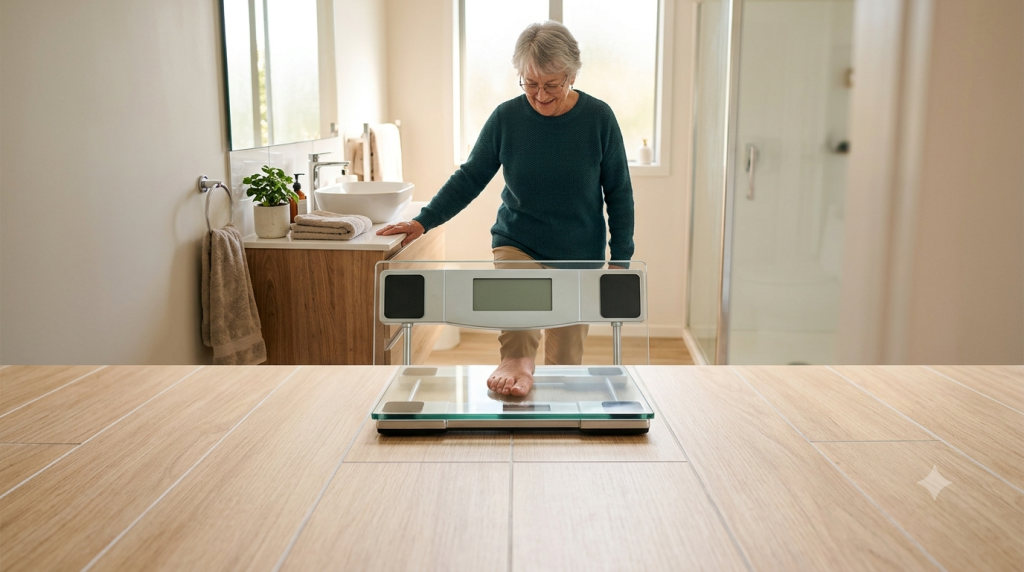
Safety and Placement Checklist
Before using a bathroom scale, check:
- Is the floor firm and level?
- Is the area dry?
- Is the scale away from the bath and shower?
- Is there enough space to step on and off?
- Is the platform wide enough?
- Can the senior stand unsupported?
- Is a wall, rail, or stable surface nearby without affecting the reading?
- Are loose mats and rugs removed?
- Is the display easy to read?
- Is another person needed for safety?
- Has a healthcare professional given specific instructions?
- Would a talking scale reduce bending or visual difficulty?
The term “bathroom scale” does not mean the scale must stay beside a wet shower. A dry bedroom, dressing area, or another firm and level location may be safer.
Common Mistakes When Buying Bathroom Scales
Choosing Too Many Features
Body-fat percentages, Apps, user profiles, and graphs may sound useful but can make a scale confusing.
Choose features the senior will genuinely use.
Ignoring Display Size
A scale can measure accurately but still be impractical if the result is difficult to see.
Display readability should be a major buying factor.
Placing the Scale on Carpet
Soft or uneven flooring can affect stability and readings.
Use the scale on a firm, level surface.
Leaving It on a Wet Bathroom Floor
A wet glass platform can become slippery.
Keep the scale dry and away from splash areas.
Weighing at Random Times
Body weight can change during the day.
When tracking trends under healthcare guidance, use a consistent routine.
Focusing on One Reading
One result may not show the full picture.
Longer-term trends and professional advice are generally more useful than reacting to a single number.
How to Use a Bathroom Scale More Consistently
Helpful steps include:
- Put the scale on a firm, level surface
- Use the same scale each time
- Weigh under similar conditions
- Stand still with weight distributed evenly
- Wait for the final result
- Record the result if instructed
- Keep the platform clean and dry
- Replace batteries when readings become inconsistent
- Avoid moving the scale between different floor surfaces
- Follow healthcare instructions when monitoring a medical condition
- If a healthcare professional has asked you to monitor your weight for heart failure, follow their specific instructions and see Healthify New Zealand for general guidance.
If balance is uncertain, the senior should not weigh alone simply to obtain a reading.
If a healthcare professional has asked you to monitor your weight for heart failure, follow their specific instructions and see Healthify New Zealand for general guidance.
Bathroom Scales and Other Home Health Devices
A bathroom scale measures body weight.
A blood pressure monitor measures blood pressure and pulse. A digital thermometer measures temperature. A pulse oximeter estimates oxygen saturation and pulse rate.
These devices measure different things and should not be treated as interchangeable. For most seniors, simple devices that can be used correctly and consistently are more useful than a collection of complicated gadgets.
When to Seek Medical Advice
Speak with a healthcare professional if:
- Weight changes unexpectedly
- The senior is losing weight without trying
- Weight monitoring was recommended for a medical condition
- The result is difficult to interpret
- Standing on a scale is unsafe
- Swelling, breathlessness, weakness, poor appetite, or illness is also present
- Different scales produce very different results
- The senior becomes anxious or overly focused on frequent weighing
A healthcare professional can explain how often to weigh and what changes are relevant to the individual.
FAQ
What are the best bathroom scales for seniors in NZ?
For most seniors, a digital scale with a stable platform, large display, automatic step-on function, and suitable maximum weight is a good starting point. A talking scale may be better for reduced vision.
Are digital or mechanical scales better for elderly people?
Digital scales are often easier to read precisely. Mechanical scales do not need batteries but may have small dial markings. The better option depends on vision, balance, and personal preference.
What display size is best for seniors?
Larger, high-contrast digits are generally easier to read. Some models use digits between approximately 25 mm and 40 mm high, while talking scales announce the result aloud.
Should a bathroom scale be kept in the bathroom?
Not necessarily. It should be kept on a firm, level, dry surface with enough space for safe access. A dry bedroom or dressing area may be safer than a wet bathroom.
Are smart body-fat scales accurate?
Smart scales can be useful for following general trends, but body-composition figures are estimates. They should not be treated as a medical diagnosis.
How often should seniors weigh themselves?
There is no single schedule for everyone. Some people weigh occasionally, while others are given a specific routine by a healthcare professional. Follow individual medical advice when weight is being monitored for health reasons.
Final Recommendation
For most seniors in New Zealand, the best starting point is a simple digital bathroom scale with a large display, stable platform, automatic operation, and suitable maximum weight.
The Weight Watchers Bathroom Scale is a strong option for a wide platform, large display, and higher capacity. The mBeat actiVIVA may suit seniors who need spoken results. The Beurer GS11 is a practical simple-value option, while the Salter model offers higher capacity. The Beurer BF500 is better for households that genuinely want a large display, multiple user memories, and optional App tracking.
The best bathroom scale is not the model with the most measurements. It is the one the senior can access, stand on, read, and use safely and consistently.
For seniors comparing other simple home health devices, our guide to blood pressure monitors for seniors in NZ may also be helpful.