How to Choose the Best Walking Frame for a Senior in New Zealand
Choosing the best walking frame for a senior in New Zealand starts with understanding where it will be used and how much support is needed. A well-fitted frame can improve stability, reduce the risk of falls, and help an older adult stay active and independent at home and outdoors.
The best option depends on the user’s balance, strength, height, home layout, transport needs, and whether a seat or storage is useful. For indoor use, a simple lightweight frame may be enough. For regular outdoor trips, a four-wheel rollator with reliable brakes, a comfortable seat, and wheels suited to New Zealand footpaths may be more practical.
This guide compares practical walking frame options available through New Zealand mobility retailers and explains what to check before buying.
Disclosure
This article may contain affiliate links. If you buy through these links, Golden Vibe may earn a small commission at no extra cost to you. We only recommend products that are relevant to senior safety, comfort, mobility, and everyday living.
Which Are the Best Walking Frames for Elderly People in NZ?
The best walking frames for elderly people depend on where the frame will be used and how much support the senior needs.
For everyday indoor and community use, a four-wheel rollator with reliable brakes and a seat may be the most practical option. Active seniors who regularly lift the frame into a car may prefer a lightweight walking frame, while people who care about appearance may want a more stylish walking frame with a less clinical design.
A basic or two-wheel frame may provide more controlled support for seniors who do not need a seat or cannot safely operate rollator brakes.
The five options below cover everyday, stylish, lightweight, off-road and one-handed walking support.
Quick Recommendations
| Product | Best For | Price Guide | Why It Works for Seniors | Where to Check |
|---|---|---|---|---|
| Wanaka Walker 6″ Wheels Standard | Best everyday rollator | Around $329 | Lightweight aluminium frame, seat, 6″ wheels, adjustable height | Independent Living |
| Newmarket Walker | Best stylish outdoor everyday walker | Check current price | Large wheels, height-adjustable handles, folding frame, detachable storage bag | Independent Living |
| byACRE Carbon Ultralight Walker | Best premium lightweight walker | Check current price | Very light carbon frame, suitable for active seniors and travel | Independent Living / Mobility Centre |
| Freiheit Freedom XC Off-Road Walker | Best off-road walking frame | Check current price | 12″ pneumatic tyres, suitable for gravel, grass and uneven ground | Mobility Plus NZ |
| Wheeleo One-Hand Walker | Best one-handed support option | Around $880 | Designed for one-hand use, useful when the other hand needs to stay free | Mobility Centre |
Best Everyday Rollator: Wanaka Walker 6″ Wheels Standard
The Wanaka Walker 6″ Wheels Standard is a practical everyday rollator for seniors who need more support than a walking stick but still want to move around actively. It has a lightweight aluminium frame, 6-inch wheels, a seat, and adjustable height.
This type of walker is useful for seniors who walk around the home, visit shops, attend appointments, or need the option to rest during short outings. The seat can be especially useful for people who become tired when standing or walking for longer periods.
For many seniors, this is the most realistic starting point: not too specialist, not too large, and not as expensive as premium carbon or off-road walkers.
Good For
- Seniors who need everyday walking support
- Indoor and light outdoor use
- People who want a seat for resting
- Families looking for a practical first rollator
Be Careful If
- The senior needs strong support for uneven ground
- The walker will be used mainly on grass, gravel, or rough outdoor paths
- The senior cannot safely operate hand brakes
- A non-wheeled frame would be more suitable for stronger weight-bearing support
Best Stylish Walking Frame: Newmarket Walker
The Newmarket Walker is a stylish walking frame for seniors who want a more modern-looking rollator with larger wheels, adjustable handles and a folding design. It has soft grip rubber handles, adjustable height, large front and back wheels, and a detachable storage bag.
This may suit seniors who still go out regularly and want a walker that feels more comfortable for shopping trips, community visits, and outdoor paths. The folding frame also makes storage and transport more practical.
It is not necessarily the cheapest choice, but it may be a better fit for seniors who want a walker that looks less clinical and feels more like a daily lifestyle mobility aid.
Good For
- Seniors who go outdoors regularly
- Shopping trips and community outings
- People who want a storage bag
- Families looking for a walker that folds for transport
Be Careful If
- The senior mainly needs a simple indoor frame
- The home has very narrow hallways
- The walker is too wide for the bathroom or bedroom
- A lower-cost rollator is enough
Best Lightweight Walking Frame: byACRE Carbon Ultralight Walker
The byACRE Carbon Ultralight Walker is a premium lightweight walking frame for seniors who regularly travel, lift the frame into a car or want a less bulky mobility aid. Carbon walkers are usually chosen by people who travel often, lift the walker into a car, or want a more modern design.
The main advantage is weight. A lighter walker can be easier to lift, fold, and manage. This can matter for seniors who are still active but dislike heavy mobility equipment.
However, premium carbon walkers are much more expensive than standard rollators. They make the most sense when weight, transport, and daily convenience are major priorities.
Good For
- Active seniors
- Travel and car transport
- People who need a very light walker
- Seniors who dislike heavy mobility equipment
Be Careful If
- Budget is the main concern
- The walker will mostly stay inside the home
- A standard aluminium rollator would be enough
- The senior needs heavy-duty or off-road support instead
Best Off-Road Walking Frame: Freiheit Freedom XC Off-Road Walker
The Freiheit Freedom XC Off-Road Walker is designed for seniors who need a walking frame for rougher outdoor surfaces. It uses large pneumatic tyres and is suited to surfaces such as gravel, grass, lifestyle blocks, and uneven ground.
This type of walker is very different from a basic indoor walking frame. It is made for people who want to keep walking outside where smaller wheels may feel unstable or uncomfortable.
An off-road walking frame may suit seniors living in rural areas, lifestyle blocks, or homes with uneven outdoor paths. It can also be useful for people who want to walk in parks or on rougher surfaces.
For a more detailed outdoor comparison, read our guide to off road walking frames for seniors in NZ.
Good For
- Gravel paths
- Grass and uneven ground
- Rural homes or lifestyle blocks
- Seniors who want outdoor independence
Be Careful If
- The walker will mainly be used indoors
- The senior has limited strength to control a larger frame
- Storage space is limited
- The user needs a compact walker for shops or small homes
Best One-Handed Support Option: Wheeleo One-Hand Walker
The Wheeleo One-Hand Walker is a more specialised option. It is designed to be used with one hand, leaving the other hand available for daily tasks.
This may suit some seniors who need support but also need one hand free for carrying items, opening doors, or managing small tasks. It is not the same as a standard rollator or walking frame, so it should be considered carefully.
Because this is a more specialised mobility device, it may be best for people who have received advice from a health professional or mobility equipment specialist.
Good For
- Seniors who need one-handed support
- People who want the other hand free
- Certain daily tasks around the home or community
- Users who find standard walkers awkward
Be Careful If
- The senior needs two-sided support
- Balance is poor
- A traditional rollator or frame is more suitable
- The user has not tried this style before
Walking Frame, Rollator or Zimmer Frame: What Is the Difference?
People often use the words walking frame, walker, rollator, and zimmer frame in different ways.
A basic walking frame or zimmer frame usually has no wheels or may have two small wheels. It is often used for stronger stability and controlled movement.
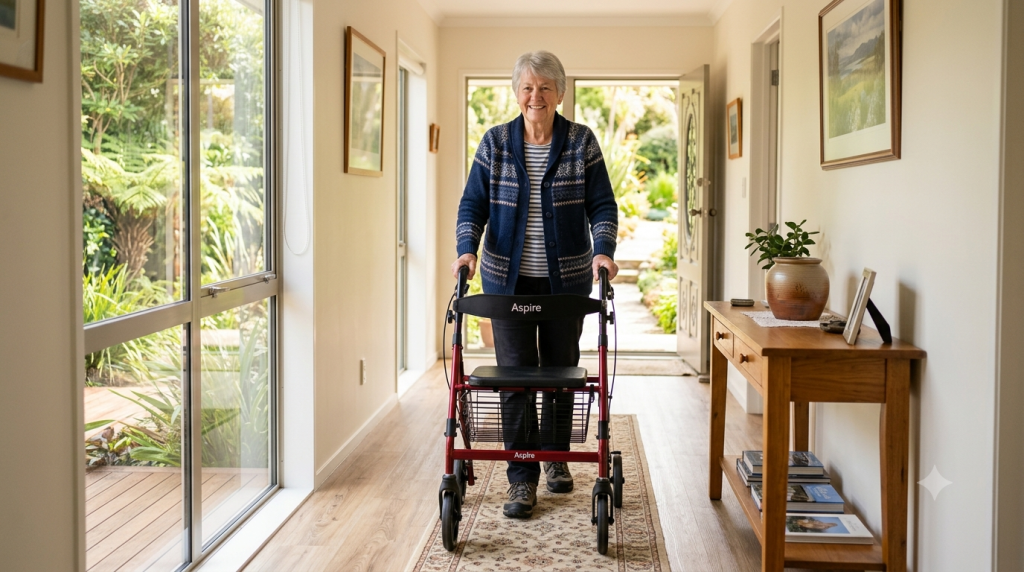
A rollator usually has three or four wheels, hand brakes, and often a built-in seat. It is easier to move forward but requires the user to control brakes and direction safely.
For seniors who need maximum stability, a basic frame may be better. For seniors who are more mobile and need help with balance, a rollator may be more practical.
For a focused comparison of seated rollators and simpler frames, read our walking frame with seat vs standard frame guide.
Walking Frame vs Walking Stick
A walking stick is lighter and easier to carry. It may suit seniors who only need light balance support.
A walking frame provides more support and can help seniors feel more stable. It may be better for people who feel unsteady, tire easily, or need support on both sides.
If a senior is unsure whether a walking stick is enough, it may be worth speaking with a physiotherapist, occupational therapist, or mobility equipment specialist.
For a direct comparison, read our guide to walking stick vs walking frame choices for seniors in NZ.
What to Look For When Buying Walking Frames for Seniors
1. Correct Type
The first decision is whether the senior needs a basic walking frame, two-wheel frame, four-wheel rollator, outdoor walker, or off-road walking frame.
Choosing the wrong type can make the product frustrating or unsafe.
2. Height Adjustment
The handles should be at a comfortable height. If the walker is too low, the senior may bend forward. If it is too high, the shoulders and arms may feel strained.
Height adjustment is important for comfort and posture. Shorter seniors may need a low walking frame with a lower handle and seat-height range. Do not assume that every adjustable walker can be lowered enough for a shorter user.
For exact measurements, compare our walking frame size and fit guide before ordering.
For a step-by-step fitting process, including handle height, doorway width, seat size and weight capacity, read our guide to choosing the correct walking frame size.
3. Brakes
Rollators with wheels should have reliable brakes.
The senior must be able to squeeze, lock, and release the brakes confidently. If hand strength is limited, brake comfort becomes very important.
4. Seat
A built-in seat is useful for seniors who need to rest.
However, the seat height and width should be suitable. The frame should also feel stable when sitting down and standing up.
5. Wheel Size
Small wheels are often fine indoors and on smooth paths.
Larger wheels are usually better outdoors, especially on uneven surfaces. Off-road walkers use even larger tyres for grass, gravel, and rougher ground.
6. Foldability
A folding walker is easier to store and transport.
This matters if the walker needs to fit into a car, be taken to appointments, or be stored in a smaller home.
7. Weight
A lighter walker is easier to lift, but it should still feel stable.
For some seniors, a very lightweight model is ideal. For others, a slightly heavier walker may feel more secure.
8. Width
The walker must fit through doorways, hallways, bedrooms, and bathrooms.
Before buying, measure the narrowest areas of the home.
9. Storage Bag or Basket
A storage bag can be helpful for shopping, water bottles, phones, or small personal items.
However, heavy bags should not be placed in a way that makes the walker unstable.
10. Indoor and Outdoor Suitability
Some walking frames are best indoors. Others are designed for outdoor surfaces.
Think about where the senior will actually use the walker most often.
Buying Checklist
Before choosing a walking frame, ask:
- Will it be used indoors, outdoors, or both?
- Does the senior need a seat?
- Can the senior use hand brakes safely?
- Does it fit through home doorways?
- Is the handle height adjustable?
- Is the walker light enough to lift or fold?
- Are the wheels suitable for the main walking surfaces?
- Does the senior need a storage bag?
- Is the frame stable when turning?
- Is professional advice needed before buying?
This checklist helps avoid buying a walker that looks good online but does not fit the senior’s daily life.
Common Mistakes When Buying Walking Frames
Buying a Rollator When a Basic Frame Is Needed
A rollator is easier to move, but it is not always the safest choice for someone who needs strong weight-bearing support.
Some seniors may need a more stable basic walking frame.
Choosing Small Wheels for Outdoor Use
Small wheels may be fine indoors, but they can feel uncomfortable on uneven paths.
For outdoor walking, larger wheels may be better.
Ignoring Brake Strength
If the senior cannot use the brakes confidently, a rollator may become unsafe.
Always check brake comfort and locking function.
Buying a Walker That Is Too Wide
A walker that cannot fit through the home properly will not be useful.
Measure doorways and hallways before buying.
Choosing Based Only on Price
A cheap walker may be enough for some seniors, but the best choice depends on safety, comfort, support, and daily use.
Safety Tips for Using a Walking Frame
Walking frames work best when used correctly.
Helpful tips include:
- Adjust handles to the right height
- Use brakes before sitting or standing
- Keep both hands on the walker when moving
- Avoid hanging heavy bags from the handles
- Keep indoor paths clear
- Use good lighting at night
- Check wheels, brakes, and rubber tips regularly
- Avoid wet or slippery floors
- Ask for help if the walker feels unstable
For step-by-step instructions on standing, walking, turning, using rollator brakes and sitting safely, read our guide on how to use a walking frame.
A walking frame should increase confidence, not create new risks.
When to Seek Professional Advice
Professional advice may be helpful if the senior:
- Has frequent falls
- Feels very unsteady
- Has sudden mobility changes
- Is recovering from injury or surgery
- Needs a walker after a hospital visit
- Has difficulty using brakes
- Needs support on uneven ground
- Is unsure whether to choose a walking stick, frame, wheelchair, or mobility scooter
A physiotherapist, occupational therapist, doctor, or mobility equipment specialist can help match the walking aid to the person’s needs.
FAQ
What is the best walking frame for elderly people in NZ?
The best walking frame depends on where it will be used. For everyday use, a four-wheel rollator with a seat may be practical. For indoor stability, a basic walking frame may be better. For rough outdoor areas, an off-road walking frame with larger wheels may be more suitable.
Are rollators safe for seniors?
Rollators can be safe when the senior can use the brakes properly and the walker suits the walking surface. They may not be suitable for someone who needs strong weight-bearing support or cannot control the brakes.
What is an off-road walking frame?
An off-road walking frame is designed for rougher outdoor surfaces such as grass, gravel, parks, or uneven paths. It usually has larger wheels or pneumatic tyres compared with standard indoor walkers.
Is a walking frame better than a walking stick?
A walking frame provides more support than a walking stick. A walking stick may be enough for light balance support, while a walking frame may be better for seniors who feel less steady or need support on both sides.
Should seniors get a walker with a seat?
A seat is useful for seniors who need to rest during walks or outings. However, the walker must be stable, and the senior should use the brakes before sitting or standing.
Final Recommendation
For most seniors in New Zealand, the best walking frame is the one that matches daily movement, balance, home layout, and outdoor routine.
A standard rollator such as the Wanaka Walker may be a good everyday starting point. Seniors who go outdoors often may prefer a larger-wheel model like the Newmarket Walker. Active seniors who want something very light may consider a premium carbon walker. Seniors living on lifestyle blocks or rougher outdoor surfaces may need an off-road walking frame.
The best walking frame is not simply the most expensive one. It is the one the senior can use safely, comfortably, and confidently every day.
For a broader overview of mobility options, our guide to mobility aids for seniors in New Zealand may also be helpful.
For information about aids and equipment support after an injury in New Zealand, visit ACC New Zealand.
For seniors who find longer outdoor distances too tiring, our guide to mobility scooters for seniors in NZ may also be helpful.
For seniors reviewing the wider home environment, our guide to fall prevention products for seniors in NZ may also be helpful.