Introduction
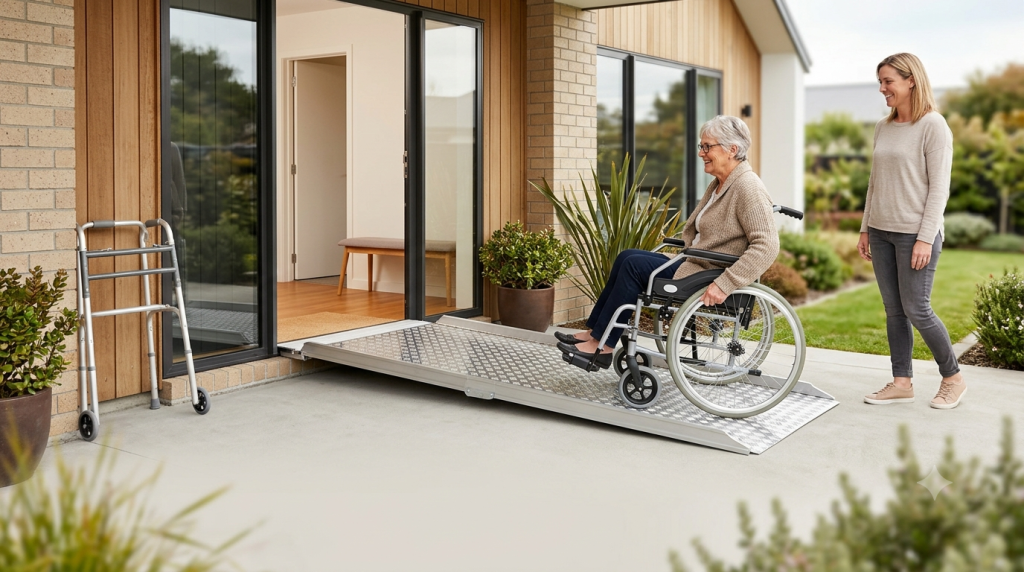
Wheelchair ramps NZ seniors use can make raised door thresholds, small steps and difficult home entrances easier to cross with a wheelchair, walking frame or mobility scooter.
The right ramp depends on much more than length. You also need to check the vertical rise, doorway width, door direction, available landing space, ramp gradient, surface grip and the total weight of the user and mobility equipment.
For small doorway lips, a rubber or aluminium threshold ramp may be enough. For temporary access over a small step, a portable folding wheelchair ramp can be more practical. Larger or frequently used entrances may require a professionally assessed permanent or modular ramp.
This guide compares five practical ramp types available in New Zealand and explains what to measure before buying.
Safety Note
An unsuitable or incorrectly positioned ramp can move, flex, become too steep or create a new trip hazard.
Do not use a portable ramp over several steps, on an unstable surface or beyond the manufacturer’s stated limits.
The combined weight of the senior, wheelchair or scooter, carried items and assisting person must remain within the ramp’s safe working load.
Professional assessment is particularly important when:
- The entrance has more than a small threshold or single step
- The user operates a powered wheelchair or heavy mobility scooter
- A caregiver must push a manual wheelchair
- The ground is sloped or uneven
- The door opens outwards
- There is not enough level landing space
- The ramp will remain installed permanently
- Handrails or edge protection may be required
- The senior’s mobility needs are changing
Disclosure
This article may contain affiliate links in the future. If you buy through these links, Golden Vibe may earn a commission at no additional cost to you.
Golden Vibe has not physically tested every ramp mentioned in this guide. Product availability, prices and specifications should be confirmed with the supplier before ordering.
How We Prepared This Guide
We compared ramp types using factors that affect everyday home access and safety.
These included:
- Intended mobility aid
- Threshold or step height
- Ramp length and gradient
- Usable width
- Safe working load
- Combined user and equipment weight
- Door-opening direction
- Landing space
- Surface grip
- Raised side edges
- Portability
- Product weight
- Folding method
- Indoor and outdoor suitability
- Storage requirements
- Professional installation needs
- Availability through New Zealand suppliers
A ramp that works at one doorway may be unsuitable at another doorway, even when the step appears to be the same height.
Wheelchair Ramps NZ: Quick Comparison of 5 Ramp Types
| Ramp Type | Best For | Typical Setup | Main Advantage | Main Limitation |
|---|---|---|---|---|
| Rubber threshold ramp | Small raised door sills and floor transitions | Sits directly against the threshold | Stable, quiet and adaptable | Heavy and must fit accurately |
| Aluminium threshold ramp | Small regular thresholds | Rests against or bridges the sill | Lighter than rubber | Less adaptable to uneven surfaces |
| Portable single-fold ramp | Travel, small steps and temporary access | Unfolded when required | Available in several lengths | Longer versions become heavy |
| Multi-panel folding ramp | Portable access and storage | Folds into a compact bundle | Easier storage for its full length | Usually expensive |
| Modular or permanent ramp | Regular access over a larger height | Professionally designed and installed | Better long-term access | Requires space, assessment and higher cost |
Quick Picks
Best portable option: Silver Star Single Fold Ramp — a practical choice when the ramp needs to be carried, stored or used at more than one location.
Best for a small doorway lip: Rubber Threshold Ramp — useful when a low threshold needs a stable ramp that can remain in place.
Best lightweight threshold type: Aluminium Threshold Ramp — worth considering when accurate fit and easier handling matter.
Best for unusual doorway measurements: Cubro Ramp Range — useful when a standard off-the-shelf threshold ramp does not fit cleanly.
Best for regular long-term access: Permanent or Modular Ramp — more appropriate when the entrance is used frequently or the rise is too large for a short portable ramp.
Best Portable Wheelchair Ramp NZ: Silver Star Single Fold Ramp
The Silver Star Single Fold Ramp is a portable aluminium ramp available in several lengths.
The current range includes approximately:
- 61cm
- 91cm
- 122cm
- 152cm
- 183cm
The ramp folds lengthways and includes a suitcase-style handle.
Its grooved aluminium surface is intended to improve traction, while raised side edges help identify the usable platform.
The supplier currently states a 272kg load capacity across the range. Product weight increases with length, from approximately 5.4kg for the shortest version to 16kg for the longest.
This makes the smaller versions easier to carry, while longer versions may require a stronger caregiver or two-person handling.
The ramp may suit:
- Manual wheelchairs
- Transit wheelchairs
- Some powered wheelchairs
- Mobility scooters within the stated limits
- Small steps
- Raised thresholds
- Occasional travel
- Temporary home access
Good For
- Families wanting a readily available portable option
- Choosing from several ramp lengths
- Keeping a shorter ramp in a vehicle
- Temporary access at more than one location
- Wheelchairs or scooters within the stated dimensions and weight limit
- Users who need a broad platform rather than two narrow tracks
Be Careful If
- The advertised maximum obstacle height creates a steep setup
- The longer ramp is too heavy for the caregiver
- The doorway does not provide a secure top resting point
- The door opens outwards into the ramp
- The ground is soft, sloped or uneven
- A powered device bottoms out at the threshold
- The ramp is used without adequate landing space
Do not automatically select a ramp using only the supplier’s maximum step-height table. The safest usable height may be lower when the senior propels independently or when a caregiver is pushing a wheelchair. Check the current lengths, price and store availability of the Silver Star Single Fold Ramp at Mobility Centre.
Best for a Small Doorway Lip: Rubber Threshold Ramp
A rubber threshold ramp sits directly against a raised door sill or small vertical floor transition.
Rubber can be particularly useful when the surface is slightly uneven because the material generally conforms more readily than a rigid aluminium platform.
Rubber ramps are often:
- Dense and stable
- Resistant to sliding
- Suitable for indoor or outdoor thresholds
- Quieter than metal
- Available in different heights
- Able to be trimmed or customised in some ranges
- Suitable for wheelchairs, walking frames and scooters
The ramp must fit closely against the threshold.
A gap between the ramp and sill can catch:
- Small wheelchair castors
- Walking-frame wheels
- Mobility-scooter wheels
- Shoes or walking-stick tips
The ramp also needs enough clearance for the door to open and close.
Good For
- Small raised door thresholds
- Internal floor transitions
- Exterior doors with a suitable level approach
- Outward-opening doors where another ramp design would obstruct the door
- Walking frames with small wheels
- Wheelchair access over a low vertical lip
- Situations where a heavy ramp can remain in one place
Be Careful If
- The ramp height does not match the threshold
- The door catches the top of the ramp
- Water collects around the doorway
- The approach surface is loose or unstable
- The ramp is too narrow
- The senior approaches from more than one direction
- The sides create a trip edge for people walking past
- The ramp must be moved frequently
Rubber threshold ramps can be heavy. This may improve stability but makes them less convenient for travel.
Aluminium Ramps for Wheelchairs NZ: Best for Small Thresholds
An aluminium threshold ramp is usually lighter than a solid rubber ramp.
It may have:
- A fixed wedge shape
- An adjustable support system
- A top plate that rests on the threshold
- A textured or perforated surface
- Raised side edges
- A portable or semi-permanent design
This type can work well where the threshold and approach surfaces are level and the dimensions match a pre-made size.
However, rigid aluminium does not adapt to uneven ground in the same way as rubber.
The contact points need to remain stable, and the ramp should not rock when weight is applied.
Good For
- Regular, measurable thresholds
- Users who need a lighter ramp
- Indoor or sheltered entrances
- Wheelchairs and walking frames within the ramp limits
- Situations where the ramp needs to be removed occasionally
- Thresholds compatible with the ramp’s top plate
Be Careful If
- The ground is uneven
- The threshold shape does not match the ramp
- The door opens into the ramp
- The ramp rocks or shifts
- The surface becomes slippery when wet
- The top plate is not fully supported
- The mobility scooter has low ground clearance
A pre-made aluminium threshold ramp is only convenient when its dimensions genuinely match the doorway.
Best for Comparing Custom Threshold Solutions: Cubro Ramp Range
Cubro supplies threshold, portable, height-adjustable, rubber and aluminium ramp options through its New Zealand healthcare-equipment network.
This range may be useful when a standard retail ramp does not clearly match the entrance.
A specialist supplier can help consider:
- Threshold height
- Door swing
- Ramp gradient
- Required width
- Cut-outs around frames or skirting
- Tapered sides
- Uneven surfaces
- Wheelchair or scooter weight
- Whether a custom rubber design is needed
This is particularly relevant when the threshold height varies across the width of the doorway.
A custom solution may cost more than a basic portable ramp, but an accurate fit is more important than buying a product that leaves a wheel-catching gap.
Good For
- Unusual doorway shapes
- Custom rubber threshold ramps
- Professional measurement support
- Heavy powered mobility devices
- Wider entrances
- Uneven approach surfaces
- Situations requiring different gradients
- Families unsure which ramp type is appropriate
Be Careful If
- The ramp is ordered from approximate measurements
- The mobility aid’s total width is not checked
- The user and equipment weight are underestimated
- The door cannot open after installation
- A simple threshold ramp is being used for a larger access problem
- The family assumes every product is available directly to private buyers
Private customers may need to purchase Cubro products through an authorised retail stockist. Explore Cubro’s threshold ramp range and contact its team or a local stockist about an appropriate configuration.
Best for a Wider Supplier Comparison: Mobility Centre Ramp Range
Mobility Centre lists aluminium, rubber, carbon-fibre and portable folding ramps.
Its range includes simple threshold products as well as longer folding ramps for wheelchairs, powered chairs and mobility scooters.
This category may be useful when comparing:
- Current prices
- Available ramp lengths
- Product weight
- Folding styles
- Supplier-stated load capacity
- Local store availability
- Custom-order options
- Travel and home-use products
Some specialist or older product pages may be listed as unavailable or purchase-to-order.
Always check the live product status rather than relying on an old search result or catalogue. Compare the current portable, aluminium and threshold ramp range at Mobility Centre.
Good For
- Comparing several ramp materials
- Checking current retail stock
- Looking for a portable folding ramp
- Buyers wanting New Zealand store support
- Families wanting advice before ordering
- Comparing ramp weights and folded dimensions
Be Careful If
- A listed product is no longer available
- A special-order ramp has a long lead time
- The family selects from price alone
- Freight for a heavy ramp is not considered
- The ramp is purchased without measuring the entrance
When a Permanent or Modular Ramp Is More Appropriate
A portable ramp is not the correct solution for every entrance.
A permanent or modular ramp may be more suitable when:
- The entrance is used several times each day
- There are multiple steps
- The vertical rise is substantial
- A caregiver regularly pushes a wheelchair
- The user operates a heavy powered wheelchair
- A mobility scooter needs daily access
- The portable ramp would be too steep
- The ramp must include landings
- Handrails or edge barriers are needed
- The user’s mobility needs are likely to continue
Permanent ramps require considerably more horizontal space than many families expect.
A gentle slope may need several metres of ramp for a relatively modest rise.
The design must also account for:
- Level landings
- Door operation
- Turning space
- Drainage
- Surface grip
- Edge protection
- Handrails
- Structural support
- Local building requirements
Do not attempt to replace a properly designed home-access ramp with a short portable ramp placed over several stairs. Disability Support Services provides further New Zealand guidance about outdoor ramp width, gradient, landings and edge protection.
What Is a Threshold Ramp?
A threshold ramp is designed to overcome a small vertical change at a doorway or between floor surfaces.
Examples include:
- A raised aluminium door track
- A wooden door sill
- A small step into a home
- A transition between an indoor floor and patio
- The edge of a roll-in shower
- A raised sliding-door frame
Threshold ramps are generally shorter than full entrance ramps.
Because they are short, their angle can become steep quickly when the vertical rise increases.
This is why accurate height measurement matters.
A difference of only a few centimetres can significantly change how difficult the ramp feels to a wheelchair user or caregiver.
Threshold Ramp vs Portable Folding Ramp
A threshold ramp is normally intended to stay against one small obstacle.
A portable folding ramp is designed to be carried, stored and positioned when needed.
Choose a threshold ramp when:
- The obstacle is a small door sill
- The ramp will remain in one location
- A close fit is possible
- Portability is not important
- The door can still operate normally
Consider a folding ramp when:
- The ramp will be used at several locations
- A small step rather than only a sill must be crossed
- The ramp needs to travel in a vehicle
- The family needs different length options
- The ramp can be positioned securely each time
Neither option is automatically safer. Correct sizing and setup matter more than whether the ramp folds.
Rubber Ramp vs Aluminium Ramp
Rubber and aluminium behave differently.
Rubber Ramp Advantages
- Dense and stable
- Often sits securely on hard flooring
- Can accommodate minor surface variation
- Quiet under wheels
- May be trimmed in some product ranges
- Suitable for permanent threshold placement
Rubber Ramp Limitations
- Heavy
- Difficult to transport
- Can be bulky at greater heights
- Needs accurate height matching
- May create side trip edges
- Can retain dirt or moisture underneath
Aluminium Ramp Advantages
- Lighter
- Easier to carry
- Often available in folding designs
- Available in several lengths
- Resistant to rot
- May have textured surfaces and side edges
Aluminium Ramp Limitations
- Can move or rock on uneven ground
- May be noisy
- Can become hot in direct sun
- May be slippery if the surface is worn or contaminated
- Requires secure support at both ends
- May obstruct an outward-opening door
The correct material depends on the doorway and how frequently the ramp must be moved.
Wheelchair, Walking Frame and Scooter Requirements
Different mobility aids interact with ramps differently.
Manual Wheelchairs
A self-propelled wheelchair user needs enough upper-body strength and control to climb the ramp and brake safely when descending.
A gradient that a caregiver can manage may be too difficult for independent propulsion.
A transit wheelchair user depends on the assisting person’s strength, technique and ability to control the chair.
For help comparing manual, transit and lightweight wheelchair designs, read our wheelchairs for seniors in New Zealand guide.
Powered Wheelchairs
Powered wheelchairs are heavier than many manual chairs.
Check:
- Total chair and user weight
- Ramp load capacity
- Usable platform width
- Wheelbase
- Ground clearance
- Anti-tip wheels
- Maximum slope permitted by the wheelchair manufacturer
- Ability to turn on the landings
Never assume that a ramp suitable for a manual wheelchair is automatically suitable for a powered chair.
Walking Frames and Rollators
A small threshold can stop the front wheels of a walking frame abruptly.
A low threshold ramp may create a smoother transition, but the senior still needs enough balance and brake control to use the incline.
Check whether:
- The front wheels remain straight
- The rear wheels or stoppers clear the threshold
- The ramp is wide enough
- The user can control the frame downhill
- The ramp moves when the frame contacts it
- A caregiver needs to remain nearby
For help choosing an appropriate walking aid, compare our walking frames for seniors in NZ guide.
Mobility Scooters
Mobility scooters can be wide, heavy and low to the ground.
Check:
- Scooter width
- Total weight with the user
- Ground clearance
- Wheelbase
- Turning space
- Ramp gradient
- Manufacturer slope limits
- Whether anti-tip wheels contact the ramp
- Doorway and landing clearance
A scooter may reach the top of a ramp but still become stuck when its centre section passes over the threshold.
For a broader review of scooter size, turning radius, storage and outdoor use, read our mobility scooters for seniors in NZ guide.
How to Measure a Doorway for a Threshold Ramp
A wheelchair doorway ramp needs to match both the vertical rise and the usable width of the entrance, especially where door tracks, outward-opening doors or uneven surfaces reduce the available space.
Do not order a threshold ramp from a photograph alone.
Use a tape measure and record the dimensions carefully.
1. Measure the Vertical Rise
Measure from the lower approach surface to the top of the threshold.
Check the height at:
- The left side
- The centre
- The right side
Doorways and concrete surfaces may not be perfectly level.
If the door needs to pass over the top of the ramp, check the available clearance at the lowest point.
2. Measure the Available Width
Measure the clear opening rather than the outside of the door frame.
Also measure:
- Wheelchair width
- Scooter width
- Walking-frame width
- Hand position
- Footrests
- Side bags
- Anti-tip wheels
- Space needed by a caregiver
A ramp that is only slightly wider than the mobility aid can leave little margin for steering error.
3. Check the Door Direction
Record whether the door:
- Opens inwards
- Opens outwards
- Slides sideways
- Has two panels
- Needs to remain fully open
An outward-opening door may strike a ramp or prevent it from sitting against the threshold.
4. Check the Lower Surface
The ramp needs stable support.
Inspect for:
- Cracked concrete
- Gravel
- Soft soil
- Sloping paving
- Drain channels
- Raised edges
- Loose mats
- Water collection
- Uneven timber decking
A ramp that rocks before use will not become safer after a wheelchair is placed on it.
5. Check the Upper Landing
The user needs enough space to stop before opening, closing or moving through the door.
Check whether:
- A wheelchair can pause safely
- A scooter can clear the doorway
- The door can close
- The caregiver has standing space
- The user can turn if necessary
- Furniture blocks the route
6. Calculate the Combined Load
Include:
- Senior’s body weight
- Wheelchair or scooter weight
- Shopping or medical equipment
- Oxygen equipment where relevant
- Any carried accessories
For ramps that may also support an assisting person, follow the manufacturer’s instructions regarding how the safe working load is calculated. Cubro also provides a detailed New Zealand guide to assessing and measuring for threshold ramps.
How Long Should a Wheelchair Ramp Be?
Ramp length should be based on the vertical rise and the gradient that the user can manage safely.
A shorter ramp creates a steeper slope.
A longer ramp creates a gentler slope but needs more space and weighs more if it is portable.
For example, a ramp with a 1:12 gradient needs approximately 12 units of horizontal length for every one unit of rise.
That means:
- A 100mm rise needs approximately 1.2m of ramp
- A 200mm rise needs approximately 2.4m of ramp
- A 300mm rise needs approximately 3.6m of ramp
These examples illustrate why a full entrance ramp can require substantial space.
Short threshold ramps are sometimes supplied at steeper gradients. That does not mean every senior, wheelchair or caregiver can use the steeper ramp safely.
Consider:
- Independent or assisted use
- User strength
- Wheelchair type
- Scooter manufacturer limits
- Surface conditions
- Approach and landing space
- Frequency of use
Do not rely only on a product description stating that a short ramp can overcome a particular maximum height.
Why the Maximum Step Height Can Be Misleading
Some portable-ramp pages provide a maximum step or obstacle height for each length.
This figure does not guarantee that the resulting gradient will suit the intended user.
For example:
- A strong caregiver may manage a slope that an older caregiver cannot
- A powered chair may have a manufacturer slope limit
- A mobility scooter may bottom out
- A self-propelled wheelchair user may be unable to climb independently
- Descending may be more difficult to control than climbing
- Wet conditions may reduce grip
Treat the maximum height as a product limit, not a personalised recommendation.
How Wide Should a Ramp Be?
The mobility aid must fit fully on the usable ramp surface.
Do not measure only tyre-to-tyre width.
Check the widest part of:
- Wheelchair wheels
- Footrests
- Hand rims
- Armrests
- Mobility-scooter bodywork
- Walking-frame wheels
- Bags or holders attached to the device
Allow steering clearance on both sides.
A ramp with raised edges may reduce the effective usable width compared with its overall width.
For a permanent outdoor ramp, the space must also accommodate turning and passing needs rather than only the width of the device.
Surface Grip and Wet-Weather Use
A ramp surface should provide traction in the conditions where it will be used.
Check for:
- Grooves
- Textured plating
- Perforations
- Non-slip coating
- Rubber traction
- Drainage
- Moss or algae
- Mud and leaf buildup
- Ice in colder regions
A textured ramp can still become slippery when contaminated.
Outdoor ramps should be inspected and cleaned regularly.
Do not place a loose household mat on a ramp to increase grip. The mat may move, wrinkle or catch small wheels.
Raised Edges and Side Protection
Raised ramp edges can help reduce the risk of a wheelchair wheel leaving the platform.
They may be especially useful on longer portable ramps.
However, side edges are not a substitute for:
- Adequate ramp width
- Accurate steering
- Safe gradient
- Level landings
- Caregiver control
- Handrails where required
For higher or permanent ramps, professional advice may be needed regarding kerbs, barriers and handrails.
Can a Portable Ramp Be Left Outside?
Some ramps are suitable for outdoor use, but this does not mean they should remain unsecured in every location.
Consider:
- Theft
- Wind
- Water
- Corrosion
- UV exposure
- Leaves and dirt
- Movement caused by repeated use
- Whether the ramp blocks the door
- Whether it creates a trip hazard for other people
A portable ramp should be checked before every use.
If the ramp remains in one place every day, a properly assessed permanent or semi-permanent solution may be safer and more convenient.
Can a Senior Use the Ramp Independently?
Independent use depends on the mobility aid and the user.
A self-propelled wheelchair user may need:
- Sufficient arm strength
- Controlled steering
- Safe braking
- Enough landing space
- A manageable gradient
- A method for opening the door
A walking-frame user needs:
- Good enough balance for the incline
- Brake control where applicable
- Confidence turning or stopping
- A ramp that does not move
A scooter user needs:
- Safe speed control
- Enough ground clearance
- Adequate width
- Manufacturer approval for the slope
- Space to approach the ramp straight
Do not assume independence simply because the senior can use the mobility aid on level ground.
Portable Ramp vs Home Modification
A portable ramp may be appropriate when:
- The obstacle is small
- Use is occasional
- The entrance is rented
- The ramp travels between locations
- A temporary recovery period is expected
- The setup can be checked each time
A home modification may be more appropriate when:
- Access is needed every day
- The rise is substantial
- Multiple steps are involved
- A long ramp and landings are required
- The user has a powered mobility device
- Caregiver pushing is frequent
- Future mobility decline is likely
- Portable setup is physically difficult
- The entrance needs structural changes
A professionally assessed modification can consider the entire route rather than only the visible step.
Common Buying Mistakes
Buying Before Measuring the Door Swing
The ramp may fit the step but prevent the door from opening.
Choosing From Maximum Height Alone
The ramp may technically reach the step while creating an unsafe gradient.
Ignoring the Mobility Aid’s Weight
Powered wheelchairs and scooters can be much heavier than manual wheelchairs.
Measuring Overall Width Instead of Usable Width
Raised edges and hinges can reduce the clear platform area.
Forgetting the Caregiver
A caregiver needs enough strength, grip and standing space to control a wheelchair safely.
Placing the Ramp on Loose Gravel
The ramp may shift, sink or sit unevenly.
Using a Short Ramp Over Several Steps
This can create an excessively steep and unstable route.
Assuming Portable Means Lightweight
Long aluminium or folding ramps can still be difficult to lift.
Leaving a Gap at the Threshold
Small front castors and walking-frame wheels can become caught.
Ignoring Ground Clearance
Mobility scooters and powered chairs can become stuck at the change in angle.
Leaving the Ramp Unchecked
Repeated use, weather and movement can change how securely the ramp sits.
Buying a Permanent Solution Without Assessment
Larger entrance ramps may require landings, barriers, handrails, structural work or consent considerations.
When to Seek Professional Advice
Consider an occupational therapist, physiotherapist, equipment specialist or home-modification assessor when:
- The senior has recently begun using a wheelchair
- The entrance has several steps
- The user has fallen near the doorway
- A caregiver struggles to push the wheelchair
- A powered wheelchair or scooter is involved
- The ramp feels steep
- The ground is uneven
- The door opens outwards
- A permanent ramp is being considered
- The home needs structural changes
- The user may qualify for disability or injury-related support
- Future mobility needs are uncertain
A professional can assess:
- The senior’s mobility
- The wheelchair or scooter
- Caregiver ability
- Entrance dimensions
- Ramp gradient
- Landing space
- Door operation
- Alternative entrances
- Whether a platform lift would be more appropriate
New Zealand Home-Modification Support
Some New Zealanders may qualify for assessed home modifications when an entrance cannot be used safely because of disability or an accepted injury.
Possible modifications may include:
- Entrance ramps
- Handrails
- Doorway changes
- Platform lifts
- Safer access routes
Funding is not automatic and normally depends on eligibility, assessed need and the proposed modification.
Families should not purchase an expensive permanent structure on the assumption that funding will later reimburse the cost.
Ask about the assessment pathway before committing to major work. Disability Support Services explains the available home-modification process and the types of accessibility changes that may be considered.
Final Recommendation
For a small raised door sill, a correctly measured rubber or aluminium threshold ramp may be the simplest option.
Choose rubber when stability, minor surface variation and permanent placement matter more than portability.
Choose aluminium when a lighter removable solution fits the doorway accurately.
For occasional access over a small step, the Silver Star Single Fold Ramp provides several current length options and a broad platform. Select the length according to the actual rise, safe gradient, available space and the person who will handle the ramp—not only the supplier’s maximum-height figure.
For daily wheelchair or scooter access over a larger height, arrange a professional home-access assessment rather than relying on a short portable ramp.
For a broader comparison of walking aids, wheelchairs, scooters and home safety equipment, read our mobility aids for seniors in NZ guide.
The best ramp is the one that fits the entrance, supports the full load, suits the mobility aid and can be used safely in real daily conditions.
Frequently Asked Questions
What type of ramp is best for a door threshold?
A rubber or aluminium threshold ramp may suit a small raised sill.
Rubber is usually heavier and can accommodate minor surface variation, while aluminium is lighter but requires secure, even support.
How do I measure for a wheelchair ramp?
Measure the vertical rise, clear doorway width, available ramp length, door-opening direction, upper and lower landing space and the full dimensions of the wheelchair or scooter.
How steep can a wheelchair ramp be?
The suitable gradient depends on whether the ramp is a short threshold product or a full entrance ramp, the mobility aid, the user and whether assistance is provided.
A gentler slope is generally easier to use. Permanent outdoor-access guidance commonly uses a maximum gradient of 1:12, but individual assessment may still be required.
Is a two-foot ramp long enough for one step?
It depends on the step height.
A two-foot ramp can become very steep over anything more than a small rise. Do not select it only because a product table lists a maximum step height.
Can a walking frame be used on a wheelchair ramp?
It may be possible when the ramp is wide, stable and not too steep.
The senior must be able to control the frame in both directions. Small wheels or rear stoppers may catch at the top or bottom transition.
Can a mobility scooter use a portable ramp?
Only when the ramp is wide enough, supports the combined load and suits the scooter’s ground clearance, wheelbase and permitted slope.
The scooter may become stuck at the top even when its wheels fit on the ramp.
Are rubber threshold ramps portable?
Small rubber ramps can be moved, but solid rubber is often heavy.
They are generally better suited to remaining at one doorway than being carried regularly.
Do wheelchair ramps need side edges?
Raised edges can help prevent wheels leaving the platform, particularly on longer ramps.
Higher or permanent ramps may need more substantial edge protection, barriers or handrails.
Can I leave a portable aluminium ramp outside?
Only when the manufacturer permits outdoor use and the ramp remains secure.
It should still be inspected for movement, dirt, water, corrosion and reduced grip.
Can a wheelchair ramp go over stairs?
A portable ramp should not simply be placed over several stairs unless the specific product and complete setup are professionally confirmed as suitable.
A permanent ramp or platform lift may be safer.
Does a home ramp need building consent in New Zealand?
It depends on the design, height, structural work and local requirements.
Larger permanent ramps and modifications should be discussed with an assessor, designer, council or building professional before work begins.
Can ACC help with a wheelchair ramp?
ACC may support assessed housing modifications when access needs relate to an accepted injury.
The person should speak with their ACC recovery team or healthcare provider before purchasing or constructing the ramp independently.